
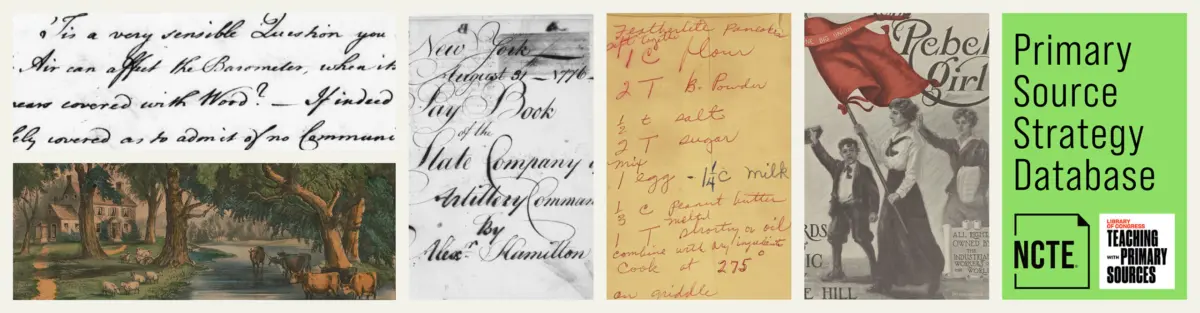
Executive Overview
In an era defined by an influx of digital information and evolving pedagogical demands, educators face the continuous challenge of fostering critical thinking, media literacy, and historical empathy in students. To address this educational imperative, the National Council of Teachers of English (NCTE) has forged a dynamic partnership with the Library of Congress as an active participant in the Teaching with Primary Sources (TPS) Consortium.
This nationwide initiative is strategically designed to embed digitized historical artifacts deeply into the instructional routines of English language arts (ELA) and literacy classrooms. At the heart of this collaborative endeavor is a robust, searchable database comprising pedagogical strategies tailored to more than 150 unique, digitized items from the Library of Congress’s vast collections.
Developed by a dedicated cohort of over two dozen expert educators and ELA curriculum leaders, these instructional frameworks do more than simply supply historical trivia. They articulate clear literacy merits for classroom integration, map out relevant thematic units, and align directly with state educational standards.
By utilizing intuitive tags such as “picturebook” and “argument,” teachers can easily navigate the repository to unearth primary sources that challenge traditional historical narratives, promote diverse perspectives, and cultivate rigorous analytical skills. This initiative marks a watershed moment in literacy education, bridging the gap between archival history and contemporary instructional practice to ensure that students are not passive consumers of history, but active, critical investigators.
Detailed Chronology: The Evolution of the NCTE-Library of Congress Collaboration
The integration of primary sources into modern curricula did not happen overnight; it represents the culmination of years of intentional program development, institutional alignment, and digital archiving.
The Foundation of Archival Accessibility
For generations, the vast historical treasures housed within the Library of Congress—ranging from rare newspapers and manuscripts to groundbreaking patents and photographs—remained largely confined to physical archives in Washington, D.C., accessible primarily to academic researchers and historians. The advent of large-scale digitization projects revolutionized this landscape, transforming the Library of Congress into a globally accessible digital repository through initiatives like Chronicling America and various online special collections. However, making these documents digitally available was only the first step. The monumental challenge remained: how to translate raw historical documents into accessible, rigorous pedagogical tools for K-12 classrooms.
Formation of the TPS Consortium and NCTE’s Integration
Recognizing the transformative potential of these historical records, the Library of Congress established the Teaching with Primary Sources (TPS) Consortium. This network of educational organizations, universities, and professional associations was charged with creating professional development models and instructional resources that leverage primary sources to improve student learning.
The NCTE joined this vital consortium, bringing its unparalleled expertise in English language arts, literacy development, and curriculum design to the table. By uniting the archival might of the Library of Congress with the pedagogical authority of the NCTE, the partnership set out to bridge the gap between social studies and literacy education.
Mobilizing Educators: The Creation of the Searchable Database
To operationalize this partnership, NCTE mobilized a select task force of over two dozen visionary teachers, instructional coaches, and ELA leaders. Over months of collaborative curriculum design, these educators meticulously analyzed over 150 specific items from the Library of Congress collections. They drafted rigorous teaching strategies, pinpointed specific literacy merits, and aligned each primary source with essential state standards, cross-curricular themes, and argumentative writing frameworks. The resulting searchable database represents a living, growing testament to the power of collaborative educational design, providing teachers with immediate, standards-aligned pathways to enrich their daily instruction.
Supporting Context & Metrics: Redefining Literacy and Representation
The urgency of integrating primary sources—particularly those highlighting marginalized voices—extends far beyond standard historical inquiry. It touches upon the very core of equity, representation, and critical literacy in the modern classroom.
Dismantling Homogeneous Historical Narratives
Historically, curricula surrounding innovation, science, and historical progress have suffered from severe demographic blind spots, disproportionately centering on white men. This homogeneity risks reinforcing a dangerous misconception among students: that innovation and historical agency are the exclusive domains of a select few.
By intentionally introducing primary sources that highlight diverse innovators—such as Black female inventors and historical figures who operated outside mainstream power structures—educators can systematically challenge these entrenched limitations. Confronting this historical erasure is vital for fostering an inclusive classroom culture where all students see themselves reflected in the tapestry of human progress.
+-------------------------------------------------------------------------+
│                  The Impact of Diverse Primary Sources                  │
├──────────────────────────────┬──────────────────────────────────────────┤
│ Traditional Curriculum       │ TPS Consortium-Enriched Curriculum       │
├──────────────────────────────┼──────────────────────────────────────────┤
│ Homogeneous perspectives     │ Multifaceted, diverse viewpoints         │
│ Passive reception of facts   │ Active textual and historical analysis   │
│ Limited student connection   │ High student self-reflection & engagement│
│ Disconnected academic silos  │ Interdisciplinary integration (STEM/ELA) │
+──────────────────────────────┴──────────────────────────────────────────+
The Power of Grassroots Innovation
Furthermore, the database emphasizes that groundbreaking contributions often arise not from a quest for fame or fortune, but from a fundamental human desire to improve daily life and solve pressing, real-world problems. Examining documents authored by individuals who lacked formal education yet successfully engineered practical solutions empowers students to recognize their own capacity for problem-solving. When students analyze historical artifacts like The Statesman—a historic weekly African American newspaper published in Denver between 1906 and 1912—they engage directly with communities that utilized their right to free expression, asserted their legal rights, and demanded structural recognition in the face of Jim Crow laws and pervasive segregation.
Standards-Based Rigor and Cross-Curricular Metrics
The instructional value embedded within the NCTE database is rigorously mapped to modern educational benchmarks, ensuring that teachers do not have to choose between historical depth and standards compliance. The integration draws heavily upon established content frameworks, such as the New Mexico Adopted Content Standards, intersecting seamlessly across multiple academic domains:
- Reading Literature and Informational Text (RI):
- RI.6.1: Requiring students to cite textual evidence to support explicit analysis as well as logical inferences drawn from primary documents.
- RI.7.2: Tasking learners with determining multiple central ideas within a text, analyzing their evolution, and constructing objective summaries.
- History, Social Sciences, Science, and Technical Subjects (RH):
- RH.9-10.1: Mandating the extraction of specific textual evidence to analyze primary and secondary sources while critically evaluating publication dates and origins.
- RH.11-12.2: Challenging advanced students to synthesize central ideas and articulate clear structural relationships among key historical details and overarching themes.
Through these metrics, the initiative proves that primary sources are not merely supplementary decorations for a lesson plan, but heavy-duty engines capable of driving complex reading, writing, and critical thinking instruction.
Official Statements and Pedagogical Philosophy
The philosophy driving the NCTE and Library of Congress partnership centers on the belief that literacy is fundamentally intertwined with historical consciousness and civic engagement.
Educational leaders within the TPS Consortium have repeatedly emphasized that working with primary sources shifts the dynamic of the classroom from teacher-led transmission to student-centered discovery. When students interact with historical newspapers, original patents, handwritten letters, and authentic photographs, they are forced to confront ambiguity, evaluate authorial bias, and construct reasoned arguments based on empirical evidence.
"Primary sources invite students into the messy, human work of history and inquiry," notes curriculum design literature associated with the initiative. Rather than reading a sanitized summary in a secondary textbook, students reading historical community newspapers or examining original patent records are stepping into an active dialogue with the past. They are asking who recorded history, whose voices were omitted, and why certain narratives prevailed.
Furthermore, NCTE leadership underscores the critical role of ELA teachers in this process. Literacy instruction is no longer confined to fictional narratives or contemporary essays. By embracing informational texts and historical artifacts across disciplines—spanning History, News, Journalism, Advertising, and STEM—EAL classrooms become vibrant incubators for cross-disciplinary inquiry. Teachers equipped with the searchable database are empowered to meet rigorous state standards while simultaneously cultivating empathy, cultural awareness, and sophisticated argumentative skills among their students.
Future Outlook: The Next Frontier in Primary Source Literacy
As the educational landscape continues to evolve under the pressures of technological disruption and shifting demographic realities, the NCTE and Library of Congress partnership stands as a model for sustainable, high-impact professional development.
Expanding the Repository and Digital Reach
Looking ahead, the TPS Consortium aims to continuously expand its searchable database, incorporating hundreds of additional primary sources paired with cutting-edge pedagogical strategies. Future updates will likely feature enhanced digital tools, interactive media integration, and expanded tagging options that allow educators to filter resources by specific critical thinking skills, socio-historical eras, or intersectional themes. By keeping the database dynamic and responsive to educators’ feedback, NCTE ensures that the repository remains an indispensable asset for modern curriculum planning.
Professional Development and Teacher Empowerment
Beyond the digital database, the partnership places a heavy emphasis on professional learning communities and educator training. Future phases of the initiative will focus on scaling workshops, webinars, and collaborative action-research projects that train teachers not only to use existing database strategies, but to design and contribute their own primary source frameworks. Empowering teachers as co-creators of pedagogical knowledge ensures that the resources remain grounded in the authentic, day-to-day realities of diverse classrooms across the nation.
Cultivating the Next Generation of Critical Thinkers
Ultimately, the long-term success of the NCTE-Library of Congress collaboration will be measured by its impact on students. In a world saturated with digital noise, conflicting narratives, and unverified information, the ability to interrogate a primary source, evaluate its origin, and construct an objective, evidence-based argument is an essential life skill.
By bridging the vast historical archives of the Library of Congress with the pedagogical expertise of the NCTE, this initiative is helping to shape a generation of students who are not only literate, but critically engaged, historically empathetic, and fully prepared to navigate and improve the world around them.

