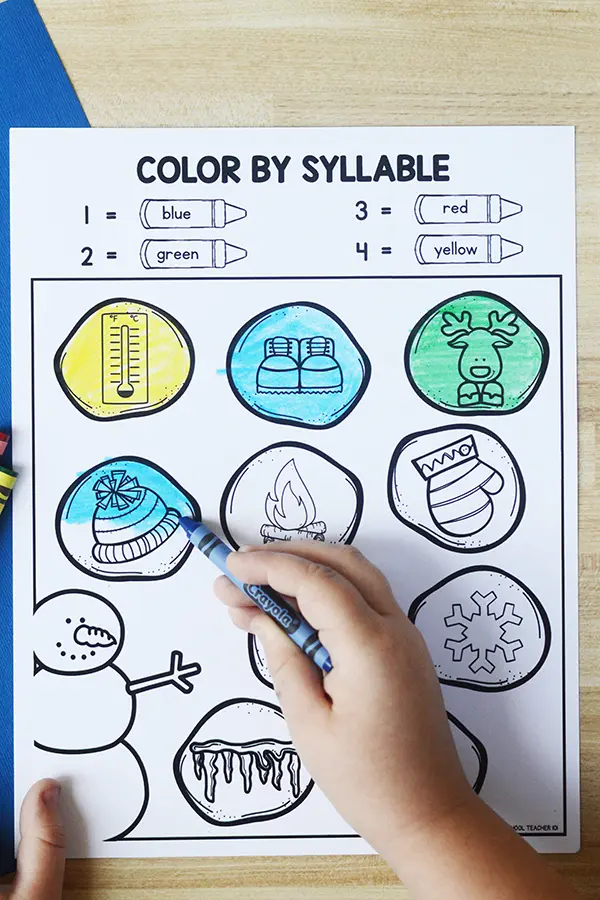
In the landscape of modern early childhood education, bridging the gap between foundational literacy development and engaging pedagogy remains a critical priority for educators. As school districts nationwide grapple with declining foundational reading metrics exacerbated by disjointed early learning trajectories, innovative instructional tools are emerging to reclaim the classroom. Among the most promising developments in phonological awareness intervention is the integration of no-prep, gamified learning models—exemplified by the newly released Winter Color by Syllable curriculum and its comprehensive year-long counterpart.
Designed specifically for preschool (Pre-K) and kindergarten classrooms, these materials merge the cognitive benefits of the time-tested "color-by-code" paradigm with rigorous segmentational phonics. By tasking young learners with breaking down spoken vocabulary into individual syllables (ranging from one to five distinct beats) and matching those counts to a corresponding color palette, these activities transform abstract phonological concepts into tactile, visual experiences.
This report provides an in-depth examination of the Winter Color by Syllable initiative, exploring its pedagogical mechanics, classroom integration strategies, developmental impacts on early readers, and the broader context of multi-seasonal phonological awareness toolkits currently reshaping early learning environments.
Detailed Chronology & Pedagogical Evolution
The journey toward gamified phonological awareness tools did not happen overnight; it represents a calculated shift in how early childhood developmental specialists view the acquisition of pre-reading skills.
Phase 1: The Traditional Rote Model (Pre-2015)
Historically, phonological awareness—the foundational ability to recognize and manipulate the spoken parts of sentences and words, including syllables, onsets, and rimes—was taught through oral repetition, clapping games, and flashcards. While these methods achieved moderate success, they frequently struggled to maintain the attention spans of four- and five-year-olds during independent practice blocks. Furthermore, they offered limited avenues for individualized assessment without one-on-one teacher intervention.
Phase 2: The Rise of Color-by-Code Interventions (2015–2020)
Educators soon realized that repurposing popular artistic pastimes, such as color-by-number or color-by-letter pages, could drastically improve student engagement. By embedding cognitive challenges into a coloring format, students could self-direct their learning while refining fine motor skills. However, early iterations primarily focused on basic visual matching or simple rote counting rather than targeted linguistic segmentation.
Phase 3: The Integration of Syllable-Segmented Design (2020–Present)
The conceptualization of the Color by Syllable framework marked a watershed moment for literacy centers. Recognizing that young children learn best when multiple sensory inputs are engaged simultaneously, developers began mapping phonetic syllable counts directly to color keys. The latest release of the Winter Color by Syllable collection refines this approach. Released ahead of the winter academic rush, the curriculum addresses the unique behavioral and instructional challenges of the winter months—a period often characterized by indoor recesses, disrupted schedules, and seasonal fatigue among students.
Supporting Context & Core Mechanics: How Color-by-Syllable Works
Phonological awareness is widely recognized by literacy experts as a primary predictor of future reading success. Before children can successfully decode written words via phonics, they must first understand that spoken language is composed of smaller, distinct sounds. Syllabification serves as a crucial stepping stone in this hierarchy.
The Mechanics of the Activity
The Winter Color by Syllable worksheets operate on a straightforward yet cognitively demanding premise:
Vocabulary Introduction: Teachers introduce a series of winter-themed vocabulary terms (e.g., mitten, snowflake, snowman, blizzard) to ensure students are familiar with the semantic meaning of the words before attempting phonetic breakdown.
Auditory Segmentation: Students speak the word aloud, clapping or tapping out the individual rhythmic beats (syllables). For instance, "mitten" breaks into two beats (mit-ten), while "snowflake" similarly divides into two (snow-flake).
Key Matching: Students cross-reference their syllable count with the instructional key provided at the top or side of the worksheet. Each count corresponds to a designated crayon or marker color.
Color Application: By filling in the corresponding section of the illustration, the student reveals a hidden winter-themed mosaic while solidifying their understanding of word structures.
Differentiation and Versatility
A core strength of the curriculum is its adaptability across diverse classroom environments. The framework functions fluidly within several instructional formats:
Literacy Centers: Serving as a station rotation activity, it allows small groups of students to work collaboratively or independently on phonological tasks while the instructor conducts guided reading groups.
Fast Finisher Tasks: It provides a productive, educationally sound assignment for students who complete core assignments ahead of schedule, eliminating idle downtime.
Take-Home Practice: The zero-preparation nature of the printables makes them ideal home-connection packets, empowering parents to reinforce foundational literacy concepts without requiring specialized teaching supplies.
Specialized Intervention: For students exhibiting delays in auditory processing or speech development, the visual-spatial feedback loop offers an alternative pathway to grasping phonetic structures.
Expanding the Scope: The Year-Long Framework
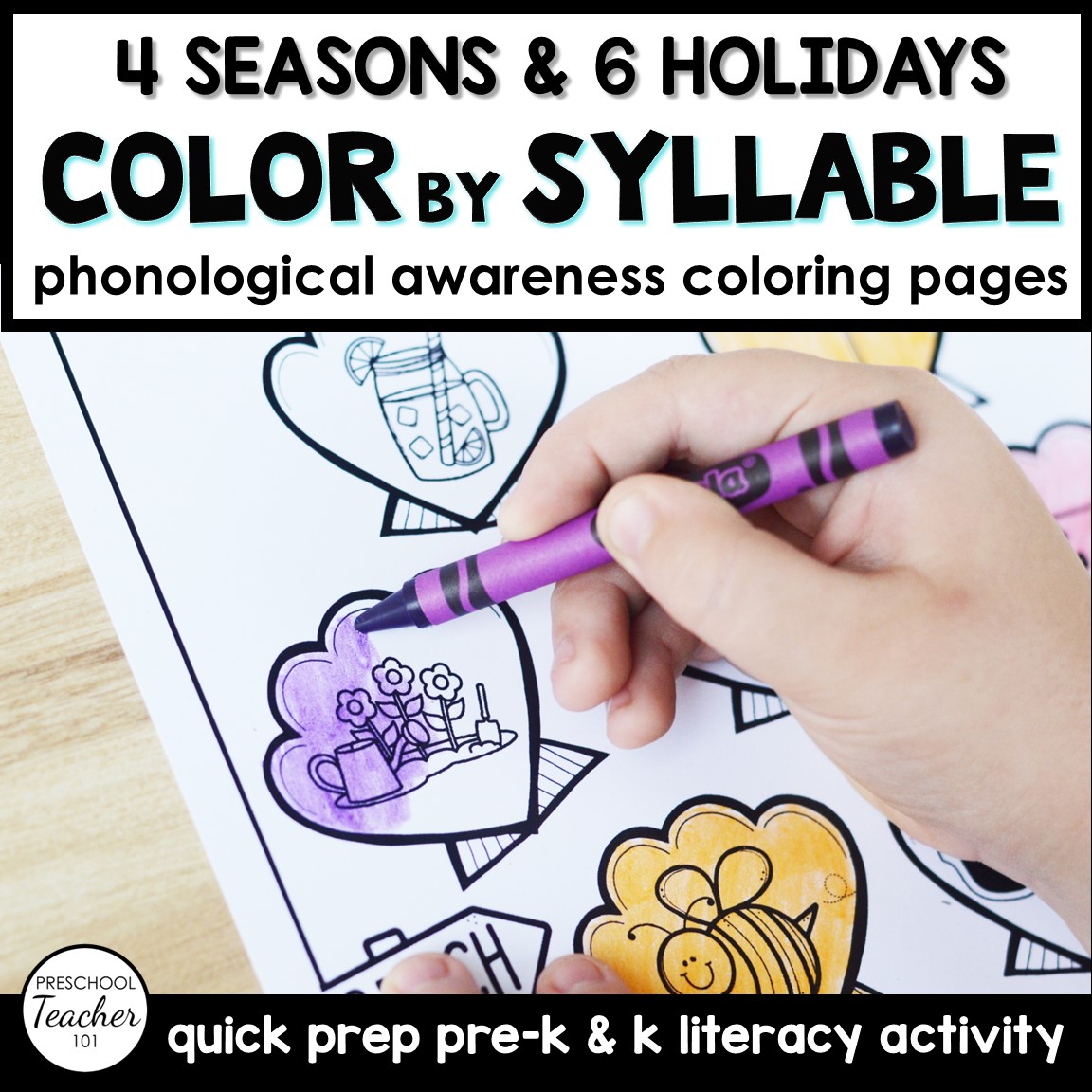
While the winter-themed freebie provides an immediate seasonal hook, literacy experts emphasize that consistent, year-round reinforcement is essential for long-term phonological mastery. To meet this demand, curriculum developers have expanded the single-season offering into a comprehensive, 33-page Year-Long Color by Syllable Set.
Curriculum Composition and Scope
The comprehensive year-long pack spans a wide array of themes, holidays, and seasonal transitions, ensuring that teachers have access to fresh, contextually relevant materials 365 days a year. Key structural elements of the full set include:
Graduated Complexity: Worksheets scale from recognizing single-syllable words up to complex five-syllable vocabulary terms, accommodating diverse developmental stages within preschool and kindergarten classrooms.
No-Prep Design: Recognizing the administrative burden placed on modern educators, every sheet requires zero preparation beyond printing, allowing teachers to allocate more time to direct student interaction.
Multi-Holiday Integration: From autumn harvest themes and winter wonderlands to spring renewals and summer milestones, the activities align seamlessly with existing thematic lesson plans (such as those provided by comprehensive classroom planning platforms like Preschool Teacher 101).
Expert Perspectives and Professional Insights
Educational specialists and early childhood researchers have weighed in on the implementation of gamified phonological tools, noting their alignment with modern cognitive science.
Dr. Elena Vance, a professor of early childhood literacy at the Institute for Child Development, emphasizes the importance of multimodal learning:
"When children engage in activities that require them to speak, listen, clap, and color simultaneously, they forge robust neural pathways. Syllable segmentation is not merely an exercise in counting; it is the cognitive foundation upon which decoding, spelling, and reading comprehension are built. Tools that make this process enjoyable without sacrificing rigor are invaluable to early educators."
Classroom teachers piloting the winter literacy centers have similarly praised the resource’s ease of use. Mark Thompson, a veteran kindergarten educator in the Midwest, shared his observations:
"During the winter months, keeping five-year-olds focused can feel like an uphill battle. These color-by-syllable sheets give my students a sense of purposeful play. They think they are simply coloring a snowman or a winter jacket, but functionally, they are performing high-level phonological sorting. It is a win-win for classroom management and academic growth."
Future Outlook: The Trajectory of Early Literacy Resources
As educational technology and printable pedagogical resources continue to converge, the demand for high-quality, research-backed, no-prep materials is projected to accelerate. School districts are increasingly shifting away from rigid, worksheet-heavy compliance models toward dynamic, skill-building activities that prioritize cognitive engagement.
Future iterations of phonological awareness frameworks are expected to incorporate augmented reality (AR) elements—allowing physical coloring sheets to interact with digital audio prompts—further bridging the gap between tactile art and auditory phonics. In the interim, foundational print resources like the Winter Color by Syllable initiative remain indispensable mainstays for classrooms striving to balance academic rigor with joyful, developmental play.
Access and Availability
Educators interested in integrating these materials into their curriculum can access the free Winter Color by Syllable introductory pack directly via early learning platforms such as Fantastic Fun and Learning. For educators seeking expanded resources, the complete 33-page Year-Long Color by Syllable set is available through specialized educator marketplaces, including Teachers Pay Teachers and companion curriculum sites like Preschool Teacher 101.