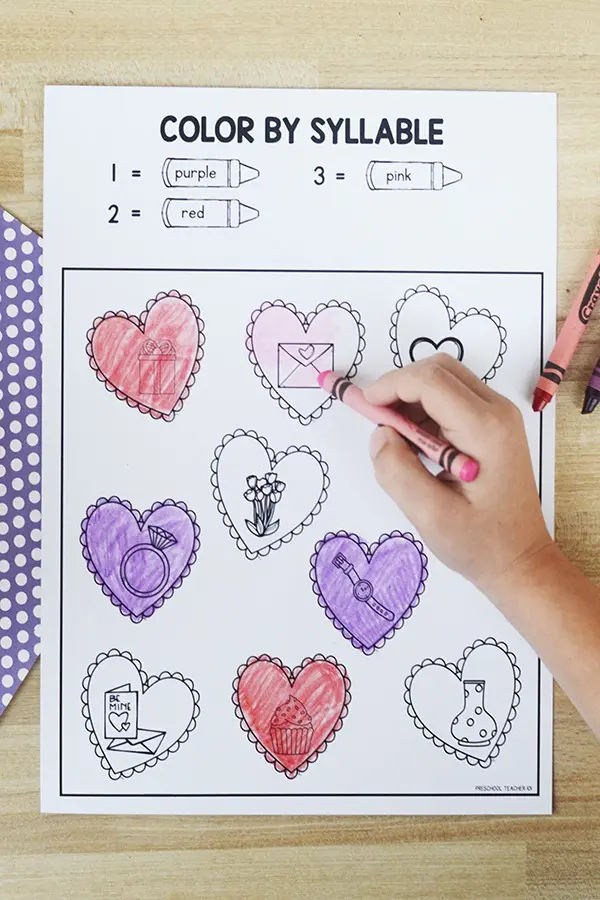
In the modern landscape of early childhood education, educators and curriculum specialists continually seek innovative methodologies to bridge the gap between foundational play and rigorous academic readiness. Among the core competencies required for early literacy success, phonological awareness—specifically the ability to recognize, isolate, and segment syllables—stands as a critical building block.
A newly released educational resource by early childhood expert Shaunna Evans, featuring the Valentine’s Day Color by Syllable activity set, introduces a zero-preparation, high-engagement strategy designed for Pre-K and kindergarten classrooms. By fusing the universally beloved mechanics of "color-by-code" worksheets with targeted syllable segmentation exercises, this intervention addresses a persistent challenge in early literacy: maintaining young learners’ attention while cultivating essential pre-reading skills.
This comprehensive report examines the pedagogical framework of the Valentine’s Day Color by Syllable curriculum, explores the broader ecosystem of year-round phonological tools, analyzes the cognitive impacts of syllable segmentation on early learners, and outlines future trends in interactive, themed classroom instruction.
1. Executive Overview & Pedagogical Context
Early childhood education experts widely agree that phonological awareness is one of the strongest predictors of future reading success. Long before children decode written words on a page, they must master the auditory landscape of spoken language. Syllable segmentation—breaking words down into beats or rhythm chunks—serves as a crucial stepping stone in this developmental progression.
Traditional approaches to teaching phonological awareness often rely heavily on rote repetition, clapping games, or flashcards. While effective, these methods frequently struggle to capture the independent focus of young children in bustling preschool or kindergarten literacy centers. The introduction of the Valentine’s Day Color by Syllable activity marks a strategic shift toward gamified, low-stress learning modalities.
Designed specifically for no-prep literacy centers, fast finishers, and take-home practice, this initiative allows educators to seamlessly integrate seasonal fun into academic goals. By utilizing familiar color-by-number mechanics and adapting them for phonetic counts ranging from one to five syllables, the activity transforms abstract linguistic concepts into a tangible, visually rewarding experience.
2. Detailed Chronology & Resource Development
The conceptualization and rollout of holiday-themed color-by-syllable packets represent a systematic evolution in early childhood curriculum design.
The Genesis of Color-by-Code Literacy: Years of classroom observation revealed that children inherently understand and enjoy color-by-number templates. Recognizing this engagement vector, educators began experimenting with substituting numbers for phonics elements, sight words, and syllable counts.
Expansion into Seasonal Themes: To maintain high student motivation throughout the academic year, developers expanded the concept into a comprehensive, year-round series. Each holiday—ranging from winter milestones to spring festivities—received a customized suite of phonological worksheets.
The Valentine’s Day Release: Positioned as a focal point for mid-winter literacy centers, the Valentine’s Day-themed module was engineered to target pre-reading skills just as classrooms transition into structured thematic units. The packet offers dedicated sheets focusing explicitly on counting syllables, matching word structures, and reinforcing vocabulary.
Scaling to the Full-Year Curriculum: Building upon the success of individual holiday releases, creators consolidated these resources into an expansive 33-page comprehensive pack. This full-year set equips preschool and kindergarten educators with a systematic toolkit to guide children through progressive syllable complexity (one to five syllables) over the course of an entire school year.
3. Supporting Context & Metrics: The Science of Syllable Segmentation
To understand the value of tools like the Valentine’s Day Color by Syllable activity, one must examine the cognitive mechanisms underlying early literacy. Phonological awareness is an umbrella term encompassing a child’s ability to recognize and manipulate the spoken parts of sentences and words, including syllables, rimes, and phonemes.
Cognitive Foundations in Pre-K and Kindergarten
Research in developmental psychology indicates that children’s brains naturally process language in rhythmic chunks. Syllables are naturally easier for young children to isolate than individual phonemes because they carry an audible peak of sonority (vowel sounds).
The 1-to-5 Syllable Progression: The comprehensive curriculum scales thoughtfully, starting with simple one-syllable words (e.g., heart, card) and advancing to complex multisyllabic structures (e.g., valentine, celebration). This gradual ramp-up prevents cognitive overload.
Fine Motor Integration: By combining cognitive linguistic tasks with coloring, students simultaneously refine their fine motor skills, bilateral coordination, and pencil grip. This dual-tasking reinforces neural pathways associated with both artistic expression and linguistic processing.
Classroom Efficiency Metrics: In busy early childhood classrooms, teacher-to-student ratios often limit one-on-one phonetic interventions. No-prep, independent literacy stations allow educators to deploy high-yield activities that students can complete autonomously after initial vocabulary and concept introduction.
4. Official Statements & Expert Perspectives
Educational creators and curriculum developers emphasize that the success of worksheets like the Valentine’s Day Color by Syllable set depends heavily on instructional scaffolding.
"Color-by-syllable activities are a fantastic no-prep resource that helps break down words into their individual syllables," explains Shaunna Evans, creator and early childhood specialist behind the initiative. "Children learn to hear the sounds within a word and successfully segment syllables, all while engaging in a fun, holiday-themed art activity."
Pedagogical experts stress that while the worksheets are designed for independent or small-group literacy centers, they should not replace direct, explicit instruction. Educators are routinely advised to introduce and review vocabulary terms before expecting students to independently identify and color based on syllable counts.
Furthermore, alignment with comprehensive classroom frameworks—such as standardized preschool lesson plans offered through partner platforms like Preschool Teacher 101—ensures that these bite-sized activities fit cleanly into broader thematic instruction rather than existing as isolated worksheets.
5. Future Outlook: The Evolution of Thematic Early Literacy Tools
As educational technology and printable curricula continue to mature, the demand for high-quality, targeted, and engaging literacy materials is projected to grow. The trajectory of early childhood education points toward several key developments:
Blended Print and Digital Integration: While tactile coloring worksheets remain irreplaceable for fine motor development, future iterations of phonological tools are expected to incorporate interactive digital overlays, audio prompts for syllable clapping, and augmented reality extensions.
Data-Driven Differentiation: Educators increasingly require granular data on student progress. Future expansions of seasonal literacy packets are anticipated to include formative assessment rubrics, allowing teachers to track individual student mastery of syllable segmentation across different holiday themes.
Inclusive and Universal Design: As classrooms become more diverse, literacy materials are adapting to incorporate culturally responsive vocabulary, multi-lingual supports, and visual cues designed to aid English Language Learners (ELL) and children with diverse learning needs.
Sustainable Teacher Resources: The ongoing shift toward ready-to-print, zero-preparation resources reduces the administrative and prep-time burden on educators, allowing them to focus more intensely on direct student interaction and individualized intervention.
Conclusion
The Valentine’s Day Color by Syllable initiative, alongside its broader year-round counterpart, exemplifies how thoughtful instructional design can transform foundational skill-building into an enjoyable experience. By bridging cognitive phonological awareness with the creative joy of holiday-themed coloring, educators are equipped with a powerful tool to foster a lifelong love of reading in the minds of our youngest learners.