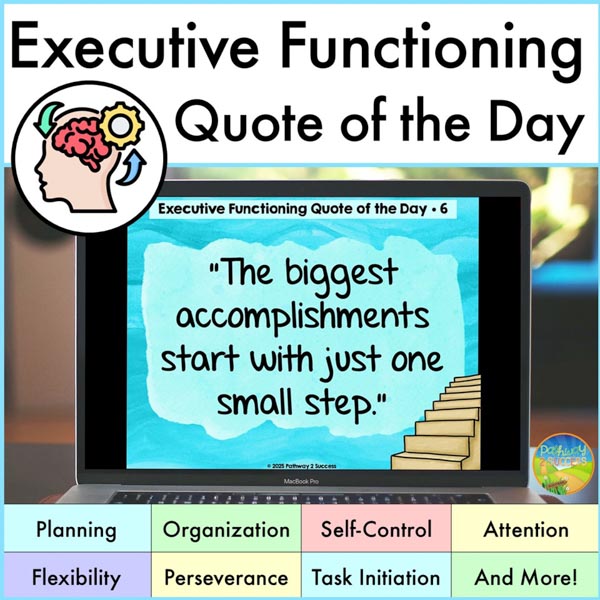
In modern classrooms, the benchmarks for student success extend far beyond traditional metrics of academic achievement like standardized test scores or GPA. Educators, school psychologists, and cognitive scientists increasingly recognize that long-term academic and life success is deeply rooted in a set of foundational mental processes known as executive functioning skills. Encompassing planning, working memory, self-control, attention, cognitive flexibility, and task initiation, these cognitive abilities act as the control center of the brain.
However, developing these critical skills during childhood and adolescence—a period of intense neurodevelopment—remains a persistent challenge for educators who are already managing packed curricula. Enter a surprisingly accessible and powerful pedagogical tool: inspirational quotations.
Far from serving as mere decorative wall art or brief motivational mantras, strategically selected and discussed quotes are emerging as a transformative framework for explicit executive functioning instruction. By coupling carefully curated statements with guided classroom discussions, educators can bridge the gap between abstract cognitive concepts and tangible real-world behaviors. This comprehensive report explores the underlying mechanics of using quotes to foster cognitive development, examines key executive functioning domains, and provides a roadmap for integrating these practices into daily classroom routines.
Detailed Chronology: The Evolution of Metacognitive Classroom Tools
The journey toward integrating reflective literature and philosophy into modern cognitive skill-building did not happen overnight. It represents a steady evolution in educational psychology, shifting from rigid behavioral management toward holistic, metacognitive empowerment.
Late 20th Century – The Rise of Social-Emotional Learning (SEL):
For decades, American and international classrooms relied heavily on punitive or reward-driven behavioral models. As emotional intelligence research gained traction in the 1990s, schools began introducing Social-Emotional Learning (SEL) frameworks. Educators realized that students needed explicit instruction in self-awareness and self-management, laying the groundwork for more targeted cognitive interventions.
Early 2000s – Neuroscience and the Executive Functioning Boom:
With advancements in neuroimaging, researchers mapped the adolescent brain more clearly than ever before. Science confirmed that the prefrontal cortex—the hub of executive functioning—continues to develop well into a person’s twenties. Schools recognized that many students struggling with disorganization, emotional dysregulation, or procrastination were experiencing genuine developmental lags in executive control, rather than intentional defiance or laziness.
2010s – The Bell-Ringer Movement:
To maximize instructional time, educators widely adopted "bell-ringers"—short, focused activities at the beginning of class designed to transition students into an academic mindset. While initially focused on math problems or grammar drills, innovative teachers began substituting these prompts with thought-provoking quotes to spark critical thinking and emotional check-ins.
Present Day – Systematic Integration and Curricular Resources:
Today, the use of quotes has evolved from random daily inspiration into a systematic, evidence-informed strategy. Teachers are leveraging structured programs—such as yearlong executive functioning quote-of-the-day sets—equipped with tailored discussion guides, targeted skill matrices, and reflective questioning frameworks. This systematic approach ensures that every quotation serves a distinct cognitive objective.
To understand the value of using quotes as a pedagogical vehicle, one must first examine the critical nature of executive functioning itself. Often described by cognitive scientists as the "conductor of the mental orchestra," executive functioning comprises three core pillars: working memory, mental flexibility, and inhibitory control.
The Brain’s Command Center
Executive functions are governed primarily by the prefrontal cortex. During childhood and teenage years, this region undergoes massive synaptic pruning and myelination. Because these neural pathways are still under construction, kids and teens frequently struggle with:
Planning and Organization: Structuring multi-step projects or keeping physical materials orderly.
Task Initiation: Overcoming the mental friction required to start an assignment.
Self-Control: Inhibiting impulsive reactions in favor of long-term goals.
Emotional Regulation: Calming an overwhelmed mind to restore focus.
The Educational Impact
Data from educational research organizations consistently highlights a strong correlation between robust executive functioning skills and academic performance. Students with high executive control demonstrate better reading comprehension, higher mathematical reasoning abilities, and superior classroom engagement. Conversely, deficits in these areas are frequently misdiagnosed as behavioral problems or learning disabilities.
Because traditional school subjects rarely teach these skills explicitly, educators must find creative ways to make abstract cognitive processes visible and discussable. Quotes provide a low-stakes, high-engagement entry point for this vital work.
Official Statements and Pedagogical Insights
Educational leaders and curriculum designers emphasize that the efficacy of using quotes lies not in the words themselves, but in the intentional dialogue they generate. A random quote on a poster provides minimal value; a quote analyzed through guided, reflective questioning transforms into a cognitive workout.
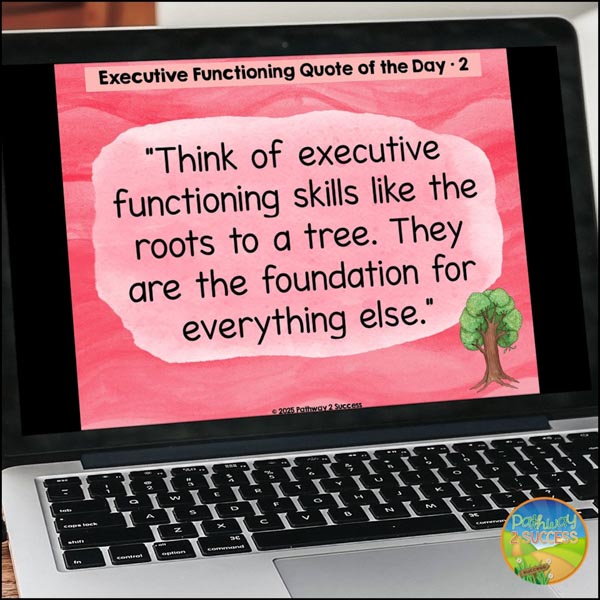
"Executive functioning skills are like the roots to a tree. They are the foundation for everything else."
According to leading curriculum specialists behind comprehensive classroom resources like the Executive Functioning Quote of the Day sets, framing abstract skills through metaphors helps students internalize complex concepts. "When learners understand that their brains are developing systems—much like the root system of a tree anchoring its growth—they stop viewing academic struggles as personal flaws and start viewing them as skills that can be cultivated," notes educational strategy literature from The Pathway 2 Success.
Educator guides accompanying these frameworks emphasize three core steps for effective classroom implementation:
Read and Reflect: Introduce the quotation clearly at the start of class, giving students time to read and process the literal meaning.
Connect to Life: Move past surface-level definitions by asking learners to tie the quote’s underlying message to their own personal experiences, academic challenges, or social interactions.
Identify Actionable Strategies: Conclude the discussion by extracting concrete, actionable behaviors that students can apply immediately in their daily lives.
Deconstructing Core Executive Functioning Domains Through Quotations
To make this approach practical for educators, specific domains of executive functioning can be paired with targeted quotations and reflective questions designed to ignite deep student engagement.
1. Executive Functioning Foundations: Understanding the Brain
The Quote:"Think of executive functioning skills like the roots to a tree. They are the foundation for everything else."
The Meaning: Executive functioning encompasses the mental processes that enable us to plan, organize, manage time, and navigate challenges. Just as roots nourish a tree unseen, these skills underlie every classroom task, from focusing during a lecture to solving a complex math problem.
Guided Discussion Questions:
What are some activities you enjoy doing outside of school?
How do planning, focus, and self-control help you succeed in those activities?
Why is it empowering to learn about how your brain works?
2. Self-Control: Investing in Tomorrow
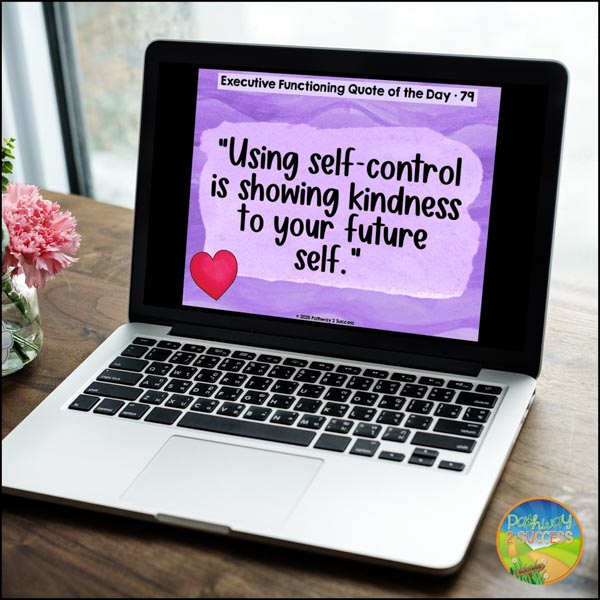
The Quote:"Using self-control is showing kindness to your future self."
The Meaning: Self-control is the ability to pause, weigh options, and make choices aligned with long-term well-being. By reframing self-regulation as an act of self-kindness—such as organizing a messy binder or studying ahead of a test—students realize that discipline is not about restriction, but self-care.
Guided Discussion Questions:
What does genuine self-control look like in a busy school environment?
How can practicing self-control today make tomorrow easier or less stressful?
What is one tangible way you can show kindness to your future self today?
3. Task Initiation: Overcoming the Starting Barrier
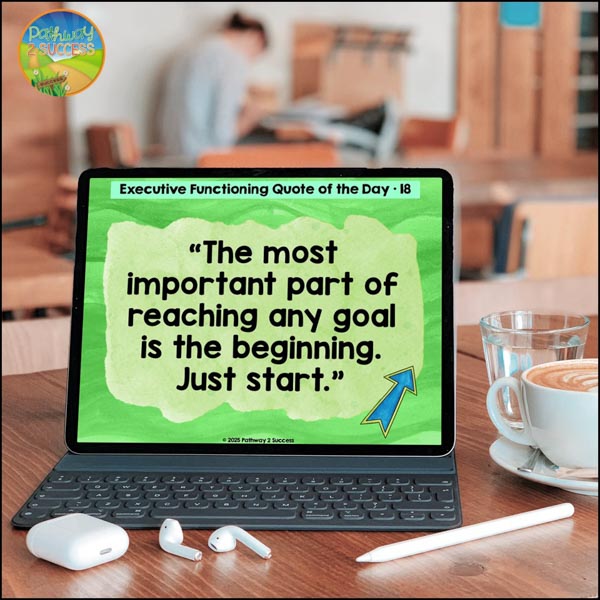
The Quote:"The most important part of reaching any goal is the beginning. Just start."
The Meaning: Task initiation represents the mental spark required to begin a project, especially when motivation is low. Recognizing that the anticipation of a task is often more daunting than the work itself helps students push past initial inertia.
Guided Discussion Questions:
Why do you think getting started on a homework assignment or chore is often the hardest part?
What mental barriers or distractions pop up right before you start working?
What micro-strategies (like setting a 5-minute timer) can you use to break the inertia and just start?
4. Attention and Focus: The Power of Calm
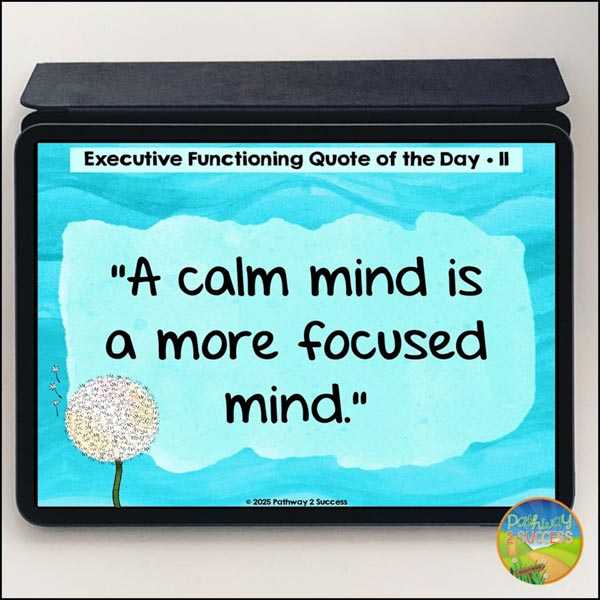
The Quote:"A calm mind is a more focused mind."
The Meaning: Attention is heavily influenced by emotional state. When students are stressed, anxious, or overwhelmed, their prefrontal cortex goes offline. Cultivating calmness directly supports cognitive focus and high-quality work.
Guided Discussion Questions:
Why is it so difficult to concentrate when you feel upset, anxious, or rushed?
How does physical tension or a cluttered workspace affect your ability to pay attention?
What are your personal favorite strategies to relax your mind and reset your focus?
5. Perseverance: Embracing Persistence
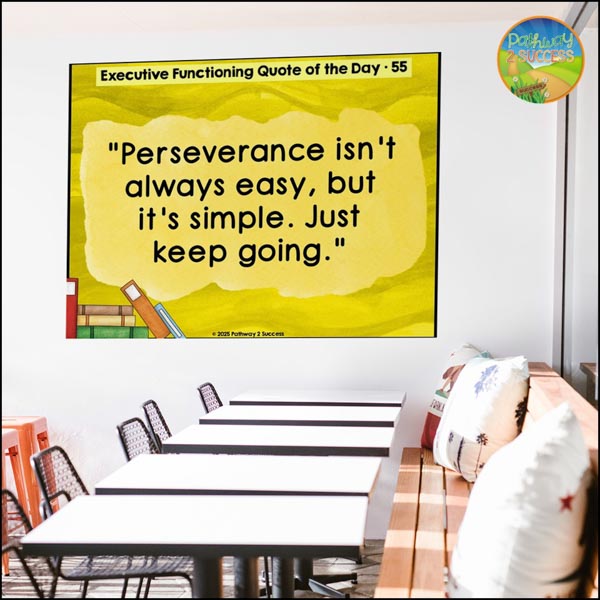
The Quote:"Perseverance isn’t always easy, but it’s simple. Just keep going."
The Meaning: Perseverance is the commitment to pursuing goals despite obstacles. While the emotional journey can be grueling, the mechanical solution remains simple: maintain forward momentum.
Guided Discussion Questions:
What does it truly mean to persevere when faced with a difficult subject or personal setback?
Can you share a time when you wanted to give up, but pushed through? What was the outcome?
What mantras or support systems help you keep going during tough moments?
The Quote:"Every problem has a solution. Most have many."
The Meaning: Cognitive flexibility is the mental agility required to adapt to change, shift perspectives, and brainstorm alternative problem-solving strategies when initial attempts fail.
Guided Discussion Questions:
Think of a recent problem you faced. What was your first approach, and did it work?
What were some alternative ways you could have solved that same problem?
Why is it dangerous to assume there is only "one right way" to tackle a challenge?
Future Outlook: The Next Wave of Metacognitive Education
As educational landscapes continue to adapt to the post-pandemic era, the integration of explicit executive functioning instruction is projected to become a cornerstone of comprehensive school curricula. Educators and administrators are moving away from treating cognitive skills as innate traits that students either possess or lack, embracing instead a growth mindset model where executive functioning can be explicitly taught, practiced, and mastered.
Future developments in this space will likely include:
Cross-Curricular Alignment: Embedding executive functioning reflections not just in homeroom or advisory periods, but integrating them organically into STEM, humanities, and arts curricula.
Digital and Interactive Formats: Expanding beyond physical quote cards into interactive digital bell-ringers, peer discussion forums, and student self-monitoring journals.
Parent-School Partnerships: Extending these reflective frameworks into the home environment, enabling parents to use identical terminology and quotational prompts to reinforce planning, self-control, and task initiation outside of school hours.
Ultimately, using quotes to build executive functioning skills represents a profound shift in how we view student development. By honoring the growing minds of kids and teens through thoughtful dialogue, deep reflection, and actionable strategies, educators are equipping the next generation with the cognitive anchors they need to thrive—not just in the classroom, but throughout their lives.