

Executive Overview
While the broader educational landscape remains locked in intense, decades-long debates over phonics, reading fluency, and comprehension, a critical pillar of literacy consistently gets left behind: writing instruction. Reading and writing are inextricably intertwined cognitive processes, yet writing is frequently treated as an afterthought or an instinctive byproduct of reading proficiency.
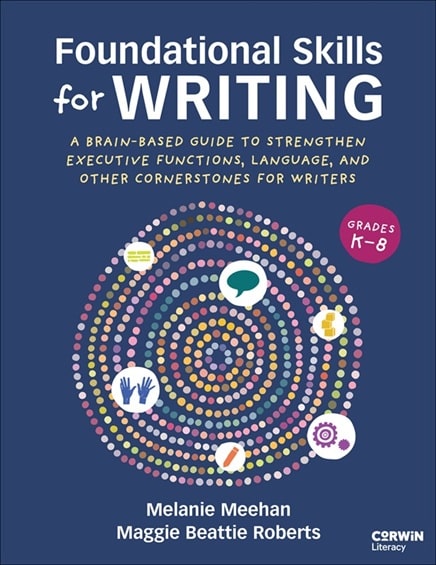
This glaring omission has prompted literacy experts Melanie Meehan and Maggie Roberts to shift the narrative. Earlier this month, Meehan—a former curriculum coordinator and independent writing center founder—and Roberts—a literacy consultant and veteran middle school teacher—released their groundbreaking new book, Foundational Skills for Writing: A Brain-Based Guide to Strengthen Executive Functions, Language, and Other Cornerstones for Writers.
The text addresses a fundamental question educators rarely ask: What does the human brain actually have to do when a child is asked to write, and what neurological roadblocks get in the way?
By breaking down the complex orchestration of writing into manageable cognitive domains—including transcription mechanics, oral language foundations, and executive functioning—the authors provide educators with actionable tools. Central to their methodology are "Minute Moves": quick, flexible, 60-to-90-second instructional activities designed to be seamlessly integrated into classroom transitions, warm-ups, or downtime. These micro-lessons are engineered to automatize foundational skills, freeing up vital cognitive energy so students can focus on the higher-order art and craft of composition.
Detailed Chronology: The Evolution of a Neglected Literacy Crisis
The Reading-Writing Disconnect in Modern Education
For generations, educational policy and standardized testing have prioritized reading metrics. Phonics interventions and fluency checks dominate elementary and middle school schedules. However, this hyper-focus on input (reading) has inadvertently starved output (writing). When writing is taught, it is often approached as a final product rather than a cognitive process that requires explicit, foundational scaffolding.
Recognizing this systemic gap, Meehan and Roberts spent decades observing classrooms, working with struggling students, and analyzing cognitive research. They noted that students frequently freeze over blank pages not because they lack imagination, but because the mechanical act of writing overloads their working memory.
Bridging Research and Practice
In response, the co-authors embarked on a mission to synthesize cognitive science with practical classroom pedagogy. Their collaboration culminated in the publication of Foundational Skills for Writing. Rather than offering another sweeping curriculum overhaul that overwhelms teachers, Meehan and Roberts focused on micro-interventions. They curated a suite of "Minute Moves" that target specific cognitive bottlenecks, ensuring that foundational mechanics—such as spelling patterns, sentence architecture, and cognitive flexibility—become second nature through playful, high-engagement repetition.
Supporting Context & Metrics: The Cognitive Architecture of Writing
Writing is arguably one of the most complex tasks we ask the human brain to perform. It requires the simultaneous synchronization of multiple neural networks. Meehan and Roberts categorize these foundational skills into three primary pillars:
- Transcription Skills: Encompassing handwriting, keyboarding, spelling, and gross/fine motor development. When a student has to consciously labor over how to form a letter or spell a word, their working memory capacity plummets.
- Oral Language: The speaking and listening precursors to writing, which govern syntax, sentence construction, and auditory processing.
- Executive Functioning: The managerial system of the brain—including working memory, cognitive flexibility, and inhibitory control—which dictates a writer’s ability to plan, revise, and shift perspectives.
To combat cognitive overload, the authors’ Minute Moves are partitioned into specific skill categories designed to reinforce these exact neural pathways.

Official Strategies: Eight "Minute Moves" to Transform the Classroom
During their recent interview on the Cult of Pedagogy podcast, Meehan and Roberts detailed eight high-impact Minute Moves categorized by the cognitive domain they target.
Spelling Minute Moves
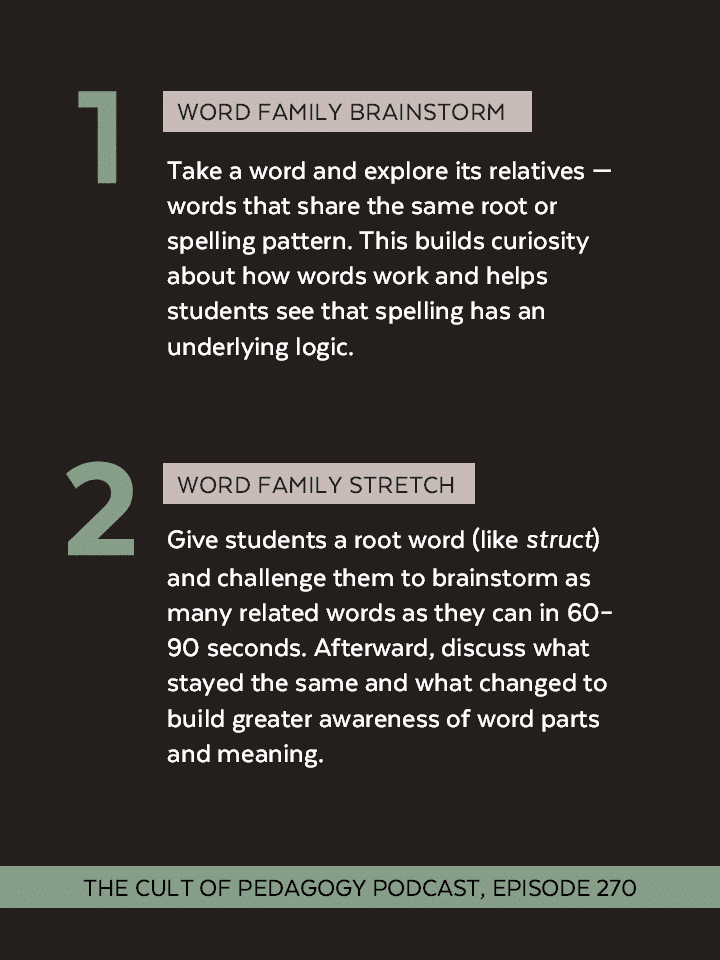
1. Word Family Brainstorm
Rooted in the research of spelling scholar Rebecca Treiman, this activity shifts students away from rote memorization and toward linguistic curiosity. Instead of teaching confusing homophones like two, to, and too in isolation, educators connect two to word relatives like twin, twine, and twenty, revealing a shared conceptual pattern of "twoness."
- Application: When students struggle with complex spellings like decision, connecting it to decide, incision, concise, and scissors—all tracing back to a Latin root meaning "to cut"—transforms spelling from a guessing game into a logical puzzle.
2. Word Family Stretch
Students are given a Latin or Greek root (such as struct, meaning "to build") and a 60-to-90-second timer to brainstorm all related words (structure, destruction, construct, instruct).

- The Debrief: The critical learning happens after the timer stops. Teachers lead a discussion: What stayed the same? What changed? How did the prefix or suffix alter the meaning? This deepens students’ understanding of bound versus free morphemes.
3. Prefix Swap
Building on root-word exploration, students take a base word like form and systematically swap prefixes (reform, transform, inform, deform). This strategy is particularly transformative for multilingual learners, who often recognize familiar morphemes from their primary languages (such as bene and mal in benevolent and malevolent), cementing vocabulary in long-term memory.
Sentence Construction Minute Moves
4. Sentence Scramble
Educators write the individual words or phrases of a sentence on separate index cards, scramble them, and challenge students to reconstruct the sentence physically.
- Scaffolding: Teachers can remove punctuation, introduce a distractor word that doesn’t belong, or prompt students to extend the sentence. This tactile manipulation builds an internalized intuition for syntax and sentence patterns.
5. Sentence Expander
Starting with a basic kernel sentence (The cat purrs), students collectively expand it by answering targeted questions: Which cat? What color? Where? When? Why?
- Pedagogical Shift: Meehan advocates using terms like "doer" and "doing" instead of abstract grammatical labels like "subject" and "predicate." Once students build a fully expanded sentence (The orange cat is sleeping on the couch…), they experiment with rearranging the clauses to discover how syntax impacts rhythm and meaning.
6. Sentence Combining
Described by Roberts as a high-impact, rapid intervention, this strategy asks students to merge two bare-bones sentences (My cat is orange + My cat is big = My big orange cat…). As learners grow confident, they integrate conjunctions (because, but, and) to navigate complex relationships between ideas, a skill that naturally bleeds into their independent essay writing.
Executive Functioning Minute Moves
7. "What’s Another Way?"
Targeting cognitive flexibility—the executive function that allows writers to shift approaches and revise thinking—this move asks students to rewrite a given sentence from a fresh angle. What happens if the dependent clause goes first? What if the sentence is compressed into a single, punchy statement?
- Empowerment: Meehan emphasizes that students must learn that the craft of writing relies on intentional variation. Naming this explicitly as "cognitive flexibility" gives students an empowering vocabulary to describe their own metacognitive processes.
8. New Angle
Zooming out from the sentence to the narrative level, this strategy requires students to retell a familiar scene from a book, class text, or short film through an alternate character’s perspective.
- Beyond the Classroom: Utilizing narrative resources like Pixar’s Snack Attack, students write parallel perspectives. Beyond improving narrative point-of-view mechanics, Meehan notes that this exercise fosters empathy, critical thinking, and civic awareness: “It’s not just about writing… it’s also about democracy and thinking about how other people think and what their perspectives are.”
Future Outlook
As educational institutions continue to grapple with literacy recovery, the integration of brain-based foundational skills in writing marks a vital evolution in pedagogy. By shifting away from punitive, product-oriented grading and moving toward micro-interventions that target working memory, transcription, and cognitive flexibility, educators can dismantle the psychological barriers that impede young writers.
The widespread adoption of strategies like Meehan and Roberts’s "Minute Moves" signals a promising shift: an educational culture where writing is no longer viewed as an elite, mysterious talent reserved for the naturally gifted, but as a teachable, cognitive skill accessible to every brain in the classroom.

