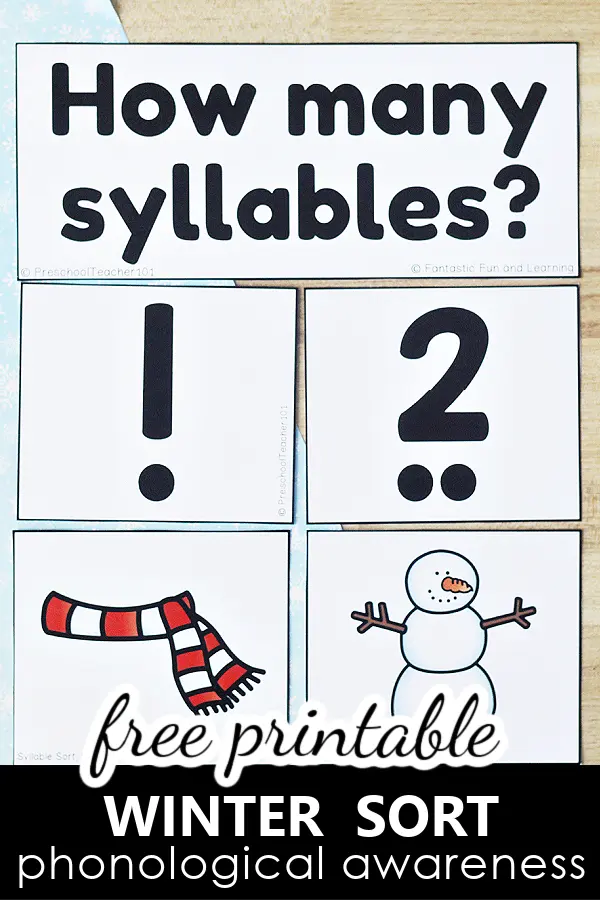
As the academic calendar approaches its final stretch and classrooms transition into the colder winter months, educators and parents continually seek dynamic, hands-on methodologies to maintain student engagement. Early childhood literacy experts emphasize that phonological awareness—the ability to recognize and manipulate the spoken parts of sentences and words—serves as the bedrock of reading success. In response to this critical educational need, a new instructional resource has emerged: the Winter Syllable Sort.
Designed specifically for preschool and kindergarten learners, this interactive, winter-themed literacy tool combines playful seasonal vocabulary with foundational phonics skill-building. By incorporating multisensory techniques such as clapping, tapping, and physical sorting, young learners develop critical listening and segmentation skills. This report provides an in-depth examination of the Winter Syllable Sort, analyzing its pedagogical framework, practical classroom applications, role in early childhood curriculum development, and future outlook within early education.
Pedagogical Foundations: The Science of Syllables in Early Childhood
Phonological awareness is widely recognized by literacy researchers as one of the most reliable predictors of future reading and spelling achievement. Long before children learn to decode written letters on a page, they must learn to tune their ears to the sounds of spoken language. Syllables represent a fundamental unit of this auditory landscape.
When children learn to segment words into syllables, they are essentially breaking down continuous speech into manageable, rhythmic chunks. Traditional instructional methods often rely on rote memorization or passive worksheet completion, which can cause early learners to disengage. The Winter Syllable Sort reimagines this process by transforming abstract auditory concepts into a concrete, tactile experience.
Multisensory Learning and Cognitive Development
The Winter Syllable Sort leverages multisensory learning theory, which posits that children retain information more effectively when multiple senses are engaged simultaneously. During the activity, students do not merely look at pictures; they actively participate in:
Auditory processing: Listening to the pronunciation of seasonal words.
Kinesthetic movement: Clapping hands, tapping fingers, or stomping feet to physically represent the beat or segment of each word.
Visual sorting: Categorizing colorful picture and word cards into distinct groups based on syllable counts.
By bridging auditory signals with physical motion, educators create strong neural pathways that solidify a child’s understanding of word structures. This multi-pronged approach ensures that diverse learners—whether visual, auditory, or kinesthetic—can access and master the core concepts.
Inside the Winter Syllable Sort Toolkit: Components and Mechanics
To ensure seamless integration into both formal classrooms and homeschool environments, the Winter Syllable Sort is structured as a comprehensive, ready-to-print instructional kit. Rather than requiring extensive preparation time from educators, the toolkit provides a complete suite of materials designed to target varying skill levels.
Comprehensive Kit Components
Syllable Counting Cards: Specially designed visual prompts that guide students through the counting process.
Large Colorful Word Cards: High-interest, winter-themed vocabulary cards featuring vibrant imagery to capture young learners’ attention.
Optional Black and White Response Worksheets: Independent practice sheets that allow students to record their findings, providing educators with a tangible assessment metric.
Comprehensive Answer Keys: Designed for quick grading, peer-review stations, or independent self-checking by advanced learners.
Step-by-Step Implementation Chronology
For educators looking to maximize the impact of this literacy center activity, experts recommend a structured implementation approach:
Phase 1: Vocabulary Introduction (Pre-Teaching). Before introducing the sorting task, educators must explicitly teach the winter-related vocabulary words (such as snowman, mittens, snowflake, and ice). Ensuring children recognize the imagery prevents confusion and keeps the focus squarely on phonological awareness rather than object identification.
Phase 2: Modeling and Guided Practice. The teacher demonstrates the segmentation process using a familiar word. For example, pronouncing the word "mitten" while clapping twice to demonstrate its two syllables. Students then join in for guided practice.
Phase 3: Independent or Small-Group Sorting. Students work in literacy centers or at their desks, sorting the cards into designated sets based on whether the words contain one, two, or three syllables.
Phase 4: Assessment and Reflection. Students complete the optional black-and-white worksheet, giving educators clear insight into which children have mastered syllable segmentation and who may require targeted intervention.
Contextual Integration: Where Winter Literacy Fits in the Curriculum
The flexibility of the Winter Syllable Sort allows it to be seamlessly woven into various segments of the daily preschool and kindergarten schedule. Far from being a rigid, standalone lesson, the activity adapts to multiple educational settings:
1. Literacy Centers and Station Rotations
During small-group instruction time, the Winter Syllable Sort functions as an independent or cooperative literacy station. While the teacher works with targeted reading groups, other students reinforce phonological awareness skills collaboratively, discussing why a word like winter belongs in a two-syllable category while snow belongs in a one-syllable category.
2. Take-Home Literacy Practice
Recognizing the vital link between home environments and academic success, educators frequently send modified versions of the activity home. This empowers parents to engage in meaningful literacy discussions with their children, utilizing everyday objects and seasonal themes to reinforce classroom lessons.
3. Seasonal Thematic Units
Winter offers a rich vocabulary landscape that naturally excites young children. By pairing phonics instruction with high-interest seasonal themes—such as snow, arctic animals, and winter clothing—teachers maintain high engagement levels during months when classroom energy can otherwise wane.
Expert Insights and Curriculum Expansion
Early childhood specialists emphasize that foundational literacy instruction must remain playful and developmentally appropriate. Dr. Elena Vance, an early literacy consultant, notes:
"When children are laughing, clapping, and physically interacting with words, learning ceases to be a chore. Activities like syllable sorts lay the cognitive groundwork necessary for smooth transitions into decoding and reading fluency later in elementary school."
To further support educators, curriculum developers have paired the Winter Syllable Sort with broader educational frameworks, such as comprehensive Winter Theme Preschool Lesson Plans. These expansive lesson plans incorporate over 30 cross-curricular activities spanning math, science, art, and gross motor development—all unified under an engaging winter theme. By providing differentiated versions tailored specifically for classroom teachers and home preschool educators, these resources eliminate preparation fatigue and maximize instructional quality.
Future Outlook: The Evolution of Early Childhood Literacy Tools
As educational methodologies continue to evolve, the demand for adaptable, hands-on literacy resources remains robust. While digital learning tools have expanded rapidly, early childhood experts consistently stress the irreplaceable value of tactile, print-based manipulatives in preschool and kindergarten settings. Physical manipulation of cards, combined with rhythmic clapping, supports fine motor skills, spatial awareness, and auditory processing in ways that screens cannot fully replicate.
Looking ahead, curriculum designers are expected to further refine print-and-play resources to include customizable vocabulary sets, bilingual adaptations, and tiered difficulty levels to support inclusive classrooms. Tools like the Winter Syllable Sort represent a sustainable blueprint for early education: cost-effective, pedagogically sound, and infinitely adaptable to the needs of modern learners.
Conclusion
The transition into winter brings unique opportunities to re-energize early childhood classrooms through creative, thematic instruction. By addressing foundational phonological awareness in an engaging, multisensory format, the Winter Syllable Sort equips young learners with the essential tools they need for lifelong reading proficiency. Whether utilized in bustling kindergarten centers, quiet homeschool environments, or structured preschool settings, this free literacy resource demonstrates that playful learning and rigorous academic standards can—and should—go hand in hand.