

Executive Overview
The corporate adoption curve for artificial intelligence has entered a radical new phase. Organizations have moved past the initial era of passive experimentation, where standalone chatbots and generalized large language models (LLMs) served as novelties or productivity adjuncts. Today, autonomous and semi-autonomous AI agents are rapidly embedding themselves into mainstream enterprise workflows, operating with increasing independence across departments, systems, and operational pipelines.
Yet, beneath the surface of this rapid deployment lies a precarious structural deficiency. According to the newly released 2026 State of AI in the Enterprise report—commissioned by cloud content management leader Box and conducted by The Harris Poll—corporate content infrastructure, security architecture, and governance frameworks are failing to keep pace with the velocity of agentic AI adoption.
The report exposes a startling dichotomy at the heart of modern enterprise digital transformation: while 83% of organizations are actively running AI agents in some capacity, a mere 36% of those utilizing or experimenting with the technology have successfully integrated these agents with trusted, unified internal content across multiple enterprise use cases. Furthermore, nearly half of all surveyed organizations have already experienced at least one AI-related data exposure incident, highlighting the immediate operational perils of deploying autonomous software without robust underlying data plumbing.
These revelations signal a fundamental pivot in the enterprise AI challenge. The primary constraint to unlocking enterprise value is no longer access to sophisticated frontier models or raw computing power. Instead, organizations face a much harder architectural hurdle: how to structure, govern, and secure institutional knowledge so that autonomous agents can interact with it safely, accurately, and at scale.
As enterprises race to deploy agents capable of reading contracts, synthesizing reports, and executing multi-step business processes, they are finding that the true bottleneck is not the artificial intelligence itself, but the chaotic, fragmented, and poorly governed state of human-created enterprise data.
Detailed Chronology: From Model Access to Contextual Integration
To understand how enterprises arrived at this architectural precipice, it is necessary to examine the rapid evolutionary trajectory of corporate artificial intelligence over recent years.

Phase One: The Model Availability Gold Rush
When generative artificial intelligence first detonated into the mainstream enterprise consciousness, the primary corporate objective was access. Organizations scrambled to secure API keys, evaluate proprietary versus open-source frontier models, and establish proof-of-concept environments. The executive mandate was simple: Get our hands on the smartest model available.
During this initial phase, success was measured by model parameter counts, reasoning benchmarks, and token throughput. Companies tested the waters with isolated use cases—marketing copy generation, basic software debugging, and general-purpose conversational interfaces. Because these early applications operated largely in isolation from sensitive corporate data stores, the risks of data leakage, hallucination-driven compliance violations, and improper access control were relatively contained.
Phase Two: The Rise of the Autonomous Agent
As foundational models matured in speed, accuracy, and reasoning capabilities, the software paradigm shifted from passive generation to active execution. The industry entered the era of the AI agent—software entities designed to perceive their environment, formulate plans, use tools, and execute complex workflows over extended periods with minimal human intervention.
Enterprises quickly recognized the transformative potential of these agents. Unlike static chatbots that wait for prompts, agents could proactively monitor supply chains, draft complex legal filings, reconcile financial ledgers, and coordinate cross-functional projects. The adoption metrics tracked by the 2026 State of AI in the Enterprise report reflect this breathless acceleration: 83% of organizations are now deploying these systems, turning what was once a bleeding-edge experiment into standard operational infrastructure.
Phase Three: The Context Wall (Present Day)
However, as organizations attempted to scale agentic workflows from isolated sandboxes into core enterprise operations, they hit a hard structural barrier: context.
An AI agent is only as intelligent as the data it can access, interpret, and trust. While an enterprise model may possess world-class reasoning capabilities, it knows nothing about a company’s proprietary pricing strategies, historical client communications, or confidential product roadmaps unless that information is securely fed into its working memory.
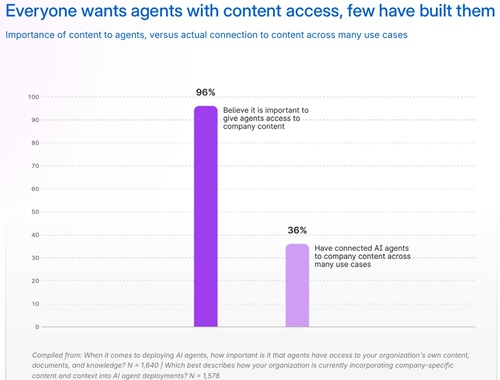
Between April 30 and May 8, researchers surveying 1,640 IT decision-makers across the United States, United Kingdom, France, and Japan uncovered the stark reality of this transition. While 96% of organizations surveyed agree that it is critical for agents to seamlessly access internal corporate content, only 36% have successfully built the technical bridges required to make this happen across multiple use cases.
This chasm between strategic aspiration and technical execution has created a dangerous operational limbo. Enterprises have unleashed powerful autonomous actors into environments characterized by legacy silos, disorganized document repositories, and ambiguous security permissions.
Supporting Context & Metrics: Unpacking the 2026 Enterprise Survey
The empirical data compiled by Box and The Harris Poll provides a granular map of the vulnerabilities, bottlenecks, and maturity divides defining the enterprise AI landscape today.
The Maturity Chasm: Leaders vs. Laggards
The report reveals a pronounced bifurcation between organizations at the bleeding edge of technological maturity and those lagging behind. When examining companies that self-identify as "leading edge" versus those classified as "early stage," the disparity in infrastructure readiness is stark:
- Multipurpose Content Integration: 42% of leading-edge organizations have successfully connected their AI agents to trusted internal content across multiple use cases. In contrast, only 17% of early-stage organizations have achieved the same milestone.
- Governance and Standards: Across the entire respondent pool, just 34% of organizations have established formal, institutional standards governing how AI agents are permitted to access, read, and modify corporate information.
- Security Incidents: The failure to establish these guardrails has exacted a heavy toll. Nearly 50% of all surveyed organizations reported experiencing an AI-related data exposure incident, underscoring that security vulnerabilities are no longer theoretical risks but active operational liabilities.
Anatomy of the Plumbing Problem: Why Content Infrastructure Fails
When IT decision-makers are asked to pinpoint the exact barriers preventing them from connecting agents to organizational content, the responses paint a picture of deep-seated technical debt. While overarching risk concerns form the initial line of defense, a dense web of data management failures lies directly beneath the surface:
- Security and Privacy Concerns (38%): Cited as the single most prominent barrier. Organizations are paralyzed by the fear that giving agents broad read/write access to internal files will inadvertently expose trade secrets, PII (Personally Identifiable Information), or regulated financial data.
- Regulatory and Compliance Burdens (29%): Navigating complex global frameworks—such as the European Union’s Artificial Intelligence Act, GDPR, HIPAA, and industry-specific financial regulations—makes organizations deeply hesitant to let autonomous software roam unmonitored through document archives.
- Data Fragmentation Across Systems (25%): Corporate knowledge is rarely centralized. It is scattered across disparate SaaS applications, legacy on-premises servers, local employee hard drives, cloud storage buckets, and communication platforms like Slack and Microsoft Teams. Agents struggle to traverse these fragmented digital islands without losing context.
- Integration Friction (24%): Tying modern AI agent frameworks into legacy enterprise resource planning (ERP), customer relationship management (CRM), and document management systems requires complex, costly, and brittle custom engineering.
- Missing Permissions and Access Controls (21%): Many organizations discover that their existing user permission structures are outdated, overly broad, or poorly enforced. Granting an AI agent access to a user’s credentials often inadvertently grants it access to thousands of documents the user has no business viewing.
- Poorly Organized or Classified Content (18%): Decades of haphazard file naming, lack of metadata tagging, and missing taxonomy mean that enterprise data stores resemble digital junk drawers rather than structured knowledge bases.
- Outdated or Low-Quality Content (16%): Agents fed on stale, inaccurate, or contradictory legacy documents rapidly generate flawed outputs, compounding operational errors at scale.
+-----------------------------------------------------------------+
|          PRIMARY BARRIERS TO AGENT-CONTENT INTEGRATION           |
+-----------------------------------------------------------------+
| Security & Privacy Concerns        [38%]                        |
| Regulatory & Compliance Burdens    [29%]                        |
| Data Fragmented Across Systems     [25%]                        |
| AI System Integration Difficulty   [24%]                        |
| Missing Permissions/Controls       [21%]                        |
| Poorly Organized/Classified Data   [18%]                        |
| Outdated/Low-Quality Content       [16%]                        |
+-----------------------------------------------------------------+
Official Perspectives: Shifting Paradigms in Enterprise Architecture
Industry analysts and corporate technology leaders agree that the findings of the 2026 State of AI in the Enterprise report mark a permanent turning point in how companies must approach digital transformation.

The Shift from Storage to Working Environments
For decades, enterprise content management (ECM) systems have functioned primarily as passive digital filing cabinets. Documents, contracts, spreadsheets, and technical reports were uploaded, tagged, stored, and retrieved strictly by human actors.
The report argues that the advent of agentic AI fundamentally redefines the nature of unstructured enterprise data:
"If the first phase of enterprise AI was defined by access to models, the next is defined by access to context."
Under the agentic paradigm, passive repositories must evolve into active, dynamic working environments. In these next-generation environments, AI agents do not merely retrieve static files; they actively read information, execute operational changes, write results back into the system, preserve contextual continuity across multi-step projects, and collaborate in real-time with human teams and other specialized sub-agents.
The Governance Imperative
To achieve this transition safely, organizations must dismantle the artificial wall that has long separated data security from artificial intelligence initiatives. Historically, IT departments treated AI model deployment and document storage as distinct operational domains.
Experts emphasize that this siloed approach is no longer viable. Enterprise agents require governance, auditing, identity management, and fine-grained permission controls that are baked directly into the content infrastructure itself. If an employee does not have permission to view a merger-and-acquisition document, an AI agent operating on that employee’s behalf must be programmatically barred from accessing it.

Without this tight coupling of identity, permission, and artificial intelligence, enterprises invite catastrophic data leakage, intellectual property theft, and regulatory non-compliance.
Future Outlook: Building the Next-Generation Enterprise AI Architecture
As organizations look toward the remainder of the decade, the roadmap for enterprise artificial intelligence is clear. The companies that successfully extract transformative value from agentic AI will not be those that simply license the most advanced frontier models, but those that systematically rebuild their foundational data plumbing.
1. Modernizing Content Architecture and Taxonomy
Enterprises must embark on comprehensive data hygiene initiatives. This involves auditing legacy repositories, establishing rigorous automated metadata tagging, cleaning out obsolete files, and centralizing fragmented knowledge stores into secure, interoperable cloud content platforms. Structured data is a prerequisite for reliable autonomous execution.
2. Enforcing Dynamic Access Control and Zero-Trust Frameworks
Security architectures must evolve to support machine-to-data interactions. Implementing robust Identity and Access Management (IAM) systems that extend seamlessly to AI agents is non-negotiable. Enterprises must adopt zero-trust principles, ensuring that agents operate under the principle of least privilege, with continuous auditing and real-time monitoring of all data read/write operations.
3. Bridging the Gap Between IT, Compliance, and Business Units
Overcoming the content infrastructure lag requires cross-functional alignment. Chief Information Security Officers (CISOs), Chief Compliance Officers (CCOs), and business unit leaders must collaborate to establish clear governance frameworks before deploying autonomous agents into production environments. Compliance cannot be an afterthought retrofitted onto broken data plumbing.
Conclusion
The message of the 2026 enterprise data landscape is unambiguous: Agents are only as good as the content they can safely reach.

While nearly all organizations recognize the imperative of connecting autonomous agents to internal institutional knowledge, only a fraction have built the secure, governed infrastructure required to do so. Bridging this gap will define the next era of enterprise technology leadership. Those who fix their plumbing will unlock unprecedented levels of automated productivity and operational intelligence; those who do not will find themselves navigating a minefield of data exposure, regulatory penalties, and operational failure.

