Securing the Autonomous Enterprise: Inside the Blueprint Alliance’s Quest for a Unified AI Agent Security Model
Asep Darmawan September 29, 2026 36 views 0 Comments
Executive Overview
The rapid deployment of artificial intelligence across corporate environments has introduced a profound paradigm shift: the rise of autonomous and semi-autonomous AI agents. Unlike static models that merely answer prompts, modern AI agents possess the agency to execute multi-step workflows, access internal databases, invoke external tools, interface with SaaS platforms, and communicate with other agents. While this capability unlocks unprecedented operational efficiencies, it simultaneously shatters traditional enterprise perimeter security.
An enterprise AI agent is rarely monolithic. In a typical modern corporate architecture, an agent might be architected within one proprietary framework, authenticated through a separate identity provider, granted access to tools and data hosted across diverse cloud services, and monitored by an entirely distinct security dashboard. This fragmented lifecycle has created a sprawling attack surface.
To address this mounting security crisis, identity and access management leader Okta has spearheaded the formation of the Blueprint Alliance. This high-profile industry coalition unites twelve founding technology giants—spanning cloud infrastructure, cybersecurity, data platforms, and enterprise software—to establish a shared, open reference architecture for securing AI agents across complex enterprise environments.
The founding members of the Blueprint Alliance include AWS, CrowdSight, Databricks, Docker, Google Cloud, Lovable, Okta, Proofpoint, Salesforce, ServiceNow, Wiz, and Zscaler. Additionally, major consumer and non-profit organizations GE Appliances and World Central Kitchen have signed on as strategic advisors to ground the initiative in real-world enterprise and humanitarian operational realities.
Rather than dictating how developers build the underlying models or applications, the Blueprint Alliance focuses squarely on governance, visibility, and unified control across diverse vendor boundaries. By leveraging established protocols like the Model Context Protocol (MCP), the Open Cybersecurity Schema Framework (OCSF), and the Shared Signals Framework (SSF), the Alliance aims to ensure that security telemetry can flow seamlessly across disparate enterprise tech stacks. This in-depth report explores the architectural foundations, strategic motivations, technical standards, and future outlook of the Blueprint Alliance as it attempts to secure the next generation of enterprise automation.
Detailed Chronology & Background: The Fragmentation of AI Security
The Shift from Static Prompts to Dynamic Agents
For the first two years of the enterprise generative AI boom, security concerns were largely focused on data leakage through user-facing chat interfaces. Organizations deployed data loss prevention (DLP) guardrails and content filters to prevent employees from pasting proprietary source code or confidential financial records into large language models (LLMs).
However, enterprise software architectures have evolved past simple request-response chat tools. Businesses are now rapidly deploying autonomous agents capable of performing complex administrative tasks, managing software development pipelines, orchestrating customer service workflows, and executing financial transactions. These agents utilize application programming interfaces (APIs), call external code repositories, and leverage Model Context Protocol (MCP) servers to interact directly with backend infrastructure.
The Multi-Vendor Disconnect
This transition brought to light a critical architectural flaw: the multi-vendor fragmentation of agent lifecycles. Because organizations rarely build their entire AI ecosystems within a single vendor’s walled garden, security teams face a labyrinthine puzzle:
Creation & Development: An internal team might build an agent using open-source frameworks hosted on GitHub and containerized via Docker.
Authentication & Identity: The agent’s identity and permissions might be managed through an identity provider like Okta or Azure AD.
Tool & Data Access: The agent accesses data stored in Databricks, interacts with customer records via Salesforce, and pulls internal documentation through custom enterprise APIs.
Monitoring & Auditing: Security telemetry may be captured by platforms such as Wiz, CrowdStrike, or Zscaler, each interpreting logs through proprietary taxonomies.
This operational siloship meant that if an agent’s behavior drifted maliciously—or if it fell victim to a prompt-injection attack that manipulated its API calls—no single security tool possessed total visibility over the agent’s complete operational path. Security teams were left blind, unable to trace an anomaly back to its source, revoke privileges in real-time, or contain rogue agent instances across disparate clouds.
Genesis of the Blueprint Alliance
Recognizing that no single vendor could solve this systemic fragmentation alone, Okta took the initiative to scale an internal framework into an open, multi-vendor reference architecture. The foundational discussions coalesced throughout 2025 and early 2026, leading to the formal announcement of the Blueprint Alliance. By bringing together hyper-scalers (AWS, Google Cloud), security heavyweights (CrowdStrike, Proofpoint, Wiz, Zscaler), enterprise platforms (Salesforce, ServiceNow), data infrastructure providers (Databricks), containerization leaders (Docker), and agile development platforms (Lovable), the Alliance established a coalition capable of enforcing end-to-end security standards across the entire enterprise technology stack.
Architectural Framework: The Four Pillars of Agent Security
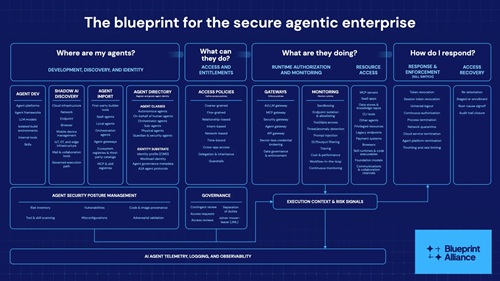
The core intellectual property of the Blueprint Alliance is its reference architecture, which cuts through complex enterprise toolchains by organizing agent security around four fundamental operational questions:
Where are my agents? (Discovery and Inventory)
What can they do? (Permissions, Access Control, and Capabilities)
What are they doing? (Runtime Telemetry, Monitoring, and Behavioral Auditing)
How do I respond? (Remediation, Containment, and Incident Response)
[Agent Lifecycle] ──> 1. Where are my agents? (Discovery & Inventory)
                      2. What can they do?   (Permissions & Capabilities)
                      3. What are they doing?(Runtime Telemetry & Monitoring)
                      4. How do I respond?   (Remediation & Containment)
1. Discovery and Inventory
Before an organization can secure its AI agents, it must locate them. Enterprise security teams frequently struggle with "shadow AI"—developers deploying local agents, scripts, and autonomous workflows without IT approval.
The Blueprint Alliance architecture spans the entire development and deployment lifecycle. According to the Alliance’s foundational whitepaper, the discovery mechanisms must encompass:
Command-line tools and local runtime environments.
By cataloging these components, the architecture ensures that visibility begins the moment an agent is conceptualized in a code repository and persists as it transitions into production.
2. Permissions and Access Control
Once agents are discovered, security teams must govern what resources they are authorized to access. Traditional identity and access management (IAM) assumes human users sitting behind screens. AI agents, however, operate at machine speed and can request context from thousands of files or APIs in seconds.
The Alliance architecture emphasizes strict boundary controls. It dictates that as agents move from development environments into production pipelines, their connections and permissions must remain clearly visible and strictly controlled. This prevents agents from inheriting over-permissioned access tokens that grant them sweeping authority across unrelated corporate databases or SaaS applications.
3. Runtime Telemetry and Monitoring
Passive configuration management is insufficient for dynamic AI agents. The architecture requires continuous, real-time logging of agent activities. Because agents interact with internal APIs, databases, and other downstream agents, their runtime behavior must be captured in standardized formats so security operations centers (SOCs) can detect anomalous patterns—such as unexpected data exfiltration, unusual command-line execution, or unauthorized tool invocation.
4. Remediation and Incident Response
The final pillar addresses the containment phase. When a security control point detects anomalous or malicious agent behavior, the architecture mandates automated mechanisms to neutralize the threat. This includes the ability to instantly revoke an agent’s access tokens, isolate its execution container, or terminate its communication channels before cascading damage occurs across the enterprise infrastructure.
Cross-Vendor Interoperability and Technical Standards
A major achievement of the Blueprint Alliance is its reliance on open standards rather than proprietary lock-in. To achieve cross-vendor operability, the initial reference architecture integrates several established protocols and security frameworks:
Model Context Protocol (MCP): Utilized for standardizing how agents interact with external tools, code repositories, and data sources. MCP ensures that tool-calling mechanisms remain uniform, regardless of which vendor hosts the underlying infrastructure.
Open Cybersecurity Schema Framework (OCSF): Adopted to normalize security telemetry. By translating agent activity logs into OCSF-compliant schemas, tools from different vendors (e.g., CrowdStrike, Wiz, Databricks) can read, parse, and analyze event data without translation bottlenecks.
Shared Signals Framework (SSF) and Continuous Access Evaluation Profile (CAEP): Employed for exchanging real-time risk intelligence across the enterprise stack. If one security control point detects a threat or behavioral anomaly, it can broadcast a shared signal via SSF/CAEP to other integrated platforms, triggering immediate, automated policy enforcement.
Through this interoperability, an anomaly detected by a network security layer (such as Zscaler) can instantly notify an identity platform (such as Okta) to revoke an authentication token, demonstrating a cohesive defense-in-depth model tailored specifically for autonomous systems.
Supporting Context, Metrics, and Strategic Insights
Implementation Strategy: Crawl, Walk, Run
Recognizing that enterprises cannot overhaul their entire security architecture overnight, the Blueprint Alliance whitepaper advocates for a phased implementation roadmap. Rather than attempting to deploy every governance control simultaneously, organizations are advised to start with foundational capabilities:
Phase 1 (Discovery & Logging): Establish unified logging, agent discovery pipelines, and centralized telemetry collection to gain baseline visibility into existing agent deployments.
Phase 2 (Policy Enforcement): Implement granular access controls, token management, and permission boundaries across developer toolchains and SaaS integrations.
Developer Perspectives: Handling Local and SaaS Agents
Founding member Lovable published a developer-oriented breakdown of the Alliance’s mission, highlighting the diverse nature of agent deployment models that modern enterprises must manage. According to Lovable, organizations face three distinct categories of agents that require unified governance:
Internally Built Agents: Custom-coded workflows developed in-house by engineering teams.
Locally Running Agents: Developer-driven scripts and local AI assistants executing on workstations or edge servers.
Bringing all three categories under a single, cohesive governance model is one of the primary hurdles the Blueprint Alliance seeks to overcome.
Official Statements and Industry Perspectives
The formation of the Blueprint Alliance has drawn widespread industry praise, reflecting the urgent market demand for standardized AI governance.
"An agent can be created in one system, authenticated through another, access tools and data from several others, and be monitored by yet another security platform. The Blueprint Alliance is focused less on how agents are built and more on how organizations can govern them consistently across vendor boundaries."
— Industry Analysis / Alliance Consensus
While specific cross-vendor performance benchmarks and integration timelines were not fully detailed in the initial launch announcement, founding members have committed to building and publishing reference integrations as the initiative progresses.
Strategic advisors such as GE Appliances and World Central Kitchen underscore the broad applicability of the framework. Whether managing global supply chains, manufacturing operations, or humanitarian logistics, organizations across every sector are increasingly reliant on multi-agent AI ecosystems that demand institutional-grade security.
Future Outlook: Challenges and Next Steps
As the Blueprint Alliance moves past its initial launch phase, several critical milestones and challenges lie ahead:
Integration Testing and Validation: The true test of the Alliance will be the practical execution of its reference integrations. Enterprise security teams will be watching closely to see how effectively products from competing vendors (such as AWS and Google Cloud, or CrowdStrike and Wiz) exchange telemetry and execute automated remediation in live production environments.
Timeline Transparency: While the architecture is currently available for community use via the Blueprint Alliance website, member-specific product integration timelines remain unannounced. Providing clear roadmaps will be essential for enterprise buyers planning their 2026 and 2027 security budgets.
Ecosystem Expansion: As more organizations adopt AI agents, the Alliance will need to expand its membership to include niche agent-development platforms, container security startups, and vertical-specific software vendors to ensure the standard remains universally applicable.
Conclusion
The Blueprint Alliance represents a mature, pragmatic response to the chaotic reality of enterprise AI deployment. By shifting the industry’s focus away from proprietary model wars and toward open, collaborative governance, Okta and its founding partners have laid the groundwork for a secure autonomous future. For enterprise security leaders, adopting the Alliance’s four-pillar architecture—Discovery, Permissions, Telemetry, and Remediation—offers a viable path toward harnessing the immense power of AI agents without compromising organizational integrity or data safety.