
Executive Overview
For decades, the holy grail of educational reform has been singular, highly personalized instruction. Decades of empirical research—most notably the foundational work of educational psychologist Benjamin Bloom—have consistently demonstrated the efficacy of what is known as the "2 Sigma Problem." Bloom discovered that students receiving one-on-one tutoring perform two standard deviations better than students learning in a traditional, lecture-based classroom environment.
Yet, translating this pedagogical breakthrough into widespread, systemic practice has perpetually run aground on a singular, intractable barrier: cost. Traditional high-dosage tutoring—defined as frequent, intensive, individualized or small-group instruction delivered by trained educators—is universally recognized as one of the most potent academic interventions available. It is also staggeringly expensive, logistically complex, and exceptionally difficult to scale across diverse, underfunded school districts.
Enter generative artificial intelligence. With the explosive rise of advanced Large Language Models (LLMs), the educational technology sector has positioned AI as the ultimate equalizer: a scalable, near-zero-marginal-cost engine capable of delivering personalized, synchronous tutoring to millions of students simultaneously.
However, as classrooms nationwide grapple with the digital transformation, a fierce debate has ignited at the highest levels of philanthropy, policy, and practice. Can artificial intelligence genuinely elevate student tutoring, or is it merely the latest ed-tech silver bullet destined to falter upon first contact with the messy, unpredictable reality of a physical school day?
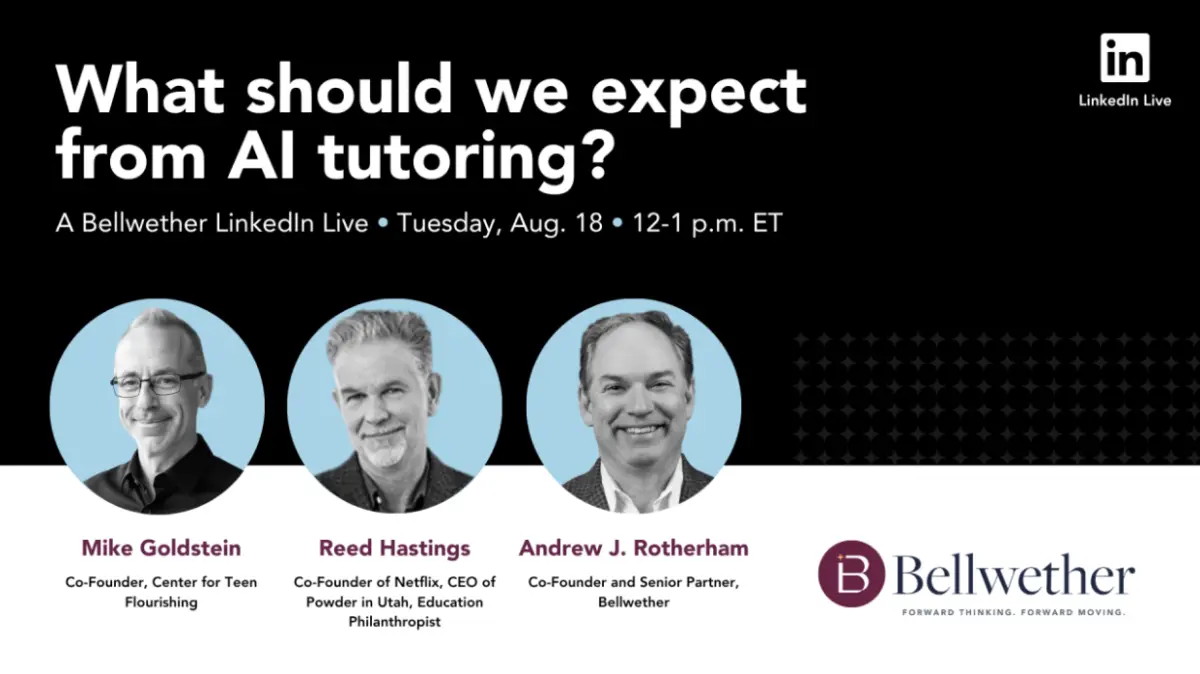
This critical question took center stage in a high-stakes dialogue moderated by Andrew Rotherham, co-founder of the national policy and research nonprofit Bellwether. The debate pitted two towering figures of education and innovation against one another: Reed Hastings, Netflix co-founder turned education philanthropist, and Michael Goldstein, a veteran tutoring pioneer.
While the broader educational landscape remains consumed by cyclical anxieties over screen time, academic loss recovery, and data privacy, this discourse zeroes in on a singularly promising—and deeply contentious—use case for artificial intelligence. This in-depth report examines the core arguments of the Hastings-Goldstein debate, analyzes the underlying economics and metrics of high-dosage tutoring, evaluates the irreplaceable nuances of human pedagogy, and provides an actionable roadmap for school and district leaders navigating the algorithmic frontier.
Detailed Chronology: The Evolution of Ed-Tech and the AI Tutoring Pivot
To understand the current polarization surrounding AI tutoring, one must trace the historical trajectory of educational technology over the past quarter-century. Each successive wave of innovation has promised to revolutionize learning, only to encounter severe limitations in practical application.
[Early 2000s: Digital Delivery] ---> [2010s: Adaptive Software Era] ---> [Present Day: Generative AI & LLMs]
- Basic Computer Labs                - Personalized Learning Platforms    - Conversational, Socratic Chatbots
- Drill-and-Practice Software         - Data-Driven Pacing                 - High-Dosage Tutoring at Scale
Phase 1: The Early Digitization Era (Early 2000s–2010s)
The dawn of the twenty-first century saw the introduction of basic computer-aided instruction. Classrooms transitioned from static textbook learning to rudimentary educational software. Programs focused primarily on drill-and-practice mechanics—digitizing multiple-choice quizzes and offering linear remediation pathways. While these tools successfully tracked student attendance and baseline metric completion, they lacked true adaptivity. They acted as digital worksheets rather than responsive intellectual partners.
Phase 2: The Adaptive Learning Wave (2010s)
As computational power grew and venture capital flooded the "ed-tech" sector, the industry shifted toward adaptive learning platforms. Companies like DreamBox, Knewton, and various digital curriculum providers promised algorithms that could dynamically alter a student’s learning trajectory based on real-time performance data.
Despite substantial investments by school districts, the results were mixed. While adaptive software proved useful for independent practice, it consistently struggled to replicate the motivational scaffolding and emotional intelligence provided by a human teacher. Students frequently disengaged from sterile, metric-driven interfaces, and teachers found the software difficult to integrate seamlessly into core instructional time.
Phase 3: The High-Dosage Tutoring Renaissance (Post-2020)
The COVID-19 pandemic induced an unprecedented academic crisis, resulting in historic drops in national math and reading proficiency scores. In response, federal COVID-19 relief funds (ESSER) catalyzed a massive, nationwide push toward high-dosage tutoring.
Research published by organizations like the National Student Support Accelerator confirmed that high-dosage tutoring—defined as three or more sessions per week during the school day with a consistent tutor—could largely recover lost learning. However, districts quickly confronted the fiscal cliff. Once federal relief funds expired, maintaining human-staffed tutoring programs proved economically unsustainable. Districts were forced to scale back or shutter programs just as students were beginning to rebound.
Phase 4: The Generative AI Disruption (Present)
The public release of transformer-based language models in late 2022 fundamentally disrupted the educational technology paradigm. Unlike previous iterations of software that operated strictly within rigid, pre-programmed decision trees, modern generative AI can engage in open-ended, contextual, and surprisingly empathetic dialogue.
This technological leap breathed new life into the dream of automated tutoring. For the first time, ed-tech developers could construct conversational agents capable of explaining complex mathematical proofs, parsing historical texts, and adjusting their instructional tone in real-time. This set the stage for the ideological clash between Reed Hastings and Michael Goldstein—a debate over whether these new digital tutors are powerful enough to bridge the chasm between educational ideal and financial reality.
Supporting Context & Metrics: The Economic and Pedagogical Reality
Evaluating the promise of AI tutoring requires a rigorous examination of the data surrounding traditional academic interventions, cost structures, and student engagement metrics.
The Economics of Human Tutoring
According to data compiled by educational economists, the cost of delivering high-dosage tutoring using human instructors typically ranges from $2,000 to $4,000 per student, per academic year. This calculation accounts for:
- Recruitment and background-checking of qualified personnel.
- Intensive pre-service and ongoing professional development.
- Wages, benefits, and administrative oversight.
- Logistical overhead (scheduling, space allocation, and technology infrastructure).
For a mid-sized school district serving 20,000 students, scaling high-dosage tutoring to reach just the bottom quartile of struggling learners (5,000 students) requires an annual investment of $10 million to $20 million. In an era of tightening municipal budgets and expiring federal stimulus funds, this expenditure is financially impossible for the vast majority of public school systems.
The Cost-Reduction Promise of Artificial Intelligence
Artificial intelligence proponents argue that LLMs offer a structural transformation of these unit economics. Once a specialized educational AI model is trained, fine-tuned, and safely deployed, the marginal cost of serving an additional student approaches zero.
- Software Licensing: Enterprise-grade educational AI platforms can be licensed for a fraction of human labor costs—often ranging from $50 to $200 per student annually.
- Infinite Scalability: An AI tutor does not require physical classroom space, sleep, or scheduling coordination. It is available 24 hours a day, 7 days a week, both inside the classroom and at the student’s home.
- Immediate Responsiveness: While human tutors must split their attention across small groups of two to four students, an AI model provides immediate, simultaneous, one-on-one attention to every single student in a classroom concurrently.
The Pedagogical Caveat: What the Data Shows About Engagement
However, cost efficiency is meaningless if the educational intervention fails to drive learning outcomes. Early empirical studies on AI-assisted learning reveal a nuanced picture:
- The Socratic Paradox: Standardized prompt engineering often causes AI models to simply give students the answer when pressed. Without strict algorithmic guardrails designed to force critical thinking (the Socratic method), AI tutors risk becoming sophisticated cheating engines rather than genuine instructional tools.
- The Engagement Gap: Younger students and adolescents alike display varying levels of trust and engagement when interacting with conversational bots. While tech-savvy students may readily embrace AI interfaces, others quickly experience chatbot fatigue or seek to bypass the learning process through prompt manipulation ("jailbreaking").
- The Equity Risk: Critics of the rush toward AI warn of a two-tiered educational future: wealthy private schools and suburban districts will afford premium, human-led tutoring models, while under-resourced urban and rural districts will be relegated to low-cost, algorithmic chatbot interventions.
Official Statements & The Hastings-Goldstein Debate
Moderated by Andrew Rotherham, the discourse between Reed Hastings and Michael Goldstein laid bare the central tensions of the modern educational technology movement. Below is a thematic synthesis of their competing philosophies.
Reed Hastings: The Optimistic Technologist
Reed Hastings approaches education through the lens of radical scalability and structural disruption. Known for transforming the entertainment industry via algorithmic streaming, Hastings argues that education must similarly leverage technology to overcome the physical limitations of the traditional classroom.
- On the Scaling Crisis: Hastings contends that human-centric educational models, while noble, are fundamentally bottlenecked by labor supply. "We do not have enough high-quality teachers and tutors in the world to provide every struggling child with the individualized attention they deserve," Hastings asserts. "To pretend otherwise is to abandon millions of children to systemic failure."
- On the Capabilities of AI: Hastings views current generative AI models not as static digital worksheets, but as rapidly evolving cognitive partners. He points out that the rate of improvement in LLM reasoning capabilities far outpaces traditional software development cycles. For Hastings, deploying AI tutoring is an ethical imperative to drive down costs and democratize access to elite-level academic support.
- On Pragmatic Adoption: Rather than waiting for a utopian, fully funded public school system, Hastings urges educational leaders to embrace imperfect technology immediately, iterating alongside developers to refine safety protocols and pedagogical effectiveness in real-time.
Michael Goldstein: The Pragmatic Realist
Michael Goldstein, speaking from extensive frontline experience as a tutoring pioneer and school operator, adopts a more cautionary posture. While acknowledging the severe constraints of human tutoring, Goldstein emphasizes the irreplaceable emotional and motivational architecture of human interaction.
- On the Limits of Chatbots: Goldstein argues that learning is fundamentally an emotional and social endeavor, not merely an intellectual exchange of information. "A student does not stay up late struggling with math because they love algebra; they push through because they trust, respect, and want to please a human adult who believes in them," Goldstein notes. "A chatbot cannot care whether a child succeeds."
- On Classroom Reality: Goldstein warns that ed-tech promises routinely fail when introduced into chaotic, under-resourced classrooms. Without comprehensive teacher training, robust infrastructure, and strict oversight, AI tools risk becoming digital babysitters that isolate students behind screens rather than fostering collaborative learning communities.
- On Quality Control: Goldstein cautions against the uncritical adoption of commercial AI products. He stresses that educational algorithms must be rigorously vetted by independent researchers to ensure they do not reinforce cognitive biases, generate fabricated information (hallucinations), or compromise student data privacy.
Future Outlook: A Strategic Roadmap for School Leaders
As artificial intelligence cements its presence in the educational ecosystem, school administrators, district superintendents, and policymakers face the complex challenge of separating genuine pedagogical innovation from marketing hype. The transition from experimental trials to systemic integration requires a disciplined, strategic framework.
+-------------------------------------------------------------------+
       STRATEGIC FRAMEWORK FOR AI INTEGRATION IN TUTORING
+-------------------------------------------------------------------+
  1. Pilot with Purpose   -> Restrict AI to specific, measurable gaps.
  2. Guardrails First     -> Enforce Socratic, anti-cheating logic.
  3. Hybrid Models        -> Pair AI scale with human empathy.
  4. Equity Audits        -> Ensure equal access across demographics.
  5. Teacher Empowerment  -> Train educators to manage AI tools.
+-------------------------------------------------------------------+
1. Shift from Replacement to Augmentation
District leaders must reject the false dichotomy that pits human teachers and tutors against artificial intelligence. The most promising path forward is not the wholesale replacement of human educators with conversational bots, but rather a hybrid model. AI can handle routine diagnostic assessments, initial concept explanations, and repetitive skill drills, freeing human tutors and teachers to focus on complex emotional support, motivational coaching, and nuanced critical thinking.
2. Implement Rigorous Algorithmic Guardrails
School systems purchasing AI tutoring platforms must demand total transparency from ed-tech vendors. Software must be explicitly programmed to utilize Socratic questioning techniques rather than providing direct answers. Furthermore, strict privacy protocols must be established to protect student data from being harvested or used to train commercial language models without explicit consent.
3. Prioritize Equity and Access
Policymakers must ensure that the deployment of AI tutoring does not widen the achievement gap. State and federal funding should be directed toward ensuring that Title I schools and low-income districts have access to the highest-tier, safely vetted AI tutoring infrastructure, alongside the necessary high-speed broadband and hardware required for seamless execution.
4. Invest in Professional Development
Technology is only as effective as the educator wielding it. School districts must allocate resources toward comprehensive professional development programs. Teachers must be trained not only in how to operate AI software, but also in how to interpret algorithmic diagnostic data, identify when a student is becoming over-reliant on a chatbot, and seamlessly blend digital tools into daily lesson plans.
Conclusion: Navigating the Frontier
The debate between Reed Hastings and Michael Goldstein ultimately highlights the fundamental tension defining modern education: the tension between the desperate urgency of scale and the irreplaceable intimacy of human connection.
Artificial intelligence will not single-handedly rescue public education from its structural challenges, nor will it eliminate the need for well-funded schools and dedicated teachers. However, when deployed with rigorous oversight, strategic humility, and an unwavering commitment to equity, AI tutoring offers a powerful mechanism to extend personalized academic support to the millions of students who need it most.
The task for school and district leaders today is clear: resist both the blind utopianism of tech evangelists and the reflexive cynicism of traditionalists. By engaging critically with the technology, establishing robust safeguards, and keeping the holistic development of the child at the center of every decision, education can harness the promise of artificial intelligence without losing its essential human soul.

