
Executive Overview
In the ever-evolving landscape of English language teaching (ELT), educators continually seek innovative methodologies to demystify core grammatical structures for learners at various proficiency levels. Among the foundational pillars of English syntax, the present continuous tense—frequently termed the present progressive—holds a position of critical importance. It serves as the primary linguistic vehicle for expressing actions unfolding in real time, temporary states of affairs, and evolving personal or global trends.
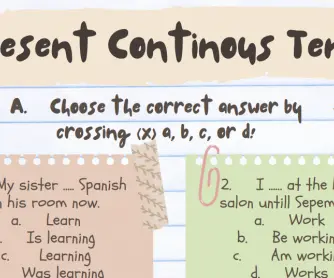
Recently, pedagogical resource hubs have seen a surge in specialized instructional materials targeting this exact construct. A prominent addition to this educational repository is a newly published pre-intermediate instructional module authored by educator Ayu Rahmi Kintan Jamil and hosted on the widely recognized platform BusyTeacher. Garnering substantial initial engagement—evidenced by over 44,000 views and a flawless five-star rating from early adopter reviews—this resource underscores a persistent demand for high-quality, practical grammar worksheets.
This investigative report provides an in-depth examination of the Jamil worksheet, analyzing its structural design, the underlying pedagogical principles of the present continuous tense, and its broader implications for English as a Foreign Language (EFL) and English as a Second Language (ESL) classrooms worldwide. By dissecting the mechanics of the tense alongside contemporary teaching trends, this article aims to offer educators, curriculum developers, and linguistic researchers a holistic view of how contemporary materials bridge the gap between abstract grammatical theory and engaging classroom practice.
Detailed Chronology: The Evolution and Release of the Jamil Resource
The pathway from conceptualization to the digital dissemination of modern educational worksheets represents a sophisticated interplay between digital content management, peer review, and community-driven quality control.
Phase 1: Conceptualization and Pedagogical Need
The genesis of the Jamil worksheet emerged from a recognized bottleneck in pre-intermediate English instruction. While beginner-level students grasp simple present structures (e.g., "I work every day"), transitioning to actions happening right now ("I am working right now") often introduces friction. Educators frequently report that students confuse stative verbs with dynamic verbs or struggle with the orthographic rules of adding the -ing suffix (such as dropping silent ‘e’s or doubling consonants). Recognizing this pedagogical gap, Ayu Rahmi Kintan Jamil engineered a targeted quiz and worksheet combination tailored specifically to consolidate these concepts.
Phase 2: Digital Upload and Metadata Indexing
In mid-2023, the resource was formally integrated into the BusyTeacher ecosystem under the grammar and present continuous categories. The administrative architecture of the platform immediately indexed the material:
- Target Audience Level: Pre-Intermediate (CEFR Level A2).
- Primary Focus: Grammar / Present Continuous Tense.
- File Specifications: A downloadable PDF document sized at 1.51 MB, accompanied by visual preview assets (specifically, screenshot-2023-06-02-at-12.17.45.png).
Phase 3: Community Review and Quality Assurance Iteration
Following its publication, the worksheet entered a dynamic phase of peer evaluation. Unlike static textbook publications, modern digital teaching resources rely heavily on crowdsourced feedback and interactive revision pipelines. The platform integrated an open-source revision framework via /engine/ajax/upload.revision.php, allowing educators who identify typographical errors or formatting anomalies to submit corrected files directly. Within its initial deployment window, the resource secured a maximum rating of 5 out of 5 stars from foundational teacher evaluations, signaling immediate utility and alignment with classroom needs.
Supporting Context & Metrics: Quantitative and Qualitative Analysis
To fully comprehend the significance of this instructional module, one must examine the broader quantitative data surrounding its reception and the linguistic framework it addresses.
Statistical Metrics Breakdown
- Total Views: 44,444+ (indicating exceptionally high digital visibility and organic search traffic within the EFL community).
- Target Proficiency Level: Pre-Intermediate. At this stage (typically corresponding to A2 on the Common European Framework of Reference for Languages), learners have moved beyond basic survival vocabulary and are actively constructing more complex, time-sensitive sentences.
- File Weight & Accessibility: Optimized at 1.51 MB, ensuring rapid download speeds even in regions with restricted bandwidth—a critical factor for international educators operating in diverse infrastructural environments.
- User Rating: 5/5 stars, validated through early teaching practitioner assessments.
Linguistic Anatomy of the Present Continuous
The instructional core of the Jamil worksheet reinforces fundamental grammatical rules that govern the present continuous tense. Linguistically, the tense is constructed through a compound predicate formula:
$$textSubject + textPresent Tense of "To Be" (am/is/are) + textBase Verb + text-ing$$
While the formula appears mathematically straightforward, its execution requires mastery across several cognitive dimensions:
- Subject-Verb Agreement: Ensuring that "I" pairs with am, singular nouns and third-person pronouns (he, she, it) pair with is, and plural nouns and pronouns (we, you, they) pair with are.
- Morphological Alterations: Applying the present participle suffix (-ing) correctly. This includes managing silent e deletions (make $rightarrow$ making), short vowel consonant-doubling (run $rightarrow$ running), and handling irregular transformations or vowel-consonant combinations (travel $rightarrow$ travelling in British English).
- Semantic Distinction: Differentiating between habitual actions (expressed via the Present Simple) and temporary or ongoing actions (expressed via the Present Continuous). For instance, contrasting "She plays the piano" (habitual skill or routine) with "She is playing the piano right now" (action in progress).
Official Statements and Pedagogical Perspectives
The release and reception of targeted grammar worksheets highlight evolving philosophies among language educators regarding how grammar should be taught in the 21st century.
The Role of Scaffolded Practice
EFL methodology experts emphasize that explicit grammar instruction must be followed immediately by controlled and semi-controlled practice. Speaking on the integration of digital worksheets into modern lesson plans, curriculum developers note:
"Resources like the Jamil present continuous worksheet bridge the vital gap between declarative knowledge—knowing what the rule is—and procedural knowledge—being able to apply it spontaneously in conversation or writing. At the pre-intermediate level, students cannot rely solely on intuitive language acquisition; they require targeted visual cues, contextualized sentences, and structured quizzes to solidify structural patterns."
Crowdsourced Quality Control in ELT
The inclusion of user-driven revision mechanisms on distribution platforms represents a paradigm shift in educational publishing. Traditionally, textbooks underwent multi-year revision cycles before errors could be corrected. Modern digital architecture allows for agile, community-policed improvements.
Platform maintainers and contributors advocate for this collaborative approach:
"By empowering teachers to correct and re-upload revision files directly, we eliminate the friction of traditional publishing. When 44,000 educators interact with a single grammar resource, collective oversight ensures that the pedagogical material remains pristine, accurate, and immediately responsive to the practical realities of diverse classrooms."
Future Outlook: The Trajectory of Digital Grammar Instruction
As educational technology continues to mature, the mechanisms through which students practice grammar—and teachers source materials—are undergoing profound transformation. Several key trends will shape the future of resources like the present continuous worksheet developed by Ayu Rahmi Kintan Jamil.
1. Integration of Artificial Intelligence and Adaptive Learning
While static PDF worksheets remain a staple of lesson planning due to their print-friendliness and universal compatibility, future iterations of grammar modules are increasingly incorporating interactive digital layers. Educators are moving toward hybrid models where printable worksheets are paired with automated grading scripts, AI-driven conversational bots, and adaptive quizzing software that adjusts difficulty based on student error patterns.
2. Contextualized and Content-Based Instruction
Future grammar worksheets are shifting away from isolated, decontextualized sentence-completion exercises toward thematic, content-driven modules. For the present continuous tense, this means embedding grammar practice within real-world scenarios, such as describing live-streamed events, analyzing dynamic infographics, or discussing rapidly changing global environmental trends. This contextual grounding enhances cognitive retention and makes grammar acquisition more meaningful.
3. Global Accessibility and Open Educational Resources (OER)
The staggering view counts associated with pre-intermediate grammar materials demonstrate a global hunger for accessible, high-quality Open Educational Resources. As digital connectivity expands to remote and underserved regions, platforms that offer free, downloadable, and easily modifiable lesson plans will play an instrumental role in democratizing English language education.
Conclusion
Ayu Rahmi Kintan Jamil’s present continuous worksheet, backed by robust community engagement and sound pedagogical foundations, exemplifies the enduring value of well-crafted instructional tools. By systematically addressing the complexities of the present progressive tense—from morphological rules to contextual application—such resources empower both educators and learners. As the educational landscape embraces digital agility and collaborative content creation, tools of this caliber will remain foundational to effective English language teaching for years to come.

