
Executive Overview
In the modern educational landscape, the integration of digital technology is often touted as the ultimate catalyst for student engagement. From one-to-one tablet initiatives to interactive whiteboards, EdTech has fundamentally shifted how lessons are delivered. However, a digital-first approach frequently collides with complex classroom realities.
Across schools globally, educators face a persistent friction point: device scarcity, strict "no-phone" policies that lock personal devices away in backpacks, and the unique accessibility needs of students for whom fast-paced, screen-based interfaces create sensory overload or anxiety. For children with developmental delays, special learning requirements, or sensory sensitivities, a high-speed digital competition can quickly transform from an engaging activity into an overwhelming hurdle.
Enter a paradigm shift championed by innovative educators and Kahoot! Teacher Ambassadors: engagement does not depend on a screen.
For years, a prevailing misconception has dictated that Kahoot!—a staple of interactive learning—only functions within a strict one-to-one device ecosystem where every student requires a gadget in hand to experience its trademark magic. Yet, the core appeal of Kahoot! has never truly been about the hardware; it has always been rooted in pedagogical design. At its heart, the platform provides a structured learning framework: clear questions, visual answer cues, predictable routines, shared anticipation, and joyful, immediate feedback.
By deconstructing this architecture, educators in device-restricted schools, special education programs, early childhood centers, and phone-free secondary campuses are proving that high engagement and low-tech environments are not mutually exclusive. Through thoughtful pedagogical adaptation, classrooms are discovering that the most powerful innovations do not always involve adding more technology—sometimes, they involve intelligently stripping it away.
Detailed Chronology: The Evolution of "Offline" Play
The journey toward unplugged and low-tech interactive learning did not happen overnight; it was born out of necessity, classroom adaptation, and grassroots teacher innovation.
Phase 1: The Device Bottleneck (Early Adoption to Mid-2010s)
When interactive quiz-based learning platforms first gained mainstream traction, their deployment relied heavily on the assumption of ubiquitous hardware. Schools invested heavily in computer labs, class sets of laptops, and later, one-to-one tablet rollbacks. However, budget fluctuations, maintenance cycles, and equity gaps meant that many classrooms were left behind. Teachers found themselves with brilliant digital tools but insufficient infrastructure to support them uniformly.
Phase 2: The Policy Pendulum (Late 2010s to Present)
Simultaneously, a cultural and administrative shift began sweeping secondary and primary education: the "phone-free school" movement. Citing concerns over distraction, cyberbullying, declining attention spans, and social isolation, school districts worldwide enacted stringent no-phone policies. While these measures successfully reclaimed instructional focus, they inadvertently locked teachers out of utilizing student-device ecosystems (BYOD – Bring Your Own Device models), forcing educators to abandon favorite digital engagement strategies.
Phase 3: The Pedagogical Awakening (The Teacher Takeover Era)
Recognizing the widening chasm between software availability and hardware access, pioneering educators—working in tandem with platform developers—began experimenting. Rather than viewing missing devices as a dead-end, teachers started reverse-engineering interactive lessons. They asked a fundamental question: What makes the learning experience compelling?
The answers pointed not to the glowing pixelated display, but to social dynamics, cooperative problem-solving, kinetic movement, and structural anticipation. This realization catalyzed the formal development and institutional support of unplugged, kinesthetic, and tactile adaptations of gamified learning, redefining how interactive software interacts with physical classroom spaces.
Supporting Context & Metrics: Accessibility, Inclusion, and Efficacy
To understand why unplugged and low-tech adaptations of interactive learning are experiencing a renaissance, one must examine the intersection of cognitive load theory, physical ergonomics, and educational equity.
Bridging the Equity Gap
Device disparities remain a silent disruptor in modern education. Schools in underfunded districts or rural areas frequently struggle to maintain functional hardware fleets. By decoupling gamified learning from individual student devices, educators level the playing field. Every student—regardless of socioeconomic background or school technology budgets—gains equal access to high-engagement pedagogical routines.
Catering to Diverse Learning Needs and Neurodiversity
While mainstream students often thrive on rapid-fire digital competition, the mechanics of timer-based, device-dependent quizzes can alienate neurodivergent learners.
- Sensory Sensitivities: Flashing lights, rapid audio cues, and constant screen flicker can trigger sensory overload in students with autism spectrum disorder (ASD) or sensory processing differences.
- Developmental Delays: Fine-motor control required to manipulate small touchscreens or keyboards can impede a student’s ability to demonstrate true cognitive understanding.
- Anxiety and Pressure: The live scoreboard effect—where ranking shifts dynamically—can induce performance anxiety, discouraging participation among hesitant learners.
Unplugged adaptations mitigate these barriers entirely. By shifting from individual competition to collective group-think or tactile manipulation, the cognitive pressure dissolves, fostering an inclusive environment where all learners can contribute meaningfully.
Official Strategies: Four Ways to Bring Kahoot! Beyond the Screen
Educators and Teacher Ambassadors have successfully formalized several robust, out-of-the-lobby methodologies that maintain the spirit of interactive learning without relying on individual hardware.
1. The Classic Unplugged Experience: Collaborative Content Review
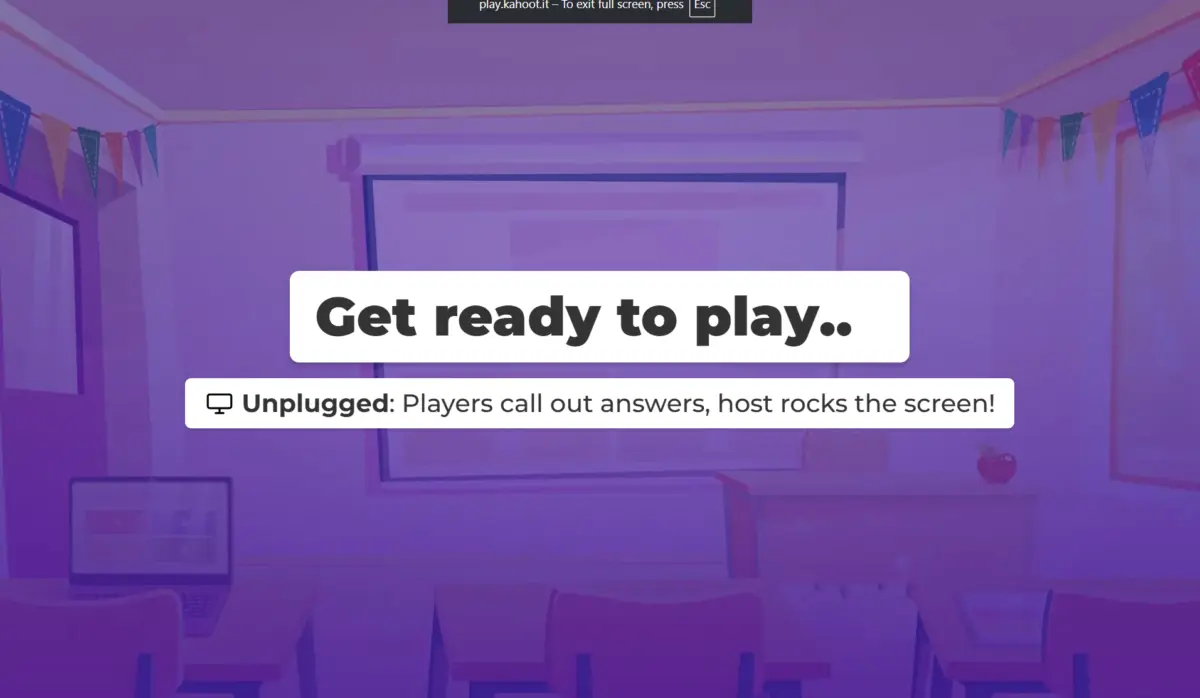
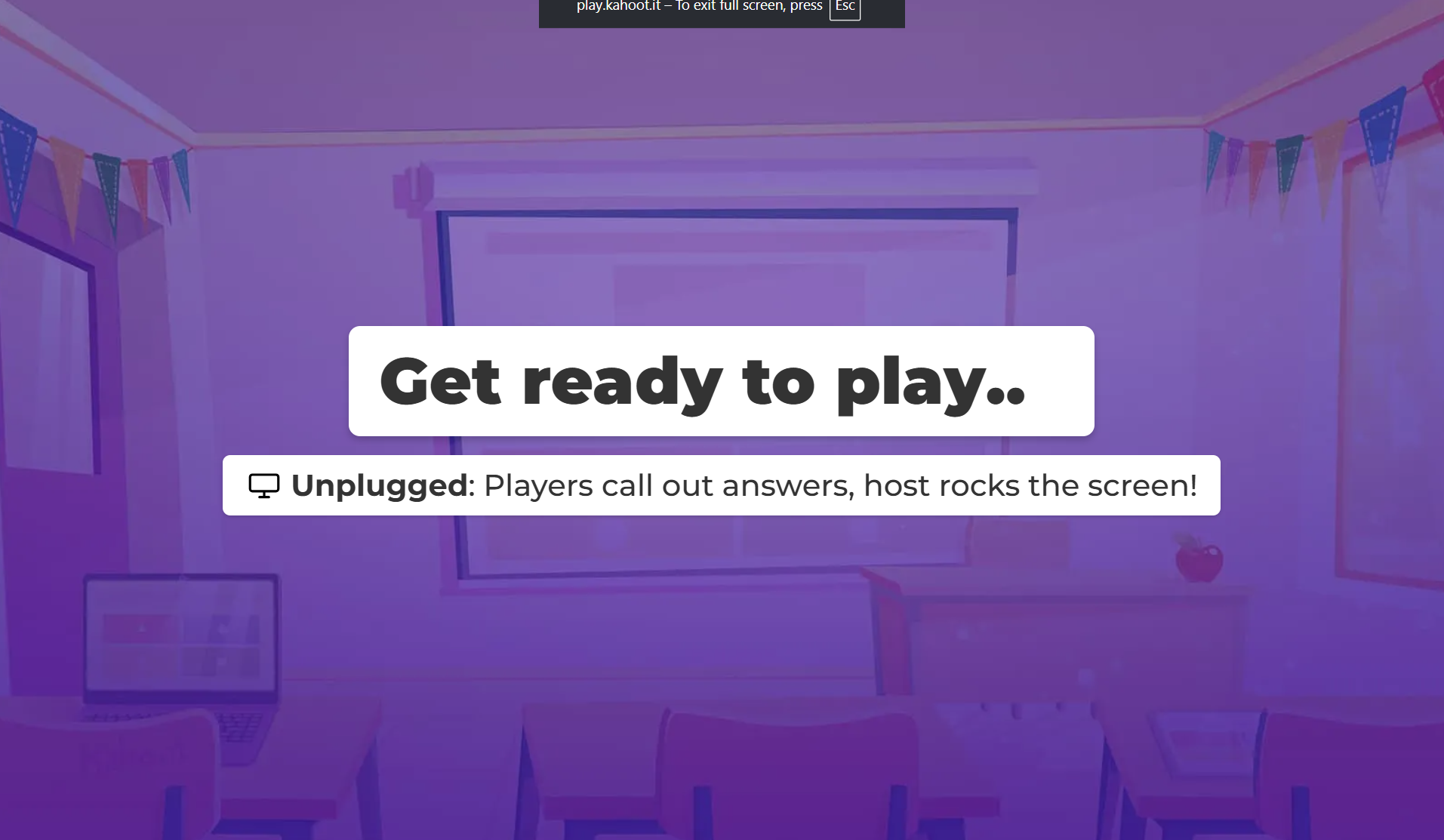
Designed explicitly for content review and formative assessment, the classic unplugged experience strips away individual competition and time pressure. Mirroring self-study modes, this format removes answer timers entirely.
- How it Works: The teacher projects the question and visual cues for the entire room to see. Instead of tapping on personal devices, students discuss the options collaboratively and call out their answers as a collective body.
- The Scoring Shift: There are no individual podiums or fierce ranking battles. Instead, the final screen celebrates the collective effort of the entire room, displaying a cumulative score out of total questions (e.g., 28 correct responses out of 30 total questions).
- Impact: This approach eliminates game PINs, technical delays, and device scarcity, allowing educators to instantly launch interactive reviews with zero preparation friction.
2. Kinesthetic Learning: Turning the Classroom into a Quiz Board
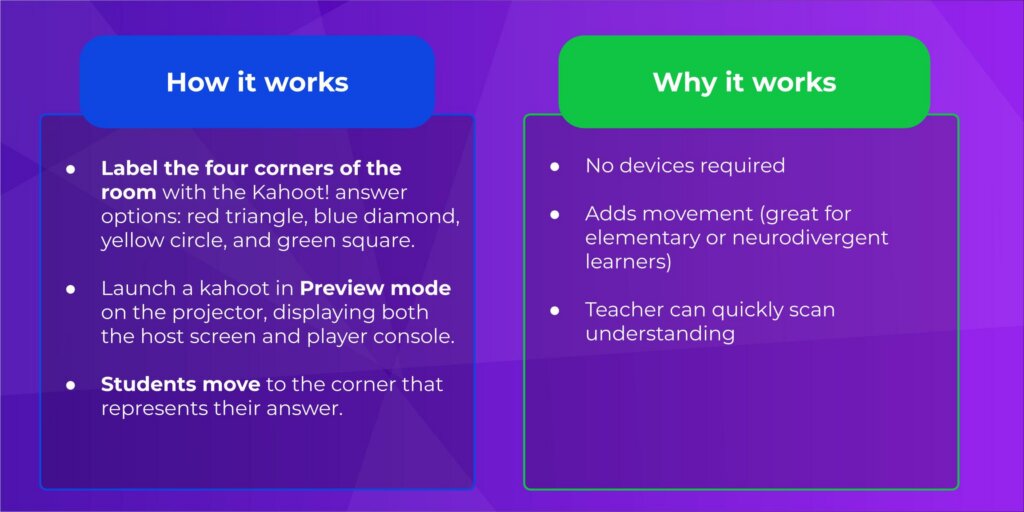
For classrooms needing physical activity and a mental reset, educators are transforming physical space into a giant multiple-choice grid.
- The Setup: The four corners of the classroom are designated as answer choices (A, B, C, D). Advanced or flexible question types can even incorporate fifth and sixth spatial zones.
- The Execution: When a question appears on the main screen, students physically walk to the corner of the room that corresponds to their chosen answer. The corner holding the highest concentration of students represents the class consensus, which the teacher then logs on the main dashboard.
- Pedagogical Benefit: This method delivers a dual benefit: students receive a much-needed kinesthetic brain break, and the group-think protocol removes personal performance pressure. Students learn collectively, tracking progress and course-correcting misconceptions in real time.
3. The "Gallery Walk": Student Autonomy and Self-Paced Mastery
When curriculum sequencing is flexible and topics can be explored independently, the Gallery Walk format serves as a powerful differentiated adaptation.
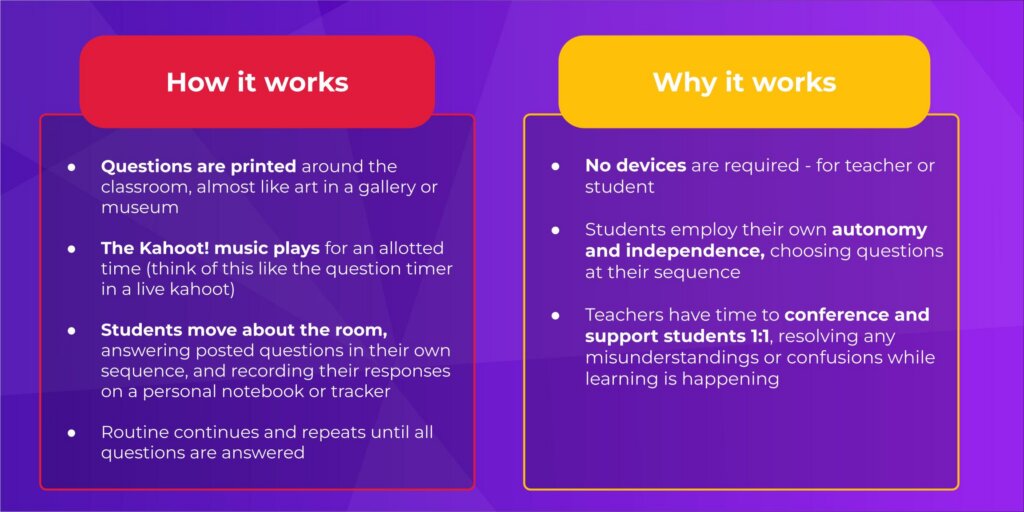
- The Execution: Question cards derived from lesson modules are posted around the room. Students—either individually or in assigned pairs—move through the stations at their own pace, analyzing prompts, discussing answers, and formulating conclusions.
- Permanent Artifacts: Unlike fleeting digital chat logs, a Gallery Walk produces a tangible, permanent record of student learning and collaborative discourse.
- Blended Extension: To reinforce mastery, teachers can assign the digital equivalent of the same Kahoot! as homework, blending physical classroom exploration with digital review.
4. Tactile Storyboards: Integrating Motor Skills and Executive Functioning
Particularly effective in early childhood education, special education, and occupational therapy settings, physical Kahoot! storyboards marry academic curriculum with physical skill development.
- The Execution: Teachers or students create physical cards featuring questions, prompts, and visual answer choices. The physical manipulation—sorting, arranging, adding, and separating question cards—exercises fine-motor skills and executive functioning.
- Efficiency: In packed school schedules where instructional time is precious, this dual-purpose approach allows educators to target academic standards simultaneously with occupational and physical education goals.
Future Outlook: The Hybrid Classroom of Tomorrow
As educational technology continues to mature, the definition of "innovation" is undergoing a healthy maturation. The future of interactive learning is not exclusively digital, nor is it strictly analog; it is a fluid, intentional hybrid model.
Educational leaders anticipate that platform developers will increasingly build native, low-tech features directly into software suites—bridging the gap between software architecture and offline execution. By recognizing that engagement is fundamentally a human social phenomenon rather than a hardware dependency, schools are future-proofing their teaching strategies.
Ultimately, the successful classrooms of tomorrow will be those where technology serves as a flexible tool rather than an absolute prerequisite. Whether accessed via a state-of-the-art tablet, projected onto a classroom wall for a collective shout-out, or arranged across physical desks in a tactile storyboard, the core mission remains unchanged: making learning awesome, accessible, and inclusive for every single student.

