

Executive Overview
The architecture of enterprise risk is undergoing a profound, foundational transformation. According to the Cloud Security Alliance’s (CSA) landmark Top Threats to Cloud Computing Survey Report 2026, the fundamental concerns dominating cloud computing have shifted away from traditional infrastructure flaws toward higher-level operational, human, and programmatic vectors. For years, technical oversights like infrastructure misconfigurations reigned supreme as the primary threat to enterprise cloud integrity. However, the 2026 survey results—compiled from the insights of 507 qualified cybersecurity professionals evaluating 23 distinct threat vectors—reveal that Identity and Access Management (IAM) has officially seized the number-one spot.
Even more notably, the modern threat landscape has been reshaped by the rapid commercial adoption of generative and predictive artificial intelligence, with two AI-centric risk categories making their historic debut within the elite Top 11 rankings. Alongside surging concerns over insecure software supply chains, third-party resources, and Application Programming Interfaces (APIs), these findings illustrate a clear evolution in cyber risk. Enterprise security strategies are no longer being challenged solely by weak hypervisor boundaries or unpatched virtual machines, but rather by the very mechanisms meant to grant access, automate processes, and connect disparate digital ecosystems.
This comprehensive report examines the data behind the CSA 2026 findings, analyzes the architectural and business implications of the shift from infrastructure to identity and artificial intelligence, compares historical shifts since 2024, and provides a blueprint for security leaders navigating this complex new frontier.

Detailed Chronology and Methodology of the 2026 Threat Ranking
To understand the weight of the 2026 findings, one must examine the rigorous methodology deployed by the CSA Top Threats Working Group. The organization surveyed 507 cybersecurity experts, risk management practitioners, compliance officers, and enterprise architects globally. Participants evaluated 23 distinct cloud security issues on a weighted matrix, ultimately distilling the data into a definitive Top 11 list.
The resulting scores across the top tier were remarkably tight. The highest-ranked issue scored 7.95, while the eleventh-ranked issue scored a formidable 7.45. This narrow margin indicates that modern enterprise security teams do not face one or two isolated vulnerabilities; rather, they are besieged by a dense, interconnected matrix of overlapping risks.
Evolution from 2024 to 2026: A Comparative Analysis
A direct comparison between the CSA’s 2024 benchmark report and the 2026 data highlights the velocity at which the cyber threat landscape moves. While the CSA cautions that the rows in its transition charts do not serve as rigid one-to-one numerical translations—owing to the introduction of newly defined threats and retiring of legacy concerns—the overarching trajectory is unmistakable:
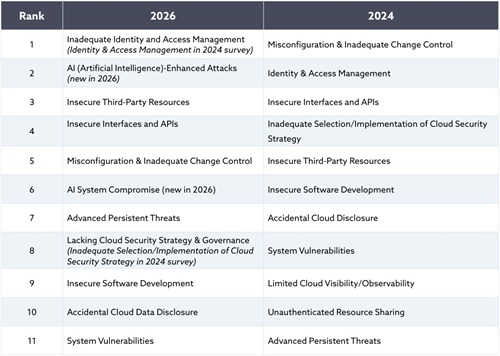
- Identity and Access Management (IAM): Climbed from the No. 2 position in 2024 to claim the crown at No. 1 in 2026.
- Misconfiguration and Inadequate Change Control: The reigning champion of the 2024 report dropped notably to No. 5 as automated security guardrails and Infrastructure-as-Code (IaC) scanning tools began to mature across organizations.
- Insecure Third-Party Resources and Software Supply Chains: Rose aggressively from No. 5 to No. 3, reflecting the deep dependencies modern cloud-native applications maintain on external code repositories, open-source libraries, and SaaS integrations.
- Advanced Persistent Threats (APTs): Surged from No. 11 to No. 7, demonstrating that nation-state actors and sophisticated cybercrime syndicates are increasingly embedding themselves into cloud environments rather than targeting on-premises assets.
- Artificial Intelligence: Made its unprecedented entry into the rankings, with two distinct AI-related threat classifications entering the Top 11 for the first time in the history of the series.
Conversely, issues traditionally viewed as existential infrastructure threats—such as Denial-of-Service (DoS) attacks, shared technology vulnerabilities, cloud service provider (CSP) data loss, unauthenticated resource sharing, and limited cloud visibility/observability—were pushed out of the Top 11 entirely. This displacement demonstrates a collective industry realization: while hyperscale cloud providers have vastly improved the underlying security, resilience, and visibility of their physical hardware and foundational infrastructure, the responsibility for securing programmatic access, data logic, and operational layers rests squarely on the shoulders of the consumer.
Supporting Context, Data, and Metrics
The implications of the 2026 CSA report extend far beyond theoretical risk modeling; they mirror real-world operational challenges reported by security operations centers (SOCs) globally.
The Ascendancy of Identity as the New Perimeter
As enterprises complete their migrations to multi-cloud and hybrid environments, the traditional network perimeter—once defined by firewalls and physical datacenters—has completely dissolved. In its place, Identity has become the new perimeter.

The elevation of IAM to the top spot is driven by the sheer proliferation of human and non-human identities (service accounts, API keys, roles, and automated agents) interacting with cloud resources. Attackers have largely pivoted away from brute-forcing hardened network perimeters to simply compromising valid credentials. Once an adversary acquires a privileged identity, their actions mimic legitimate administrative behavior, effectively bypassing legacy perimeter defenses. The integration of complex federated identity management, multi-factor authentication (MFA) bypass techniques, and overly permissive IAM roles has turned identity governance into the most critical vulnerability vector in the modern enterprise.
The Artificial Intelligence Vector
For the first time, artificial intelligence is not merely a tool evaluated for operational efficiency or defensive security automation; it is officially codified as a primary surface of vulnerability. The inclusion of AI-related threats in the Top 11 underscores the rapid, often unsecured deployment of Large Language Models (LLMs), machine learning pipelines, and automated AI agents within enterprise workflows.
Organizations rushing to capitalize on generative AI capabilities frequently deploy unvetted models connected directly to internal databases, APIs, and sensitive customer data repositories. This introduces novel attack surfaces—such as prompt injection, training data poisoning, model inversion, and unauthorized data exfiltration via AI wrappers—that traditional application firewall rules and endpoint detection and response (EDR) agents are ill-equipped to handle.

The Supply Chain Disruption
Ranking at No. 3, insecure third-party resources reflect the modern architectural reality of cloud-native development. Modern applications are rarely written from scratch; instead, they are assembled like digital skyscrapers using thousands of commercial, open-source, and proprietary components. A single compromised software package, malicious npm or PyPI library, or vulnerable API integration can compromise an entire cloud environment. The 2026 data emphasizes that an organization’s security posture is only as strong as its weakest vendor or third-party dependency.
Official Insights and Strategic Implications
The findings published in the Top Threats to Cloud Computing Survey Report 2026 are explicitly tailored to guide executive management, compliance officers, risk management professionals, and chief information security officers (CISOs) through strategic planning and governance investment.
According to the Cloud Security Alliance, the targeted audience for this research must utilize the individual threat analyses—which encompass detailed technical and business impacts, key takeaways, real-world case studies, and corresponding CSA security controls—to recalibrate their defense frameworks.

Bridging the Technical and Business Divide
A key takeaway from the 2026 report is that cloud security threats can no longer be treated as isolated IT problems. The migration of identity, AI, and software supply chain issues to the forefront of the rankings demonstrates that security failures carry immediate, catastrophic business impacts:
- Financial Impact: Identity compromises and supply chain breaches frequently result in massive regulatory fines under frameworks like GDPR, HIPAA, and emerging SEC cybersecurity disclosure rules, alongside direct operational downtime and extortion payouts.
- Reputational Damage: Loss of consumer trust resulting from AI data leaks or unauthorized data access can permanently cripple brand equity.
- Operational Disruption: Advanced Persistent Threats utilizing compromised cloud resources can halt business operations for weeks while incident responders perform forensic containment and eradication.
Consequently, executive leadership must align governance investments directly with these findings. Budget allocations must shift away from obsolete hardware-level protections toward advanced Identity Governance and Administration (IGA), continuous IAM auditing, Software Bill of Materials (SBOM) automation, and rigorous AI governance frameworks.
Future Outlook: Navigating the 2026 Threat Horizon
As organizations look toward the remainder of the decade, the insights provided by the Cloud Security Alliance serve as both a warning and a strategic roadmap. The rapid maturation of cloud computing has eliminated many historical operational friction points, but it has simultaneously unlocked vastly more sophisticated vectors for malicious actors.

Strategic Recommendations for Enterprise Security Leaders
- Zero Trust Architecture (ZTA) as a Baseline: Given that identity has claimed the top threat spot, organizations must aggressively implement Zero Trust principles. "Never trust, always verify" must be applied to every human and non-human identity, enforcing strict principle-of-least-privilege (PoLP) policies, continuous session monitoring, and phishing-resistant MFA across all cloud tiers.
- Comprehensive AI Governance and Guardrails: Before deploying generative AI or machine learning models into production cloud environments, security teams must establish rigorous AI safety protocols. This includes implementing secure API gateways for LLMs, sandboxing AI execution environments, sanitizing training data, and auditing third-party AI service providers for compliance and data privacy standards.
- Software Supply Chain Visibility: To combat the rising threat of insecure third-party resources, enterprises must mandate comprehensive Software Bills of Materials (SBOMs) for all cloud-native applications. Automated dependency scanning and continuous vulnerability management must be integrated directly into the CI/CD pipeline to intercept compromised code before it reaches production.
- Continuous Risk Prioritization: Security programs must evolve from static compliance checklists to dynamic, threat-informed defense models. By regularly mapping their internal telemetry against the CSA Top 11 framework, security leaders can effectively prioritize resource allocation, ensuring that investments directly mitigate the most prevalent and damaging vectors identified by global industry experts.
In conclusion, the CSA 2026 report marks a definitive turning point for cloud security. By acknowledging that the battleground has shifted from physical and infrastructural misconfigurations to the fluid realms of identity, artificial intelligence, and interconnected ecosystems, organizations can successfully fortify their digital futures against the threats of tomorrow.

