
Executive Overview
Every educator is intimately familiar with the invisible fracture that can occur midway through a math lesson. Within a single classroom of twenty-five students, a silent divergence unfolds. Some learners grasp abstract concepts instantly, eager to leap ahead into the next unit. Meanwhile, others struggle, lacking essential foundational skills from two or three grade levels prior. Consequently, the teacher’s daily lesson plan—designed for the mythical "average" student—often builds upward on a foundation of shifting sand.
The core challenge of responsive teaching has never been a lack of educator effort. Rather, it is the logistical impossibility of delivering truly differentiated instruction within the confines of a single, unified class period. Crafting twenty-five distinct learning paths, managing individualized sequences, and establishing separate performance goals for every student can quickly overwhelm even the most dedicated teacher.
To resolve this systemic friction, educational technology platforms are evolving beyond simple gamified quizzes. Enter Kahoot! Math Games and Math Missions—a suite of targeted digital learning tools engineered specifically to diagnose misconceptions in real-time, scaffold learning paths, and deliver adaptive K-5 practice. By automating the identification of foundational gaps and providing low-stakes, highly engaging interventions, these tools aim to restore confidence and build genuine number sense without requiring hours of manual curriculum preparation.
Detailed Chronology of the Classroom Divide and Technological Intervention
The Anatomy of the Classroom Divide
The modern K-5 mathematics classroom has long wrestled with the tension between standardized pacing and heterogeneous student abilities. Historically, educators relied on traditional grouping strategies—pulling small groups to the back table while the rest of the class worked on static worksheets. While well-intentioned, this model frequently created a bottleneck. Students working independently often stalled when encountering a concept they didn’t fully grasp, while advanced learners finished early and lacked deeper extension tasks.
Recognizing this operational bottleneck, educational researchers and platform developers began focusing on how game mechanics could isolate specific cognitive roadblocks. Rather than treating math as a monolith of right-or-wrong answers, developers mapped out the exact junctures where students historically trip up:
- The transition from counting to understanding quantity.
- The shift from rote memorization of multiplication tables to structural array comprehension.
- The conceptual leap from splitting physical shapes to plotting fractions on a number line.
The Integration of Targeted Interventions
The rollout of Kahoot! Math Games introduced a modular approach to these historical pain points. Instead of a one-size-fits-all quiz, educators could deploy specialized mini-games designed to address precise learning gaps before beginning a new unit.
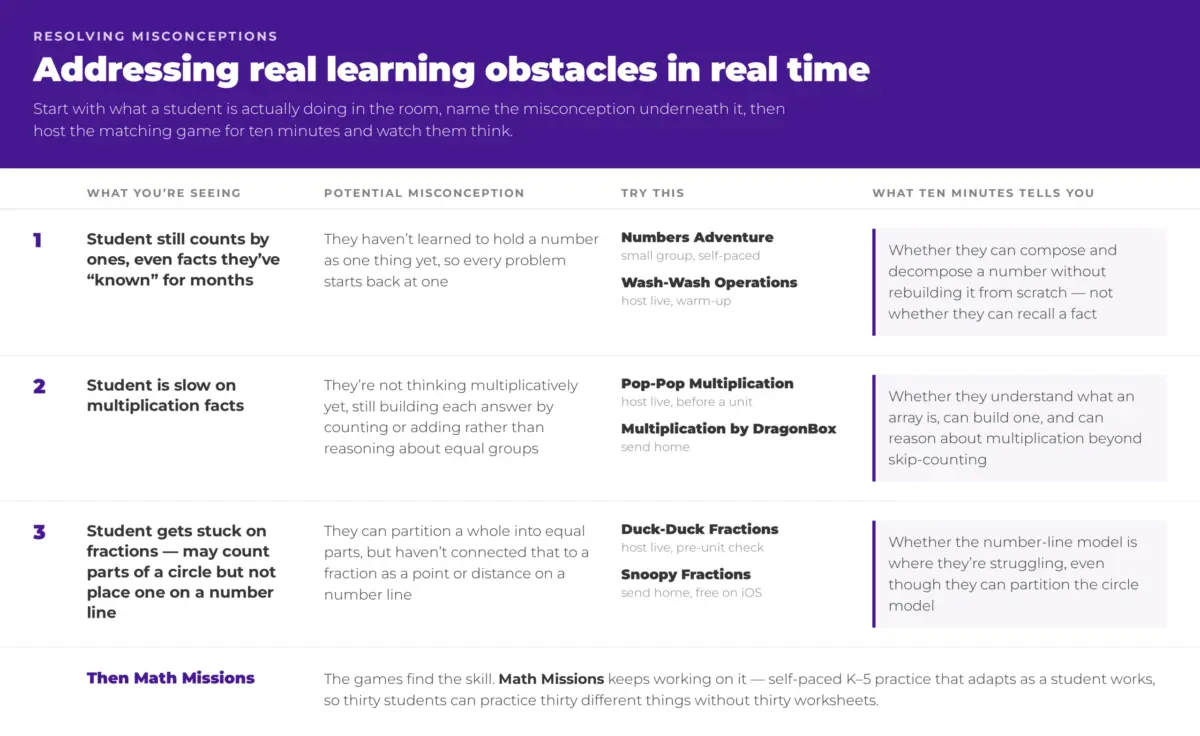
- Phase 1: Diagnostic Pre-Assessment. Teachers host a ten-minute live session (such as Wash-Wash Operations or Duck-Duck Fractions) to gauge the classroom’s baseline understanding. Students log in via standard game pins, transforming a diagnostic check into an energetic warm-up.
- Phase 2: Targeted Remediation. Students who reveal specific struggles are routed to self-paced, narrative-driven solo adventures—such as Numbers Adventure—allowing them to rebuild foundational number sense without the anxiety of public failure or peer observation.
- Phase 3: Adaptive Independent Practice. Through Math Missions, students enter an infinite loop of self-paced, K-5 practice that dynamically adjusts difficulty levels based on real-time performance data, freeing the teacher to move freely around the room and provide targeted one-on-one coaching.
Supporting Context & Metrics: Unpacking Three Core Misconceptions
To understand why traditional teaching methods often fail to bridge student gaps, one must examine the cognitive mechanics underlying early math development. Kahoot!’s curriculum design targets three specific misconceptions that frequently derail academic progress.
1. The Misconception of Count vs. Quantity
The Problem: When a young learner cannot hold the abstract concept of quantity firmly in their head, every subsequent mathematical operation demands exponentially more cognitive effort, time, and emotional resilience. A fourth-grade student who still relies on finger-counting possesses an incomplete foundation. This deficit inevitably cascades into multiplying multi-digit numbers and simplifying complex fractions.
- The Intervention: Numbers Adventure provides a progression of short, self-paced solo sessions focusing strictly on counting and comparing quantities. Because the adventure is structured into discrete worlds and levels, students requiring foundational support can dwell in earlier stages discreetly. Meanwhile, whole-class warm-ups utilizing Wash-Wash Operations engage students in manipulating quantities rather than merely reciting memorized facts.
2. The Misconception of Multiplication Without Structure
The Problem: When students view multiplication merely as a list of facts to memorize rather than an arrangement of equal groups, their mathematical reasoning stalls. Slow recall during early math drills is rarely just a memorization problem; it is a structural comprehension issue that resurfaces later in algebraic reasoning and fraction scaling.
- The Intervention: Hosting Pop-Pop Multiplications live transforms abstract numbers into visual spatial problems. Students drag characters into an interactive play area to physically build arrays, forcing them to conceptualize multiplication as structural geometry. This is followed by home assignments in Kahoot! Multiplication by DragonBox to reinforce fluency. By utilizing an array model, educators can easily differentiate between a student who simply lacks drill memorization and one who fundamentally misunderstands the multiplicative process.
3. The Misconception of Shapes vs. Number Lines
The Problem: Most elementary students can successfully cut a paper circle or physical shape into equal slices long before they can accurately place that same fractional value as a distinct point on a linear number line. This cognitive disconnect between area models and linear measurement is where fraction anxiety officially begins.
- The Intervention: Duck-Duck Fractions serves as an intuitive pre-unit diagnostic check. Teachers select a playlist and a duration of up to ten minutes. As students interact with the game, educators can observe who hesitates when transitioning from circular partitions to number lines—revealing distinct underlying misconceptions. Subsequent home practice via Snoopy Fractions gives struggling learners the extended exposure they need in an accessible format.
Official Statements and Global Perspectives
The integration of adaptive technology into everyday lesson planning has drawn praise from educators worldwide who grapple with the realities of mixed-ability classrooms.
Ika M., a certified Kahoot! Ambassador based in Indonesia, emphasizes the practical utility of continuous diagnostic tools in fast-paced school environments. Reflecting on her experience using Math Missions for post-lesson review, she notes:
"It can be useful for identifying which concepts students have understood and which areas may need further explanation or practice. It makes mathematics practice feel more like an active learning experience rather than a traditional worksheet or quiz, and it can be integrated into a lesson without requiring a lot of additional preparation."
According to educational administrators and instructional coaches, the sustainability of any classroom innovation ultimately depends on its preparation overhead. Tools that require hours of custom lesson building or grading rarely survive a demanding ten-month academic calendar. By embedding formative assessment seamlessly into gameplay, platforms like Kahoot! bridge the gap between rigorous pedagogical standards and teacher bandwidth.
Furthermore, educational specialists point out that self-paced modules like Math Missions help foster crucial student autonomy. When learners engage in purposeful, targeted practice during independent centers, they develop metacognitive skills—learning to recognize their own areas of hesitation and taking ownership of their academic recovery.
Future Outlook: The Evolution of Responsive Mathematics Instruction
As school districts increasingly embrace hybrid learning models and personalized education plans, the demand for intelligent, low-overhead adaptive tools will only accelerate. The future of mathematics instruction lies in moving away from rigid, lock-step curriculums toward fluid, data-informed pathways that adapt in real time to the cognitive needs of every child.
Platforms are poised to expand their capabilities beyond static game sets, leveraging advanced diagnostic analytics to automatically assign interventions the moment a student displays a recurring misconception. In doing so, technology can lift the administrative burden off teachers, transforming them from managers of compliance into true facilitators of mathematical thinking.
Ultimately, solving the classroom divide is not about working harder or lengthening the school day. It is about deploying the right tools at the exact moment of need—ensuring that every student, regardless of their starting point, has access to the structural foundation required for lifelong mathematical fluency.
Kahoot!’s complete suite of math games, standards-aligned tagging, and comprehensive reporting dashboards are currently accessible via the Kahoot! web platform and mobile app, with advanced instructional features available through Kahoot! EDU and Kahoot!+ school and district subscription plans.

