
Executive Overview
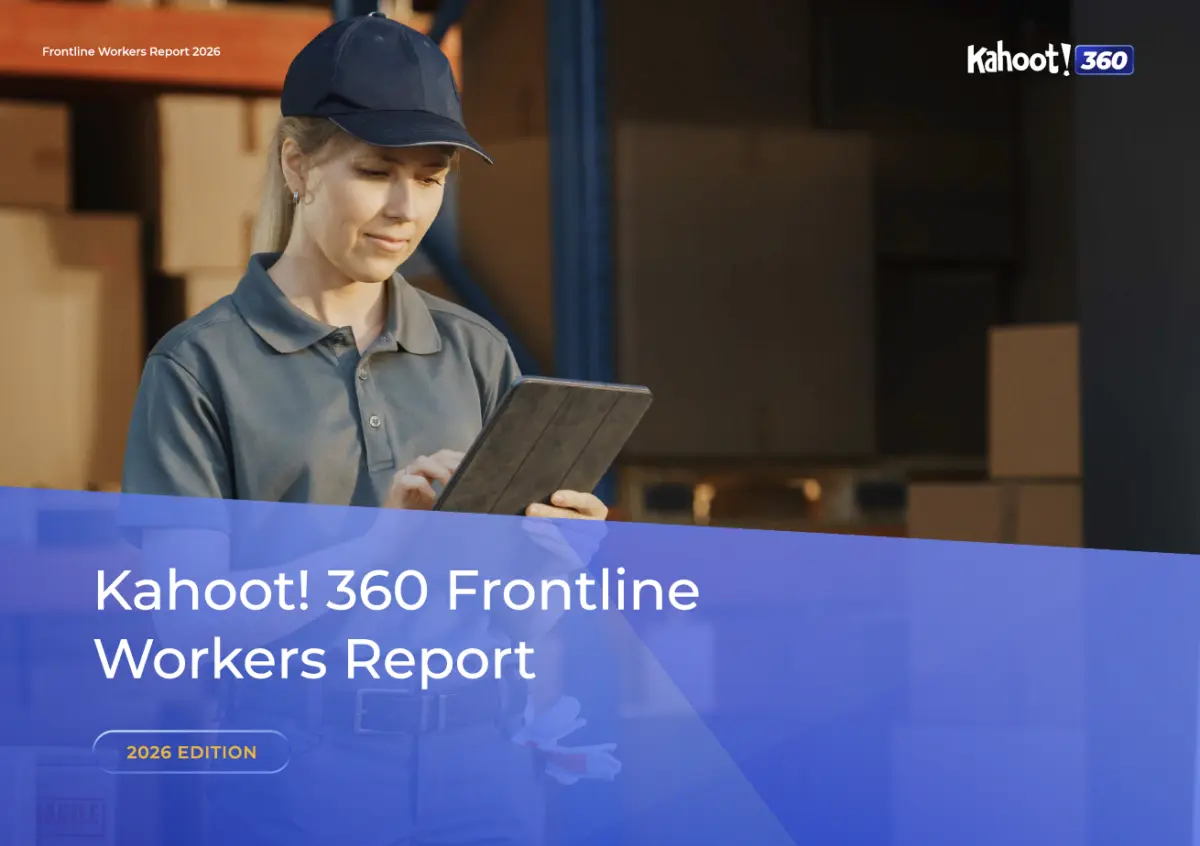
Frontline workers are the undeniable backbone of our daily lives and organizational ecosystems. From the nurses managing critical care in emergency rooms and the educators shaping young minds in classrooms to the delivery drivers navigating complex logistics networks to stock our shelves, these individuals are the face of modern enterprise. They deliver indispensable services while directly representing their organizations to the public under high-pressure conditions. Yet, despite their vital contributions, a glaring disconnect persists between corporate expectations and frontline reality. A concerning number of employees report that their organizations are falling dangerously short of providing the essential tools, continuous support, and foundational training necessary to succeed.
These findings form the core of the newly released Kahoot! 360 Frontline Workers Report, a comprehensive study based on a September survey of 4,000 frontline workers across the United States and the United Kingdom. The report paints a stark picture of an overworked, under-supported workforce facing mounting workplace pressures. More alarmingly, it highlights systemic training deficiencies that not only drive high employee turnover but also present severe safety risks to both workers and the general public.
However, the report is not merely a diagnostic of workplace malaise; it offers a strategic roadmap for transformation. By debunking persistent corporate myths—such as the assumption that frontline roles are merely transient stepping stones—and advocating for continuous, accessible learning models powered by platforms like Kahoot! 360, the research charts a clear path toward stronger engagement, enhanced performance, and long-term retention.
Detailed Chronology: The Evolution of the Frontline Crisis
To understand how modern organizations arrived at this precarious juncture, it is necessary to examine the trajectory of frontline employment over recent years, culminating in the critical data captured in the 2026 report.
The Shift from Essential Heroism to Chronic Underinvestment
During the global disruptions of the early 2020s, frontline workers were universally lauded as essential heroes. Organizations rushed to implement emergency communication channels, temporary hazard pay, and public acknowledgments of gratitude. However, as the immediate crisis faded and global markets transitioned into a permanent state of economic and operational volatility, corporate focus shifted back to cost-cutting and efficiency metrics.
Over the subsequent years, organizations increasingly leaned on lean staffing models without proportionally scaling their investments in employee enablement. Training budgets—traditionally vulnerable during economic tightening—were increasingly digitized into superficial, check-the-box e-learning modules or entirely neglected due to fast-paced operational demands. By mid-2026, the cumulative effect of this neglect reached a tipping point, setting the stage for the comprehensive survey conducted by Kahoot! 360 in September 2026.
The September 2026 Survey: Uncovering the Ground Reality
Polling 4,000 frontline professionals across diverse industries in the US and UK, the September 2026 survey was designed to pierce through corporate assumptions and capture the unfiltered voices of employees on the ground. The research methodology targeted individuals whose daily responsibilities require physical presence, direct public interaction, or operational execution outside of traditional corporate office environments.
The data gathered in this study marked a significant milestone in workplace research, providing empirical evidence that organizational failure to support frontline staff is not an isolated administrative oversight, but a systemic crisis with far-reaching consequences for public safety, economic stability, and corporate reputation.

Supporting Context & Metrics: The Human and Operational Cost
The numbers revealed in the Kahoot! 360 Frontline Workers Report quantify what many workers have long argued: the modern frontline is operating under dangerously strained conditions. The metrics detailed in the study demand immediate attention from executive leadership and human resources professionals alike.
The Training Deficit: A Threat to Safety and Productivity
Perhaps the most alarming revelation of the report centers on the systemic lack of adequate training provided to personnel tasked with complex, high-stakes responsibilities:
- 58% of frontline workers report having been asked to carry out a task without receiving the relevant training. This indicates that improvising through critical procedures has become an accepted, albeit hazardous, operational norm.
- 37% of workers surveyed received zero formal training of any kind over the preceding 12 months. This points to a stagnant professional environment where skill development is entirely absent.
These training gaps are far from benign operational inefficiencies; they carry profound human costs. When workers are thrust into roles without proper preparation, safety margins evaporate:
- More than 1 in 4 workers (26%) candidly admit that inadequate training has directly contributed to a mistake that could have caused physical harm to a customer, patient, passenger, or member of the public.
- 22% of respondents state that insufficient training has put their own physical safety—or that of a direct colleague—at serious risk.
These figures challenge the traditional corporate calculus that views training as an expendable overhead cost. In frontline environments, the price of under-training is measured not just in lost productivity, but in compromised human safety and eroded public trust.
The Retention Crisis: The Exodus from the Frontline
Compounding the training deficit is an alarming propensity for employee churn. The survey reveals that 39% of frontline workers are actively thinking about leaving their jobs within the next 12 months.
Employees attribute this looming exodus to a toxic convergence of financial strain, mounting burnout, and a pervasive lack of professional support. For years, executive leadership has often shrugged off high frontline turnover as an inevitable cost of doing business—a natural byproduct of low-barrier-to-entry jobs. However, the Kahoot! 360 report challenges this fatalistic assumption with a striking counter-metric:
- 62% of frontline workers view their current role as a long-term career, rather than a temporary stepping stone to something else.
This disconnect exposes a critical strategic flaw in organizational thinking. Many employers decline to invest heavily in frontline training because they operate under the mistaken belief that workers are uninterested in long-term growth within these roles. In reality, the opposite is true. When employees are denied proper training and career development, they feel unprepared, undervalued, and ineffective. This manufactured professional stagnation breeds frustration, which ultimately drives them to seek better opportunities elsewhere, thereby validating the self-fulfilling prophecy of high turnover.
Official Insights & Strategic Implications
Analyzing the data from the Kahoot! 360 Frontline Workers Report requires looking beyond the statistics to understand the underlying behavioral and operational shifts necessary for modern enterprises to thrive. Industry analysts and workplace culture experts point to several key takeaways.
Dismantling the Myth of the "Transient Worker"
The finding that nearly two-thirds of frontline staff view their positions as long-term careers forces a complete overhaul of how talent management is structured for non-desk employees. Historically, corporate learning and development (L&D) budgets have been heavily skewed toward corporate headquarters, executive leadership tracks, and desk-bound knowledge workers.
By treating frontline workers as transient commodities, organizations inadvertently foster an environment of disengagement. Experts emphasize that treating frontline roles as career destinations requires a fundamental philosophical shift: employers must invest in continuous upskilling, clear career progression pathways, and robust support systems that honor the professional aspirations of their staff.
The Imperative of Continuous, Accessible Learning
Traditional training models—such as hauling workers into a conference room for an annual, multi-hour compliance seminar or forcing them through tedious, desktop-based modules at the end of a grueling shift—are fundamentally unsuited for the realities of frontline work. Frontline employees operate in dynamic environments where they must make rapid decisions, adapt instantly to changing conditions, and act independently.
Consequently, organizations experiencing the highest levels of success are abandoning the concept of training as a one-off, isolated event. Instead, they are weaving learning directly into the daily workflow. Modern workforce engagement platforms like Kahoot! 360 have emerged as vital tools in this transition, bridging the gap between corporate headquarters and decentralized teams. By providing easily digestible, bite-sized information that employees can access anywhere using mobile devices or tablets, these platforms fit seamlessly into busy work schedules. Whether through live, interactive sessions that foster team connection and collaboration or asynchronous, self-paced training modules, modern technology ensures that knowledge is always within arm’s reach when it is needed most.
Future Outlook: Empowering the Frontline of Tomorrow
As organizations look toward the future, the mandate for executive leadership is clear: the operational model that relies on under-trained, unsupported frontline staff is unsustainable. Bridging the gap between employee potential and corporate support is no longer just an HR initiative—it is a baseline requirement for business continuity, risk mitigation, and brand reputation.
To successfully navigate the challenges highlighted in the Kahoot! 360 Frontline Workers Report, organizations must commit to a three-pronged forward-looking strategy:
- Audit and Overhaul Training Protocols: Executive leadership must immediately review current onboarding and continuous education programs. Training cannot be treated as a checkbox exercise; it must be rigorous, relevant, and directly tied to the real-world safety and operational challenges workers face every day.
- Embrace Technology-Driven Flexibility: By leveraging advanced employee communication and engagement applications, organizations can democratize access to information. Empowering workers with on-demand, mobile-friendly learning tools ensures they are never left guessing in high-stakes situations.
- Invest in Long-Term Career Pathways: Recognizing that the majority of frontline staff view their work as a career rather than a temporary job allows organizations to align their retention strategies with employee ambitions. Providing clear pathways for growth, backed by continuous learning support, transforms disengaged workers into deeply committed brand advocates.
Ultimately, the health of any organization is directly mirrored by the empowerment of its frontline workers. By addressing training deficits, respecting long-term career aspirations, and deploying modern engagement tools, businesses can transform their frontline operations from a source of operational risk into their greatest competitive advantage.
To dive deeper into the data, explore the complete findings, and discover actionable strategies for your organization, read the full Kahoot! 360 Frontline Workers Report.

