
Executive Overview
In the realm of early childhood education and foundational literacy development, few hurdles prove as persistent—or as critical to master—as navigating the erratic behavior of English consonants. Among the most notorious offenders are the letters c and g. While novice readers are initially introduced to these graphemes through their reliable hard sounds (as heard in cat and goat), they quickly encounter a linguistic labyrinth where the same letters adopt entirely different phonetic personalities.
To bridge the gap between basic decoding and fluent reading comprehension, literacy specialists emphasize the mastery of phonics generalizations. A newly released, no-cost educational resource—the Soft C and G Phonics Puzzles developed by reading specialist Becky of This Reading Mama—aims to demystify these rules for developing readers. By transforming abstract spelling patterns into interactive, hands-on puzzles, this initiative provides educators and parents with an engaging pedagogical tool designed to reinforce soft consonant generalizations.
This report provides an exhaustive examination of the phonological science underpinning soft c and g sounds, analyzes the pedagogical framework of the newly introduced puzzles, explores complementary no-prep classroom materials, and assesses the broader implications of targeted phonics instruction in contemporary primary education.
Detailed Chronology: The Evolution of Phonics Instruction and Consonant Generalization
Understanding why children struggle with soft c and g requires a brief look at the history of English orthography and how reading instruction has evolved over the past several decades.
The Historical Roots of Soft Consonants
English is a Germanic language heavily influenced by Latin, Old Norse, and Norman French. Because of this linguistic cross-pollination, its spelling system is notoriously deep (opaque), meaning there is not always a one-to-one correspondence between letters and sounds.
In Old English, the letter c was primarily pronounced as a hard /k/. However, following the Norman Conquest of 1066, French scribes introduced spelling conventions that shifted the pronunciation of c and g when they preceded front vowels (e, i, and y). Over centuries, these sounds palatalized—shifting from the back of the mouth forward—to create the soft c sound (/s/, as in city) and the soft g sound (/j/, as in giant).

The Shift Toward Systematic Phonics
For much of the late 20th century, reading instruction swung between "whole language" approaches and explicit phonics. However, modern educational consensus—backed by extensive cognitive science and the "Science of Reading" movement—has decisively returned to explicit, systematic phonics instruction.
In this contemporary framework, teaching children why words are spelled and pronounced in specific ways is paramount. Rather than forcing students to memorize words by sight entirely, educators rely on phonics generalizations. The introduction of tools like the Soft C and G Phonics Puzzles represents the latest evolution in this timeline: creating tangible, gamified ways for students to internalize historical spelling rules through kinesthetic and visual learning.
Supporting Context & Metrics: Decoding the Rules of Soft C and G
To fully appreciate the utility of the new puzzles, one must examine the mechanics of the phonics rule they target.
Hard Versus Soft Sounds: The Phonetic Breakdown
When children begin their reading journey, they learn the most common, reliable sounds associated with each letter. These are known as base or hard sounds:
- Hard C: Represents the voiceless velar plosive /k/, as heard in cat, cup, and coat.
- Hard G: Represents the voiced velar plosive /g/, as heard in goat, gum, and game.
However, proficiency requires recognizing when these letters undergo a morphological shift:
- Soft C: Represents the voiceless alveolar sibilant /s/, as heard in city, face, and nice.
- Soft G: Represents the voiced postalveolar affricate /j/ (often spelled as "dge" or "g"), as heard in giraffe, gem, and age.
The Golden Phonics Generalization
The operational rule governing these shifts is one of the most reliable generalizations in the English language:

When the letter c or g is immediately followed by the vowels e, i, or y, they typically make their soft sounds.
Phonics instructors often summarize this for young learners with simple catchphrases like "The magic e, i, y make c and g say their other name."
Notable Exceptions
In literacy instruction, exceptions are just as important to teach as rules, preventing student frustration when anomalies arise. While the e, i, y rule holds true the vast majority of the time, notable everyday exceptions include:
- Gift: Begins with a hard g, despite being followed by an i.
- Girl: Begins with a hard g, despite being followed by an i.
- Get, give, and gear: Additional common Germanic-origin words where g remains hard before an e or i.
Understanding these metrics allows educators to design targeted interventions, ensuring students do not over-generalize or become discouraged by anomalies.
Pedagogical Framework: Inside the Soft C and G Phonics Puzzles
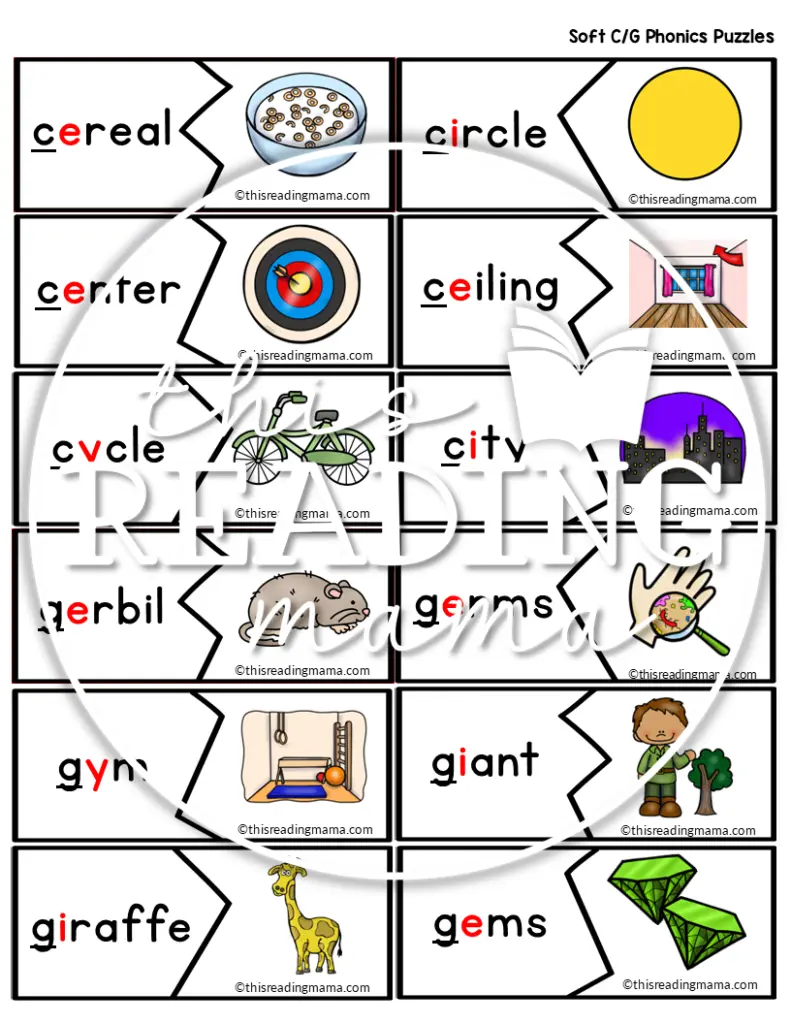
The newly released Soft C and G Phonics Puzzles are designed to address the sensory and cognitive needs of young learners. Developed by Becky, a veteran educator and creator behind This Reading Mama, the puzzles target students who have moved past basic CVC (consonant-vowel-consonant) words and are tackling more complex decoding challenges.
Design and Usability
The puzzles utilize a multi-sensory approach. By requiring students to physically match puzzle pieces—connecting words, images, or letter patterns—the activity engages fine motor skills alongside cognitive decoding.

- Visual Supports: Each puzzle incorporates clear imagery, helping visual learners anchor abstract phonetic concepts to concrete objects (e.g., matching the word city or giraffe to its corresponding illustration).
- Low-Prep Efficiency: Recognizing the time constraints placed on teachers and homeschooling parents, the materials are structured for immediate deployment. They require minimal cutting and preparation, making them ideal for literacy centers, small-group interventions, or independent morning work.
Complementary Resources: The No-Prep Pages
To reinforce the concepts introduced in the puzzles, the curriculum links directly to companion resources, such as the No Prep Hard and Soft C and G Pages. These supplementary worksheets offer scaffolded practice, allowing students to transition from tactile puzzle-solving to pencil-and-paper application, sorting words into "Hard" and "Soft" categories to solidify their analytical skills.
Official Statements and Expert Perspectives
While the digital education space is flooded with unvetted worksheets, structured literacy advocates have praised resources that ground themselves explicitly in phonics generalizations rather than rote memorization.
In releasing the materials, the creator emphasized the necessity of making foundational rules accessible:
"It doesn’t take long for learners to notice that when they happen upon the letter c or the letter g, these letters can represent more than one sound… I’m sharing these free puzzles today so that learners can practice this skill in a way that feels playful, yet deeply grounded in phonetic reality."
Educational researchers who champion the "Science of Research-Based Reading Instruction" note that interactive sorting and puzzling tasks reduce cognitive load. By isolating the variable sound patterns of c and g away from dense reading passages, students can dedicate 100% of their working memory to mastering the specific grapheme-phoneme correspondence.
Future Outlook: The Trajectory of Primary Literacy Interventions
As educational standards continue to evolve toward rigorous, evidence-based practices, the demand for high-quality, targeted phonics resources is projected to surge.

The Integration of Gamified Learning
Future iterations of literacy tools are expected to lean heavily into the hybrid model demonstrated by these puzzles: blending tactile, manipulative gameplay with rigorous linguistic rules. Educators are moving away from passive worksheet drills in favor of dynamic sorting exercises that promote active cognitive processing.
Empowering Educators and Parents
With literacy rates remaining a focal point of educational reform globally, empowering both classroom teachers and homeschooling parents with free, accessible, and scientifically grounded tools is critical. Resources like the Soft C and G Phonics Puzzles demonstrate that high-value educational interventions do not need to be cost-prohibitive.
By continuing to demystify complex rules through creative design, developers can help foster a generation of confident, highly proficient readers equipped to tackle the eccentricities of the English language with ease.

