
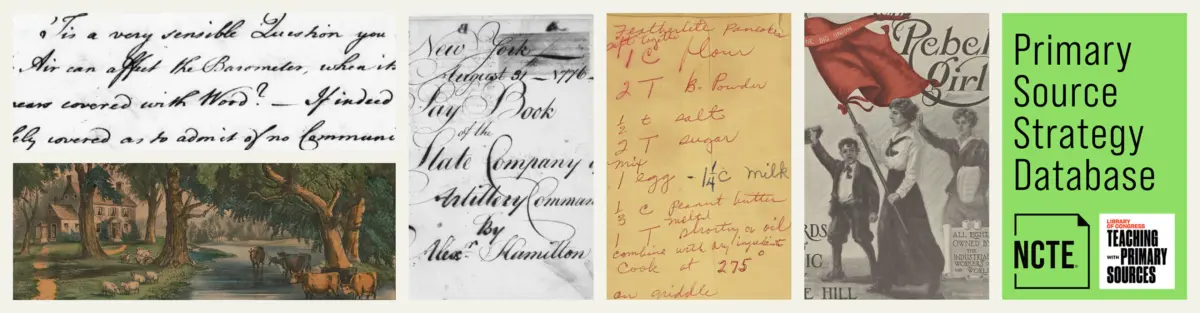
Executive Overview
In an era defined by an overwhelming abundance of digital information, the ability to critically analyze historical artifacts has never been more vital. Bridging the gap between historical archives and contemporary classrooms, the National Council of Teachers of English (NCTE) has forged a dynamic, forward-thinking collaboration with the Library of Congress. Operating as an active participant in the prestigious Teaching with Primary Sources (TPS) Consortium, the NCTE is spearheading an ambitious initiative designed to fundamentally reshape how literacy educators and students interact with primary source materials.
At the core of this partnership is a newly launched, fully searchable digital database featuring expertly crafted instructional strategies tied to more than 150 specific artifacts drawn directly from the Library of Congress’s vast digitized holdings. Developed through the rigorous, collaborative efforts of over two dozen leading English language arts educators and curriculum specialists, this repository does more than simply compile historical curiosities. It deliberately anchors them to modern educational frameworks, complete with articulated literacy merits, thematic suggestions, unit pairings, and alignments with state learning standards.
By embedding tools that allow educators to filter content via intuitive tags—such as picturebook and argument—the initiative dismantles traditional barriers to archival research. It empowers teachers to cultivate critical thinking, media literacy, and historical empathy. More importantly, this partnership addresses a profound systemic need in modern pedagogy: the intentional diversification of historical narratives. By elevating marginalized voices, spotlighting overlooked innovators, and interrogating historical periodicals like Denver’s historic The Statesman, the NCTE and the Library of Congress are providing educators with the pedagogical scaffolding necessary to build inclusive, equitable, and intellectually rigorous classrooms.
Detailed Chronology: The Evolution of the TPS Consortium and the NCTE Initiative
To understand the weight and trajectory of the current NCTE-Library of Congress partnership, it is essential to trace the historical evolution of how primary sources transitioned from the dusty basements of specialized archives into the vibrant, dynamic center of K-12 education.
Phase One: Laying the Foundation for Primary Source Integration
For decades, the use of primary sources—original documents, photographs, maps, letters, and artifacts created during the period under study—was largely restricted to advanced high school history courses or university-level research. General literacy classrooms treated reading instruction as a technical skill isolated from historical inquiry, focusing heavily on modern, canonical fiction and sanitized textbook summaries.
Recognizing this siloed approach, the Library of Congress established the Teaching with Primary Sources program to help educators tap into the immense educational potential of its multi-million-item digital collections. The program gradually scaled into a nationwide network known as the TPS Consortium, bringing together universities, school districts, and educational organizations dedicated to professional development and resource creation.
Phase Two: Forging the NCTE Alliance
As the TPS Consortium expanded, the Library of Congress recognized that true educational transformation required deep integration not just within social studies classrooms, but across English language arts (ELA) and literacy instruction. Reading comprehension, argumentative writing, and rhetorical analysis are inherently tethered to primary text evaluation.
Entering this space, the NCTE mobilized its vast network of literacy leaders. Over the course of intensive curriculum development sprints, more than two dozen educators, instructional coaches, and ELA scholars convened to review, curate, and strategize around artifacts from the Library of Congress. Their mandate was clear: bridge the gap between raw historical data and actionable, standards-aligned literacy instruction.
Phase Three: The Launch of the Searchable Strategy Database
The culmination of these collaborative development cycles is the modern searchable database now hosted by the NCTE. Rather than leaving educators to independently figure out how to weave a 19th-century newspaper or an obscure patent drawing into a modern reading unit, the project team generated comprehensive instructional rationales.
By categorizing these resources with precise metadata tags like picturebook and argument, the initiative entered its current phase of widespread implementation. Today, teachers across the nation—from New Mexico to Maine—can access plug-and-play strategies that satisfy complex state standards while fundamentally expanding the historical canon presented to students.
Supporting Context & Metrics: Redefining Representation and Literacy in the Classroom
The pedagogical rationale driving the NCTE-Library of Congress database is rooted in a dual mission: elevating literacy standards through textual evidence and dismantling historical homogenization through diverse representation.
Challenging the Monolithic Narrative of Innovation
Historically, standard K-12 curricula have framed technological and societal innovation through a remarkably narrow lens—predominantly centering the achievements of white men. This systemic oversight does more than merely omit historical facts; it inflicts profound psychological and intellectual damage by reinforcing the false premise that innovation is the exclusive domain of a privileged few.
The NCTE instructional framework actively combats this paradigm. By focusing classroom investigations on diverse historical innovators—such as unrecognized Black female inventors—the curriculum empowers students to challenge traditional, limited perspectives. When students from historically marginalized backgrounds encounter historical figures who look like them, share their lived experiences, and solved real-world problems against immense odds, the psychological impact is transformative. It validates their potential, dismantles racial and gender injustices embedded in traditional historiography, and redefines what it means to be an "innovator."
Furthermore, these instructional strategies emphasize that true innovation frequently stems from pragmatic, community-centered desires to improve daily life rather than a quest for fame or fortune. For instance, studying inventors who lacked formal education demonstrates to students that problem-solving genius is universal, democratic, and accessible to anyone willing to observe, iterate, and build.
Case Study: The Statesman and the Power of the Regional Black Press
A prime example of the rich archival material prioritized within the initiative is Denver’s The Statesman. Founded in 1888, this weekly newspaper served as a vital cultural, political, and social lifeline for the African American community across Colorado, Wyoming, Montana, Utah, and New Mexico.
Operating during an era of intense racial hostility, The Statesman acted as an institutional channel through which its readership could "voice their opinions, assert their rights, and demand their due recognition." The publication covered local church functions and society events alongside hard-hitting national stories of direct interest to Black residents in the Mountain West. Furthermore, it featured fearless op-eds interrogating the crushing reality of Jim Crow laws, legal segregation, and the complexities of interracial marriage.
When integrated into an ELA or social studies classroom, a primary source like The Statesman offers multi-layered instructional value:
- Rhetorical Analysis: Students can examine the persuasive techniques, tone, and diction employed by editorial writers demanding civil rights.
- Historical Contextualization: Learners explore the geographical and social realities of African Americans living outside the Deep South, challenging the monolithic view of Black history during the Jim Crow era.
- Civic Engagement: The paper provides a historical mirror for contemporary movements centered on media representation, advocacy, and social justice.
Standards Alignment and Measurable Academic Rigor
To ensure that these primary sources are not treated as peripheral "enrichment" activities but rather as core drivers of academic achievement, the NCTE database maps resources directly to rigorous state content standards—such as the New Mexico Adopted Content Standards.
The framework bridges foundational ELA reading standards with high-level historical and technical subject analysis:
| Grade Band | Standard Code | Focus Description | Pedagogical Application |
|---|---|---|---|
| Middle School (Grade 6) | RI.6.1 | Cite textual evidence to support analysis of explicit text and inferences. | Students examine primary source excerpts to extract surface-level facts and draw logical conclusions about historical daily life. |
| Middle School (Grade 7) | RI.7.2 | Determine two or more central ideas in a text and analyze their development; provide an objective summary. | Learners synthesize multi-paragraph historical articles, tracing how central arguments evolve across an original document. |
| High School (Grades 9–10) | RH.9-10.1 | Cite specific textual evidence to support analysis of primary and secondary sources, attending to date and origin. | Students critically evaluate the provenance of artifacts, questioning who created a document, when, and why. |
| High School (Grades 11–12) | RH.11-12.2 | Determine central ideas of primary/secondary sources; provide accurate summaries of key details and relationships. | Advanced learners synthesize complex historical arguments, mapping the intricate relationships between historical cause, effect, and documentation. |
Official Statements and Pedagogical Philosophy
The collaboration between the NCTE and the Library of Congress is underpinned by a shared philosophical commitment to inquiry-based education. While the physical partnership is formally anchored in the TPS Consortium, the broader implications of the work speak directly to the future of democratic education.
Educational leaders involved in the project emphasize that primary sources serve as an indispensable antidote to passive learning. In a traditional textbook model, students consume a finalized, authoritative narrative. In contrast, when confronted with a digitized broadside, a handwritten ledger, an inventor’s patent sketch, or a fragile 19th-century newspaper clipping, students are cast in the role of historians and literary detectives.
"When we invite students to engage directly with the messy, complex, and diverse records of the past, we are teaching them how to think, not what to think," notes curriculum design documentation associated with the TPS initiative. "By pairing the Library of Congress’s unparalleled archival wealth with the NCTE’s expertise in literacy pedagogy, we are giving teachers the exact tools they need to foster deep textual analysis while ensuring that every student sees their humanity reflected in the history we study."
Furthermore, literacy experts stress that the database’s tagging system—allowing searches by parameters like argument—directly addresses the modern imperative for media literacy. By learning how to dissect historical arguments embedded in primary texts, students develop transferable cognitive defenses against contemporary misinformation, propaganda, and bias.
Future Outlook: Expanding the Reach of Primary Source Literacy
As the NCTE-Library of Congress database continues to expand, the initiative looks toward a future of broader digital integration, enhanced professional development, and deeper classroom penetration.
Scaling Professional Development
Future phases of the partnership will likely focus on scaling professional learning opportunities for pre-service and in-service teachers. While a searchable database provides an invaluable asset, bridging the gap between resource availability and classroom execution requires continuous educator support. Workshops, webinar series, and collaborative district-level partnerships are expected to train thousands more educators in translating archival assets into daily lesson plans.
Broadening the Archival Scope
As curators continue to mine the Library of Congress’s millions of digitized items, the repository of teaching strategies is slated to grow well beyond its current footprint of 150 items. Future curation cycles will continue to prioritize underrepresented narratives, ensuring that the geographic, cultural, and socio-economic diversity of American history is comprehensively represented across the database.
Cultivating Critical Thinkers for a Complex World
Ultimately, the longevity and success of the NCTE and Library of Congress partnership will be measured by its impact on student outcomes. By systematically equipping educators to dismantle monolithic historical narratives, demand rigorous textual evidence, and connect historical inquiry to real-world problem-solving, the initiative is doing more than teaching history—it is actively shaping a more critical, empathetic, and civically engaged generation of learners.
For educators, curriculum directors, and literacy advocates looking to transform their classrooms, the searchable database and comprehensive teaching strategies are publicly accessible through the NCTE’s official Teaching with Resources portal, marking a monumental step forward in American education.

