
Executive Overview
As the month of December ushers in a season of festive celebration across classrooms and households worldwide, educators and parents continually seek innovative methodologies to maintain academic engagement. Balancing the high-energy excitement of the holidays with foundational curriculum requirements has long presented a pedagogical challenge. Enter the Christmas Ornament ABC Scavenger Hunt Game—a dynamic, kinesthetic literacy intervention designed to bridge physical movement with vital pre-reading and phonics milestones.
Developed as part of a comprehensive, yearlong series capitalizing on children’s natural affinity for investigative play, this early childhood resource reimagines alphabet acquisition. By transforming traditional, sedentary desk work into an active, immersive search-and-find experience, the scavenger hunt addresses a critical need in early education: keeping young learners physically active while simultaneously reinforcing upper- and lowercase letter recognition, phonemic awareness, and individualized learning pathways.
This report provides an in-depth examination of the pedagogical architecture behind the Christmas Ornament ABC Scavenger Hunt, exploring its structural components, implementation strategies, differentiation potential, and the broader implications of integrating kinesthetic methodologies into preschool and kindergarten curricula.

Detailed Chronology: The Evolution of Play-Based Literacy Interventions
The journey toward modern kinesthetic literacy tools did not happen overnight. For decades, early childhood education transitioned through distinct phases of instructional philosophy, moving from rigid, rote memorization models toward holistic, child-led developmental frameworks.
The Shift Toward Active Learning (Early 2000s – 2010s)
Educational researchers increasingly pointed to the limitations of traditional flashcard drills and worksheet-heavy environments for children aged three to six. Cognitive science consistently demonstrated that young brains process and retain information more effectively when gross and fine motor skills are engaged simultaneously. This realization spurred the development of "active learning" frameworks, where physical movement was no longer viewed as a distraction from learning, but rather as a vehicle for it.
The Rise of Scavenger Hunt Pedagogies (2015 – Present)
Building upon early childhood frameworks, educators began leveraging scavenger hunts as cross-curricular tools. Initially popular in science and outdoor education, the format quickly proved adaptable to literacy and numeracy. Children’s innate drive to explore, discover, and "solve" physical puzzles translated seamlessly into phonics practice.

The introduction of seasonal themed scavenger hunts marked a significant milestone. By anchoring abstract linguistic concepts—such as the shape and sound of the letter A—to tangible, highly engaging holiday motifs like Christmas ornaments, developers created a bridge between familiar cultural touchstones and cognitive skill-building. The Christmas Ornament ABC Scavenger Hunt emerged directly from this evolution, designed specifically to meet the high-energy demands of the December classroom without sacrificing academic rigor.
Supporting Context & Metrics: The Science of Kinesthetic Phonics
To understand the efficacy of the Christmas Ornament ABC Scavenger Hunt, one must examine the neurological and developmental data supporting kinesthetic learning in early childhood education.
Cognitive Retainage and Movement
According to developmental psychology research, children in preschool and kindergarten (ages 3–6) are in a critical window of sensory-motor integration. Studies in educational kinesiology reveal that incorporating physical movement stimulates the vestibular system, which in turn enhances focus, memory retrieval, and neural connectivity in the brain’s frontal lobe. When a child physically walks across a room, searches for a hidden ornament card, and connects that visual stimulus to a letter name or sound, multiple sensory pathways fire concurrently. This multisensory encoding creates stronger memory traces than passive viewing alone.

Differentiated Instruction Metrics
Early childhood classrooms are notoriously diverse, housing children operating across a wide spectrum of developmental readiness. Metrics from early reading intervention programs consistently show that one-size-fits-all curricula fail to adequately support both struggling learners and advanced students.
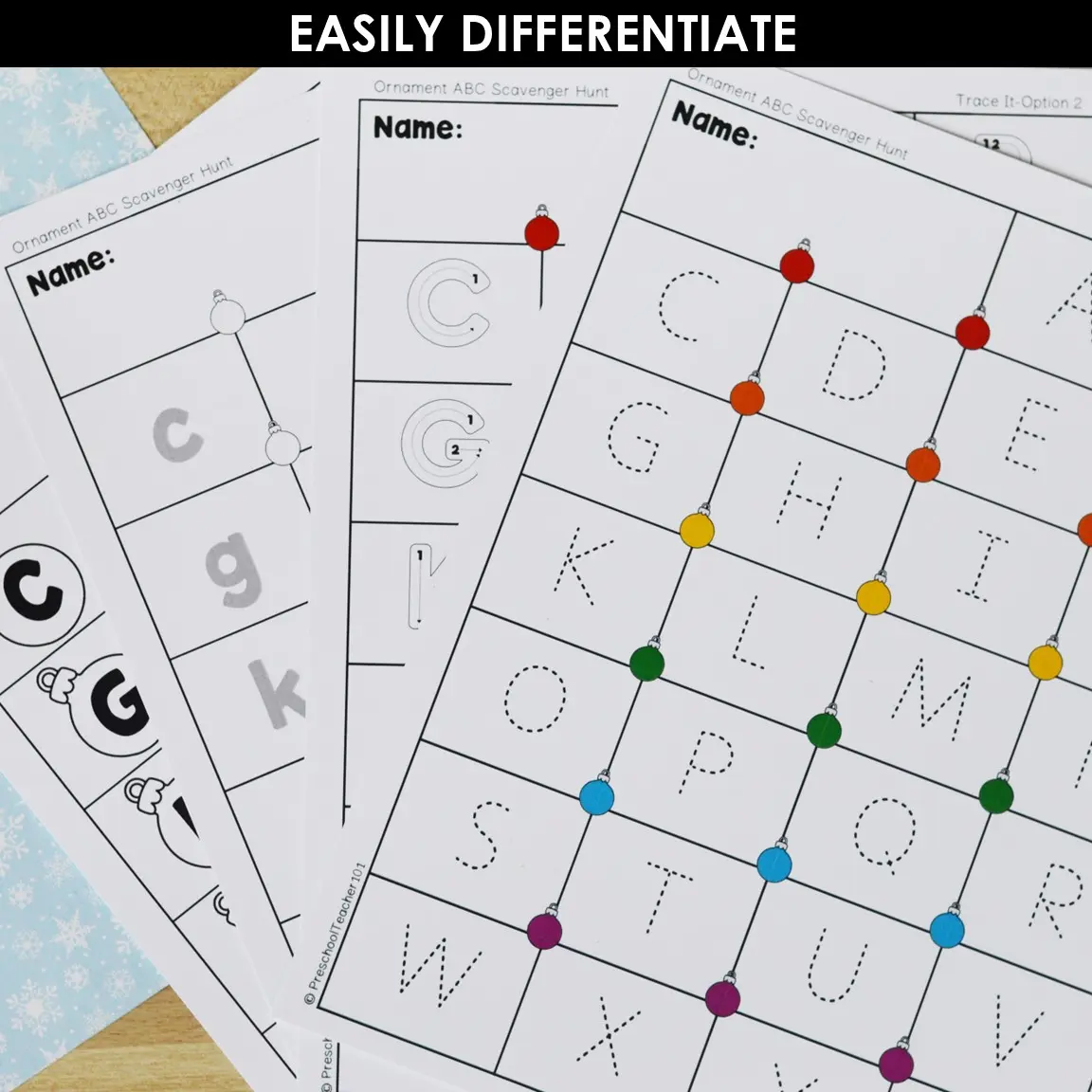
The pedagogical design of the Ornament ABC framework directly addresses this variance:
- Targeted Intervention: Instructors can isolate specific letter groups—such as the letters in a child’s given name—rather than demanding mastery of all 26 letters simultaneously.
- Flexibility in Response: Children struggling with pencil grip can utilize manipulative-based covering methods (counters, festive mini-erasers, beads), removing fine-motor frustration from the primary literacy objective.
- Scalability: The availability of both free introductory samples and comprehensive 39-page expansion packs allows educators to scale complexity, moving seamlessly from uppercase-only recognition to uppercase-lowercase matching.
Official Guidelines & Implementation Frameworks
Successfully deploying the Christmas Ornament ABC Scavenger Hunt requires a structured approach. Educators and parents can leverage a variety of proven strategies to maximize both the fun and the educational output of the activity.

Core Mechanics: How the Game Works
The activity is intentionally designed for minimal preparation time, allowing educators to deploy the game with short notice.
- Distribution: The supervisor prints out the designated recording sheets (available in various formats depending on the chosen set).
- Deployment: Large or small letter cards featuring festive Christmas ornament designs are hidden throughout the home, classroom, or outdoor play area.
- The Hunt: Children actively search for the cards. Upon locating an ornament, they identify the letter displayed upon it.
- Recording/Marking: On their recording sheets, children either color in the corresponding letter or cover it using thematic manipulatives.
Advanced Usage Strategies for Large Letter Cards
To extract maximum value from the physical letter cards included in the comprehensive pack, educators utilize several dynamic classroom stations:
- Sensory Bin Integration: Bury the small ornament letter cards inside a sensory bin filled with green crinkle paper, kinetic sand, or artificial snow. Students dig through the sensory material to find letters, matching them to their recording sheets.
- Gross Motor "Hop to the Letter": Scatter large letter cards across the floor. Call out a letter name or sound, and have children physically hop, skip, or jump to the correct ornament.
- Alphabet Fishing: Attach a small paperclip to each ornament card and use a magnetic dowel rod to let children "fish" for letters, combining fine motor practice with letter identification.
- A-B-C Ornament Tree: Hang the large ornament cards on a small classroom Christmas tree in random order. Have students practice sequencing by locating letters in alphabetical order from top to bottom.
Future Outlook: The Direction of Gamified Early Education
As educational technology and traditional classroom practices continue to intersect, the demand for tangible, hands-on activities that pull children away from passive screen time is reaching an all-time high.

Experts in early childhood curriculum development project a continued surge in "gamified physical learning"—a trend where classic play formats, such as scavenger hunts and board games, are purposefully retrofitted with foundational academic standards. The success of the Christmas Ornament ABC Scavenger Hunt underscores a broader industry shift: parents and teachers no longer want to choose between keeping children entertained and delivering rigorous academic preparation.
Looking forward, the integration of adaptable, themed literacy kits points toward a more inclusive, flexible future for early education. By empowering educators to easily differentiate instruction based on individual developmental paces—while wrapping those lessons in the joyful, exploratory spirit of the holiday season—tools like the Ornament ABC set are setting a new benchmark for how foundational skills are introduced to the next generation of learners.
Whether deployed in a bustling kindergarten classroom or utilized as a cozy weekend learning activity at home, kinesthetic literacy interventions prove that education and play are not opposing forces, but rather the twin engines of early childhood development.

