
Executive Overview
When President Trump signed the sweeping "One Big Beautiful Bill Act" into law last summer, it marked a watershed moment in American public policy by establishing the nation’s first-ever federal K-12 education choice program. Though the initiative—officially designated as the Federal Scholarship Tax Credit (FSTC)—will not officially open its doors until January 2027, the education sector is already experiencing a profound paradigm shift. School administrators, non-profit directors, state policymakers, and advocacy groups nationwide are scrambling to decipher what the statutory language means for their institutions, funding streams, and students.
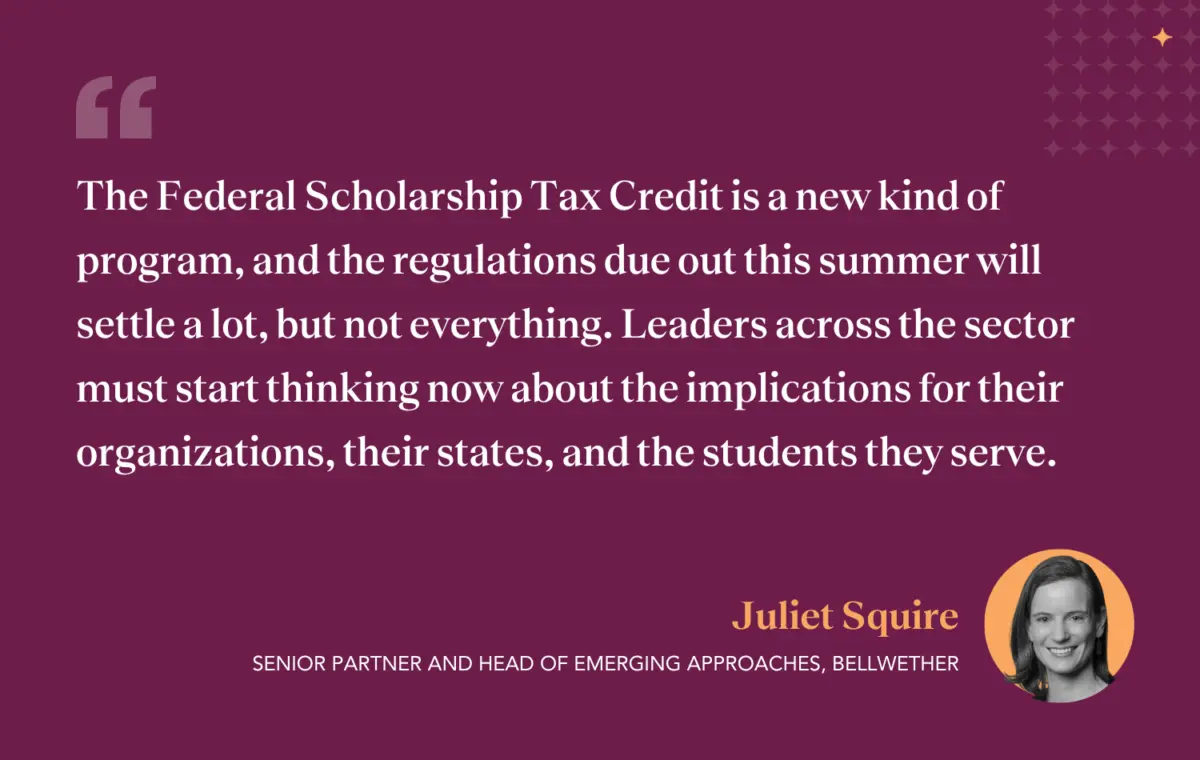
While comprehensive U.S. Treasury regulations governing the implementation of the FSTC are not slated for formal release until later this summer, a vital preview of these regulations was published last month. This preview offers critical directional guidance, illuminating the mechanics of the program while simultaneously raising complex operational questions. At its core, the FSTC introduces a federal mechanism that mirrors successful state-level tax-credit scholarship programs, allowing individual taxpayers to direct up to $1,700 annually to approved scholarship-granting organizations (SGOs) in exchange for a dollar-for-dollar federal tax credit.
Despite its underlying simplicity, the FSTC’s implementation involves a sprawling matrix of federal mandates, state-level opt-in decisions, strict SGO structural requirements, and broad household income thresholds. With the official launch looming in January 2027, education sector leaders face a narrow window of opportunity. The months leading up to the rollout will move at a breakneck pace, and early movers stand to capture significant strategic advantages. This report provides an exhaustive, authoritative breakdown of the FSTC framework, examining its operational architecture, state-by-state dynamics, compliance hurdles, and long-term implications for the American K-12 educational ecosystem.
Detailed Chronology: From Legislative Enactment to the 2027 Rollout
Understanding the trajectory of the Federal Scholarship Tax Credit requires examining the timeline that brought the program to life and maps out its future deployment. The legislative history and upcoming regulatory milestones form a critical roadmap for stakeholders attempting to time their strategic investments and organizational pivots.
1. The Legislative Milestone: Summer of Last Year
The journey of the FSTC began when the One Big Beautiful Bill Act cleared Congress and was signed into law by President Trump. For decades, school choice advocates had championed federal intervention or tax-credit mechanisms modeled after successful state programs in Florida, Arizona, and Pennsylvania. The inclusion of the FSTC in the omnibus legislation transformed a patchwork of state-level debates into a unified national framework.
2. The Regulatory Preview: Last Month
As organizations grappled with the initial statutory text, the U.S. Treasury Department released a highly anticipated preview of the forthcoming administrative regulations. This preview addressed several burning questions regarding state authority, the definition of an SGO’s geographic footprint, and income-commingling prohibitions. While not legally binding until finalized, the preview provided the clearest picture yet of how the Treasury intends to enforce the statute, allowing stakeholders to begin preliminary structural planning.
3. The Upcoming Summer: Final Treasury Regulations
Later this summer, the U.S. Treasury is scheduled to release the formal, binding regulations that will govern every facet of the FSTC program. These rules will dictate the precise reporting standards, audit requirements, and dispute resolution mechanisms for SGOs and participating states. Education sector leaders are watching this space closely, as minor adjustments in the final text could dramatically alter operational costs and compliance burdens.
4. The Fall Planning Stretch: September to December
Once the final regulations are published, a high-stakes planning window will open between September and December. During this period, state governments must finalize their participation status, emerging and existing nonprofits will need to incorporate specialized SGO entities, and large employers will begin evaluating payroll-deduction partnerships. Industry experts emphasize that organizations waiting until late 2026 or early 2027 to organize will find themselves severely disadvantaged in securing donor pipelines and state approvals.
5. Program Launch: January 2027
The FSTC program will officially launch in January 2027. On this date, approved SGOs will be legally authorized to begin accepting tax-credited donations from individuals across state lines and distributing scholarship funds to eligible families. The launch will represent the operational genesis of the nation’s first federal education choice vehicle, setting off what many predict will be a massive influx of private philanthropic capital into the K-12 alternative education market.
Supporting Context & Metrics: How the FSTC Operates
To successfully navigate the FSTC landscape, education sector leaders must master the intricate mechanics of the program. The statute establishes a clear chain of custody for capital, moving from individual taxpayers to SGOs, and finally to families and educational vendors.
The Financial Mechanism: Credits, Caps, and Donations
The engine driving the FSTC is the individual tax credit. Taxpayers are permitted to donate up to $1,700 annually to an approved SGO and claim a federal tax credit for the exact same amount on their next return. Unlike a tax deduction—which merely reduces taxable income—a tax credit provides a dollar-for-dollar reduction of tax liability, making the net cost of the donation to the taxpayer effectively zero (assuming they have sufficient tax liability).
Because the individual contribution is capped at $1,700, the success of any given SGO relies entirely on scale. An organization cannot rely on a handful of mega-donors to build a robust scholarship fund; instead, SGOs must cultivate large volumes of small-dollar contributions. Consequently, forward-thinking SGOs are already forging strategic partnerships with major corporate employers. By integrating SGO donation options directly into corporate payroll deduction systems, these organizations hope to capture a steady stream of middle- and upper-middle-class donors with minimal ongoing acquisition costs.
State Opt-In Dynamics and Geographic Boundaries
Participation in the FSTC is not mandatory for states; governors hold the discretionary authority to decide whether their state participates in the federal program. To date, 31 states have formally opted in, while four governors have explicitly announced their refusal to participate.
For states that opt in, the administrative burden includes compiling and submitting a certified list of approved SGOs to the U.S. Treasury. Once approved, these SGOs can solicit donations. However, a fascinating interstate dynamic emerges from the statute’s jurisdictional rules: while taxpayers can contribute across state lines, an SGO can only distribute scholarships within its own state.
This creates a competitive economic environment. States that choose to opt out risk seeing a significant slice of their residents’ charitable giving diverted to SGOs operating in neighboring opt-in states. Conversely, opt-in states stand to import philanthropic capital if they foster a welcoming regulatory climate for SGO formation.
SGO Structural and Compliance Requirements
The statute places stringent guardrails on organizations wishing to act as Scholarship Granting Organizations. To maintain approval, an SGO must meet the following criteria:
- Nonprofit Status: Must be organized as a 501(c)(3) nonprofit entity and cannot be structured as a private foundation.
- Firewall Protections: Must strictly prohibit the commingling of FSTC donations with other general operating funds or philanthropic revenues.
- Impartial Distribution: Must avoid channeling scholarships to specific, pre-designated students or individual schools, preserving the public-trust nature of the funds.
- Geographic Presence: Must be located in the state where it operates.
- The 90% Rule: Must distribute at least 90% of its total income as scholarships to eligible students.
The regulatory preview shed crucial light on two of these requirements. First, the definition of "located in a state" has been set at a relatively low bar—requiring only that the SGO be authorized to do business in the state and comply with local charitable organization rules. This paves the way for national non-profits to easily scale across multiple state lines.
Second, the 90% distribution rule proved to be a tougher constraint than many had hoped. Early industry advocates lobbied for the 90% threshold to apply exclusively to donation income rather than total organizational income. The Treasury preview indicated otherwise, meaning that any ancillary administrative revenue or investment income generated by the SGO will also be subject to the strict 90% payout mandate. In practical terms, this means existing multi-faceted nonprofits will find it nearly impossible to bolt an SGO onto their current operations; instead, they will need to spin up entirely separate 501(c)(3) entities dedicated solely to FSTC administration.
Student Eligibility and Allowable Expenses
Student eligibility under the FSTC has been designed to be both remarkably simple and broadly inclusive. Any student who is eligible to enroll in a public elementary or secondary school qualifies, provided their household income does not exceed 300% of the area median gross income (AMGI).
Because AMGI is pegged to local economic realities, the income cap varies wildly by geography. In a lower-cost rural area like a specific South Dakota county, the 300% AMGI threshold might translate to roughly $33,000 for a qualifying household. In high-cost metropolitan hubs, such as certain affluent California counties, the threshold climbs to nearly $200,000. This sliding scale ensures that the FSTC is not exclusively reserved for impoverished inner-city families or ultra-wealthy elites, but rather captures a broad cross-section of America’s working and middle classes.
However, certain grey areas remain. The eligibility of home-schooled students is currently ambiguous and will likely depend heavily on how the legal definition of a "school" is interpreted within individual state statutes.
When it comes to how scholarship funds can be spent, the FSTC adopts the expansive framework established by the Coverdell Education Savings Accounts provisions. The list of eligible educational expenses is extensive, encompassing:
- Private school tuition and mandatory enrollment fees
- Professional tutoring and academic coaching
- Specialized education services for students with disabilities
- Books, instructional materials, and educational supplies
- Student transportation costs
- Modern educational technology, hardware, and software
This broad definition empowers families to customize their children’s education, whether they remain within the public school system utilizing supplementary services or transition entirely to private or alternative learning environments.
Official Statements and Industry Perspectives
The announcement and subsequent regulatory preview of the FSTC have generated intense commentary from public officials, educational leaders, and advocacy organizations across the political spectrum.
Proponents of the legislation view the FSTC as a historic triumph for educational equity and parental rights. Speaking on condition of anonymity, a senior policy advisor involved in the drafting of the One Big Beautiful Bill Act noted: "For too long, educational choice has been limited by geography and personal wealth. By leveraging the federal tax code, we are unlocking billions of dollars in private philanthropy and putting the power of educational customization directly into the hands of parents, regardless of their zip code."
State-level administrators, meanwhile, are balancing enthusiasm with logistical caution. With 31 governors having already opted in, state departments of education are preparing for an unprecedented influx of administrative oversight responsibilities. A spokesperson for a Midwestern state department of education remarked: "Our priority is ensuring absolute transparency and accountability. While the federal government sets the broad parameters, state agencies must ensure that SGOs operating within our borders maintain the highest standards of financial integrity and regulatory compliance."
Conversely, public education advocacy groups have expressed profound concern over the potential drain of resources and the lack of traditional accountability metrics for entities receiving public tax credits. National teachers’ union representatives have argued that diverting potential tax revenue—even indirectly through charitable credits—undermines the foundational funding of public school districts, which educate the vast majority of American children. Critics point out that while the program is designed to expand options, the proliferation of private SGOs operating across state lines could create an opaque financial network that is difficult for watchdogs to audit effectively.
Despite these ideological fault lines, the pragmatic reality on the ground is that education sector leaders are preparing to engage. The consensus among school choice networks is that the FSTC is too large of a structural shift to ignore, forcing both traditional and alternative educational providers to adapt to a new competitive marketplace.
Future Outlook: Strategic Imperatives for Sector Leaders
As the countdown to January 2027 continues, the coming months will test the agility of organizations across the K-12 landscape. The strategic window between September and December will require decisive leadership, careful legal counsel, and aggressive operational planning.
Key Questions for Sector Leaders to Explore
To prepare effectively, institutional leaders, non-profit directors, and policy advocates should interrogate several critical operational questions over the next five months:
- Entity Structuring: Given the Treasury preview’s strict interpretation of the 90% income-payout rule, does your organization need to incorporate a standalone 501(c)(3) entity specifically dedicated to SGO operations, or can existing compliance frameworks be adapted?
- Donor Acquisition Pipelines: How will your SGO compete for individual contributions capped at $1,700? Are there local or national corporate partners willing to integrate your SGO into their payroll deduction architecture?
- Interstate Expansion: If you operate in an opt-in state, what strategies will you employ to capture cross-state donations from neighboring jurisdictions—particularly if those neighbors have governors who opted out?
- Student Outreach and Equity: How will you market scholarship opportunities to families hovering near the 300% AMGI threshold, particularly in marginalized or rural communities where digital outreach may be less effective?
- Vendor Alignment: What educational service providers, tutoring networks, and technology vendors will you vet to ensure that scholarship recipients have immediate, high-quality options for their allowable expenses?
Conclusion
The Federal Scholarship Tax Credit represents a fundamental restructuring of the American educational funding architecture. By bridging the gap between federal tax policy and local philanthropic scholarship distribution, the FSTC introduces unprecedented opportunities—and complex compliance challenges—for the K-12 sector.
While the final U.S. Treasury regulations due later this summer will provide the definitive legal boundaries, the time for passive observation has passed. Leaders who proactively build their operational infrastructure, secure strategic corporate partnerships, and resolve structural entity questions today will be uniquely positioned to lead when the doors officially open in January 2027. In the high-stakes arena of modern educational reform, the rewards of foresight will belong entirely to the first movers.

