

Executive Overview
Instructional planning stands as one of the most intellectually demanding responsibilities in the modern educational landscape. For both novice educators navigating their first year in the classroom and seasoned veterans looking to refine their craft, the task of transforming sprawling state standards into coherent, engaging instructional units can easily become overwhelming. Too often, lesson planning is approached in a reactive manner—educators design daily activities day-by-day or week-by-week, assembling a sequence of lessons before figuring out how student mastery will actually be evaluated.
To combat this inefficiency, instructional experts advocate for a systematic, pedagogical framework that shifts the entire paradigm: backward design. Popularized by educational theorists Grant Wiggins and Jay McTighe in their seminal 1991 text, Understanding by Design, this methodology inverts traditional lesson preparation. Instead of starting with content delivery, educators begin by identifying desired results, establishing clear-cut assessment parameters, and then engineering the daily learning experiences necessary to bridge the gap.
This article serves as the first installment in a comprehensive four-part series exploring the architecture of effective instructional design. Serving as a foundational introduction to the upcoming self-paced professional development course, Mastering the Lesson Plan, this piece unpacks the big-picture perspective of unit planning. Over the coming weeks, the series will dive deeper into specific components: designing holistic assessment plans, developing tactical daily lesson plans, and implementing equitable differentiation strategies. By examining the anatomy of a complete instructional unit—using a practical, hypothetical adult education course in culinary fundamentals—this guide provides educators with a repeatable, high-confidence process that guarantees alignment between teaching, assessment, and student learning.
Detailed Chronology: The Evolution of Backward Design and Unit Architecture
Understanding how to construct an effective unit requires tracing the transition from abstract educational mandates down to actionable, everyday classroom practice. To demystify this process, it is essential to first establish a shared vocabulary regarding the structural components of curriculum design.
Defining Educational Terms: Standards, Curriculum, and Units
In professional education discourse, terms like "standards," "curriculum," and "units" are frequently used interchangeably, yet they represent distinct layers of the instructional planning hierarchy.
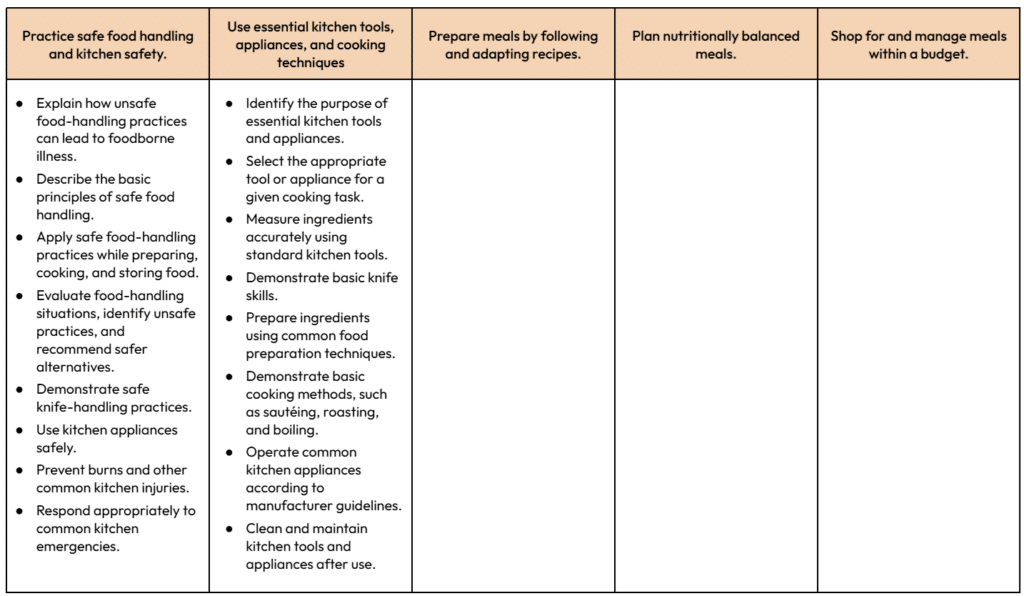
To illustrate these distinctions, consider an independent community education program offering an eight-week foundational cooking course for adults. The overarching architecture of this course begins with broad learning goals:
- Understanding basic kitchen safety and food sanitation.
- Operating essential kitchen appliances and mastering knife skills.
- Executing fundamental cooking methods (e.g., roasting, sautéing, boiling).
- Planning balanced everyday meals on a limited budget.
- Navigating grocery stores efficiently to source ingredients.
In a formal K-12 public school setting, these broad goals are established by state and local governing bodies and are officially termed standards. However, standards are merely destinations; they outline what students must know and be able to do, but they do not provide a roadmap for how to get there.

This is where the curriculum enters the equation. A curriculum acts as the master blueprint that organizes, sequences, and clusters standards into manageable chunks known as units. A unit represents a coherent collection of related knowledge and skills taught over a period ranging from a few days to several weeks. Within a typical semester, an instructor might cycle through five to ten distinct units.
While some educators receive scripted, pre-packaged curricula complete with textbooks and day-by-day lesson scripts, many others possess the professional autonomy to chunk their subject matter into thematic or skill-based units. In our cooking course example, the instructor chooses to organize the vast sea of sub-topics into six core units:
- Food Safety and Sanitation
- Kitchen Tools and Appliances
- Food Prep and Cooking Techniques
- Everyday Meal Preparation
- Basic Nutrition
- Grocery Shopping and Budgeting
By isolating the first unit—Food Safety—we can examine the step-by-step application of backward design in real time.
Supporting Context & Metrics: The 3-Step Unit Design Framework
Once the structural scope and sequence have been established, the actual work of unit construction begins. Effective instructional design relies heavily on the three-step framework of backward design: setting objectives, designing the assessment, and planning the lessons.
Step 1: Setting Measurable Learning Objectives
The foundational rule of instructional design is that objectives must be measurable. When a student "learns" or "understands" a concept, that cognitive process occurs internally. To evaluate whether that learning has genuinely taken place, educators must require students to demonstrate their knowledge through observable actions.
Focusing exclusively on the food handling subset of our culinary safety unit—which is designed to run over a concise three-to-four-day window—the instructor establishes four explicit, measurable learning objectives:
- Students will be able to identify cross-contamination risks in a simulated kitchen prep area.
- Students will be able to demonstrate proper handwashing techniques according to health department guidelines.
- Students will be able to correctly state the temperature danger zone for perishable foods.
- Students will be able to explain safe thawing methods for frozen meats.
Notably, these objectives mirror the exact language found within the broader curriculum standards chart. When standards are well-written, they often double seamlessly as instructional objectives.
To wrap up Step 1, the instructor establishes a thematic title—Safe Food Handling—and frames the unit around an open-ended essential question: "How do your choices in the kitchen affect the safety of the food you prepare?" This question elevates the unit from a dry list of safety rules to a conceptual inquiry into responsibility and public health.
Step 2: Designing the Summative Assessment
With clear objectives in hand, the next phase requires answering a critical question: What evidence will prove that students have mastered these goals?
Traditional lesson planning often relies on the "cover and test" method, where teachers present material and then quickly draft a quiz based on what was covered. Backward design flips this entirely. The summative assessment is engineered prior to crafting a single daily lesson.
For our brief, four-day food safety unit, a time-intensive project is impractical. Instead, the instructor designs an open-response scenario assessment. Students are presented with a series of narrative vignettes depicting home cooks making subtle food safety errors (e.g., leaving raw poultry on a counter at room temperature or using the same cutting board for vegetables after slicing raw meat). Students must successfully:
- Identify the specific food safety violations in each scenario.
- Explain the microbiological or health risks associated with those violations.
- Describe the corrective action that should have been taken.
This performance-based assessment measures true application and critical thinking rather than rote memorization.
Step 3: Planning the Daily Lessons
The final phase of the backward design process involves backward mapping: engineering the daily lessons and learning activities that will systematically prepare students to excel on the summative assessment.
By defining the destination first (the assessment) and the specific milestones along the way (the objectives), the daily lessons practically write themselves. Every lecture, demonstration, and hands-on practice session is rigorously vetted to ensure it directly supports student success on the final evaluation.
Official Statements and Expert Perspectives
Instructional leadership experts emphasize that the discipline of backward design is not merely an academic exercise, but a vital tool for reducing teacher burnout and maximizing student achievement.
"When educators plan backwards, every minute in the classroom gains intentionality," notes curriculum design researchers. "Teachers stop asking, ‘What activity can I do tomorrow?’ and instead ask, ‘What evidence do I need to collect to prove learning happened today?’ This paradigm shift transforms the classroom from a passive listening environment into an active, goal-oriented community."
Furthermore, veteran educators often caution against the misconception that backward design equates to "teaching to the test" in a negative, mechanistic sense. When the assessment is a high-quality, authentic measure of deep conceptual understanding—rather than a standardized, arbitrary bubble test—teaching toward that assessment guarantees that students are acquiring meaningful, real-world competencies.
Future Outlook: The Next Frontier in Professional Pedagogy
Mastering the art of unit planning is an ongoing professional journey. As classrooms evolve to incorporate diverse learners, emerging technologies, and changing community standards, the frameworks educators use to structure their instruction must remain robust, adaptable, and student-centered.
This introductory overview serves as a springboard for the rest of this four-part series. In the upcoming installments, the discussion will transition from the macro-level view of unit architecture down to the granular details of the classroom experience:
- Week 2: Designing a balanced assessment ecosystem that integrates diagnostic, formative, and summative evaluations seamlessly.
- Week 3: Constructing high-impact daily lesson plans that maintain student engagement and momentum.
- Week 4: Implementing advanced differentiation strategies to ensure equitable access and success for every single learner.
For educators seeking an even deeper dive into these methodologies, comprehensive professional development initiatives—such as the self-paced online curriculum Mastering the Lesson Plan—provide the practical tools, templates, and guidance needed to revolutionize instructional design from the ground up. By embracing a systematic approach to planning, teachers can step into their classrooms with renewed confidence, knowing that every lesson taught is a purposeful step toward lasting student success.

