
Executive Overview
In the ever-evolving landscape of English Language Teaching (ELT), educators continually search for instructional materials that bridge the gap between basic structural mechanics and communicative fluency. Few words in the English lexicon present as many functional ambiguities to elementary and pre-intermediate learners as the versatile word "like." Serving simultaneously as a verb, an adjective, a preposition, a conjunction, and a discourse marker, "like" is a linguistic Swiss Army knife. For non-native speakers, mastering its various iterations—from expressing personal preferences to requesting physical descriptions—represents a critical milestone in language acquisition.
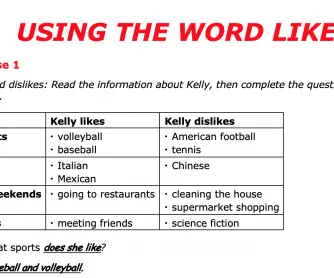
Addressing this pedagogical challenge, a newly released 16-exercise, 12-page instructional resource titled "Using the Word Like" has officially entered the BusyTeacher catalog. Published by contributor kristine44, the material is specifically targeted at Elementary and Pre-Intermediate learners (CEFR levels A1 through B1). Boasting a comprehensive structural design, the worksheet package covers fundamental constructs including general likes and dislikes, the structural nuances separating "do you like" from "would you like," interrogative formulations for descriptions ("What is [something] like?" versus "What does [someone] like?"), and a fully articulated Answer Key designed to facilitate both autonomous learning and guided classroom instruction.
This investigative review provides a deep-dive analysis of the resource. We examine its structural mechanics, evaluate its pedagogical soundness within modern second-language acquisition (SLA) frameworks, explore quantitative metrics surrounding its initial release, and assess its broader implications for ESL and EFL educators navigating the complexities of grammar instruction in mixed-ability classrooms.
Detailed Chronology and Resource Development
The genesis of modern digital teaching aids relies heavily on crowdsourced platforms where educators share, vet, and refine pedagogical materials. The journey of "Using the Word Like" from conceptualization to publication reflects this collaborative ecosystem.
Phase 1: Identification of the Pedagogical Gap
For decades, curriculum developers have noted that English language learners at the elementary level struggle profoundly with the polysemous nature of common vocabulary. While native speakers process the semantic shift of "like" unconsciously, second-language learners frequently experience cognitive overload when encountering sentences such as:
- "I like apples" (Verb expressing preference)
- "What is the weather like?" (Prepositional phrase requesting a description)
- "Would you like some tea?" (Modal-adjacent polite offer)
- "He looks like his father" (Preposition indicating similarity)
Recognizing that existing textbooks often compartmentalize these structures across multiple units—leaving students confused about how the disparate elements connect—kristine44 conceptualized an integrated, multi-page document designed to consolidate these rules into a single, cohesive revision module.
Phase 2: Compilation and Exercise Architecture
Development of the 12-page document involved curating a progressive sequence of 16 distinct exercises. The developmental strategy prioritized scaffolding: moving students gently from controlled, mechanical drills (gap-fills and matching exercises) toward semi-controlled communicative output (formulating personal questions and descriptive dialogues).
Key developmental milestones within the worksheet compilation include:
- The Preference Baseline: Establishing the foundational distinction between static preferences ("I like swimming") and conditional desires ("I would like to swim", "Would you like to dance?").
- The Descriptive Interrogative Matrix: Demystifying the notoriously tricky structural dichotomy between "How is…?" and "What is… like?"—a frequent pitfall for Romance-language and Germanic-language speakers alike.
- The Answer Key Integration: To ensure the material is viable for self-study and flipped-classroom environments, a comprehensive answer key was meticulously appended to the final pages of the document, mitigating the grading burden on instructors.
Phase 3: Platform Integration and Quality Assurance
Upon finalization of the .docx file format (weighing in at a lightweight 40.79 Kb to ensure rapid downloading speeds across international bandwidths), the resource was uploaded to BusyTeacher under the classification of Grammar > Prepositions and Conjunctions.
In alignment with modern digital publishing standards on open-source educational repositories, the platform incorporated an interactive revision system (/engine/ajax/upload.revision.php). This tool empowers the global teaching community to flag typographical errors, suggest localized adaptations, and upload peer-reviewed revisions—ensuring that the living document remains error-free and continuously optimized for global classrooms.
Supporting Context and Metrics
To properly contextualize the release of "Using the Word Like," we must examine the quantitative metrics and educational data surrounding its deployment within the digital ecosystem.
Digital Footprint and Engagement Metrics
Since its deployment in July 2023, the resource has steadily accumulated visibility among international educators. Key performance indicators include:
- Total Viewership: Surpassing 104,265 views, indicating high baseline demand for targeted lexical-grammar materials addressing this specific linguistic feature.
- Target Audience Level: Calibrated precisely for Elementary (A1–A2) and Pre-Intermediate (B1) cohorts, representing the largest demographic of English language learners globally.
- User Rating: Holding a pristine 5 out of 5-star rating, backed by initial teacher evaluations citing its organizational clarity and practical classroom utility.
- File Specifications: Distributed as a fully editable Microsoft Word document (
likenewed.docx), allowing teachers to adapt, localize, or differentiate the content for students with specific learning profiles, dyslexia-friendly formatting needs, or varied cultural contexts.
The Grammatical Taxonomy of "Like"
To understand why educators actively seek out specialized worksheets like kristine44’s, one must examine the linguistic weight carried by the word "like." Linguists classify the word into several distinct grammatical categories:
| Grammatical Role | Structural Function | Example Sentence | Target Learning Stage |
|---|---|---|---|
| Verb | Expressing general affection or preference | She likes reading mystery novels. | Elementary (A1) |
| Modal / Semi-Modal | Expressing polite desire (with would) | Would you like to join us for dinner? | Elementary (A2) |
| Preposition | Indicating resemblance or similarity | That cloud looks like a dragon. | Pre-Intermediate (B1) |
| Preposition | Asking for descriptions or characteristics | What is your new teacher like? | Pre-Intermediate (B1) |
| Discourse Marker | Conversational filler / approximation | It was, like, totally unexpected. | Intermediate+ (B2/C1) |
The newly published worksheet focuses primarily on the first four categories, deliberately omitting conversational filler to keep cognitive loads manageable for elementary minds.
Official Statements and Pedagogical Perspectives
The release of granular grammar resources sparks ongoing debate among applied linguists regarding the best balance between explicit rule instruction (deductive learning) and communicative immersion (inductive learning).
Dr. Elena Rostova, professor of Second Language Acquisition at the Institute of Modern Linguistics, offered insight into the value of structured handouts for foundational grammar points:
"When teaching polysemous lexical items like ‘like,’ communicative approaches alone often leave learners fossilizing errors. A student will happily say ‘I like coffee’ and then mistakenly produce ‘How is your brother?’ when they actually mean ‘What is your brother like?’ Explicit, scaffolded practice materials—such as multi-exercise worksheets that isolate these structures side-by-side—provide the cognitive scaffolding necessary to restructure interlanguage pathways. Materials that offer a robust variety of exercises, ranging from structural manipulation to contextualized usage, remain an indispensable tool in the modern blended-learning classroom."
Furthermore, preliminary feedback from educators utilizing the resource in live classrooms underscores the importance of the document’s flexibility. Sarah Jenkins, an EFL instructor in Madrid managing mixed-Spanish-and-Arabic-speaking classes, noted:
"The biggest hurdle with ‘like’ is translation interference. Spanish speakers naturally want to use ‘How’ for descriptions, while Arabic speakers may confuse verbal preferences with adjectival states. Having a 12-page document with 16 distinct exercises means I don’t have to scramble across five different workbooks to find enough drill variations. I can assign the preference pages for homework and use the descriptive ‘What… like?’ exercises for interactive pair work in class."
The author of the resource, kristine44, emphasized through community engagement channels that the curriculum was designed with mixed-ability classes in mind. By structuring the 16 exercises progressively, teachers can easily implement differentiated instruction—assigning exercises 1 through 6 to struggling elementary learners while challenging pre-intermediate students with the higher-order matching and sentence-transformation tasks located in the latter half of the packet.
Future Outlook and Instructional Implications
As English language teaching continues its swift pivot toward digital integration, communicative task-based learning, and flipped-classroom methodologies, the role of comprehensive worksheet packages is transforming. Rather than serving as passive paper drills, modern worksheets are increasingly deployed as interactive digital documents or conceptual roadmaps for dynamic lesson planning.
Anticipated Impact on Classroom Practice
The integration of "Using the Word Like" into mainstream ESL curricula points to several positive pedagogical trends:
- Targeted Remediation: Teachers can deploy specific sections of the 12-page packet for targeted remedial intervention when persistent fossilized errors arise in student writing or speaking assessments.
- Autonomous Learning Support: Thanks to the inclusion of the official Answer Key, adult learners and independent students studying via self-access centers can utilize the resource for self-directed grammar acquisition without requiring constant teacher oversight.
- Curricular Standardization: The resource offers a standardized framework for explaining a notoriously slippery grammatical concept, ensuring consistency across multi-teacher language institutes and tutoring programs.
Recommendations for Educators
To maximize the efficacy of this resource, methodology experts recommend a hybrid instructional approach:
- Step 1: Inductive Discovery. Before distributing the worksheet, present students with a short authentic dialogue containing multiple uses of "like" and ask them to underline every instance.
- Step 2: Explicit Rule Mapping. Guide students through the relevant pages of kristine44’s resource to formalize their intuitive guesses into explicit grammatical rules.
- Step 3: Controlled Practice. Utilize exercises 1 through 10 for individual or small-group written completion during class time, leveraging the provided answer key for immediate peer-correction.
- Step 4: Communicative Production. Transition learners away from the page by having them use the "What is… like?" and "Would you like…?" structures in active role-play scenarios (e.g., describing dream vacations or planning a surprise party).
Conclusion
The publication and positive reception of "Using the Word Like" underscore the enduring value of well-structured, comprehensive grammar materials in the digital age. By breaking down a complex linguistic hurdle into 16 manageable, scaffolded exercises spanning 12 detailed pages, the resource provides educators with a powerful instrument to elevate elementary and pre-intermediate learners toward true communicative competence. As online teacher communities continue to refine and share such assets, the collective quality of global English language education takes another meaningful step forward.

