
Executive Overview
In the modern educational landscape, the illusion of learning is a persistent challenge. Classrooms routinely hum with activity, and students frequently nod in agreement or call out correct answers during lectures. Yet, educators are constantly forced to confront a sobering question: How much of that newly acquired knowledge actually survives the school day, let alone remains intact weeks later?
Traditional instructional methods—grounded in teacher-led lectures, textbook exercises, and individual drills—have long formed the bedrock of middle school education. However, a groundbreaking new study conducted by researchers Boulahnane, Ismaili, and Haddi (2026) challenges the long-term efficacy of these conventional techniques. By examining ninth-grade classrooms in a Moroccan middle school over a rigorous three-week experimental period, the researchers set out to compare traditional pedagogical methods against a game-based learning intervention powered by Kahoot!
The findings of this empirical investigation are striking. Students instructed using the game-based platform achieved roughly double the learning gains of their peers in the conventional control group. Furthermore, when tested unexpectedly two weeks after instruction concluded, the Kahoot! cohort maintained a statistically significant advantage in long-term knowledge retention across three distinct subjects: English grammar, English vocabulary, and Life and Earth Sciences.
Beyond cognitive metrics, the study uncovered a dramatic divergence in affective engagement. Students interacting with the gamified platform reported an overwhelming surge in classroom enthusiasm and participation, scoring an average engagement rating of 23.6 out of 25, compared to just 17.0 for the control group.
This comprehensive report delves into the methodology, data, broader pedagogical implications, and future outlook of game-based learning interventions in adolescent education. It explores how immediate feedback loops, active retrieval practice, and interactive formative assessments are reshaping the future of middle school instruction.
Detailed Chronology and Experimental Methodology
To understand the magnitude of Boulahnane, Ismaili, and Haddi’s findings, it is essential to examine the meticulous structure of the 2026 study. Conducted over a three-week window, the research was designed to control for variables that frequently confound educational evaluations, such as prior academic achievement, socioeconomic background, and instructional time.
Setting the Stage: Participant Demographics and Subject Matter
The study focused on two ninth-grade classes within a Moroccan middle school. Each class comprised exactly 30 students, aged 14 to 15 years old. To ensure a fair comparison, both groups were subjected to identical curriculum requirements over the same duration. The instructional content spanned three key academic domains:
- English Grammar: Complex sentence structures and syntactical rules.
- English Vocabulary: Target lexical items appropriate for intermediate middle-school learners.
- Life and Earth Science: Core biological and geological concepts mandated by the national curriculum.
Prior to the implementation of the experimental conditions, both cohorts completed baseline pre-tests consisting of 20 standardized items per subject. The statistical analysis of these pre-tests confirmed that both groups started from virtually identical baseline knowledge levels, ensuring a clean slate for the intervention.
The Divergent Pedagogical Paths
While the control group and the experimental group received the exact same amount of instructional time and curriculum scope, the delivery mechanisms diverged significantly:
- The Control Group (Conventional Instruction): This cohort experienced traditional, teacher-centered methodologies. Lessons relied on direct teacher explanations, textbook-based reading and exercises, individual written homework, and occasional pair-work drills. Formative checks were largely passive or relied on voluntary hand-raising.
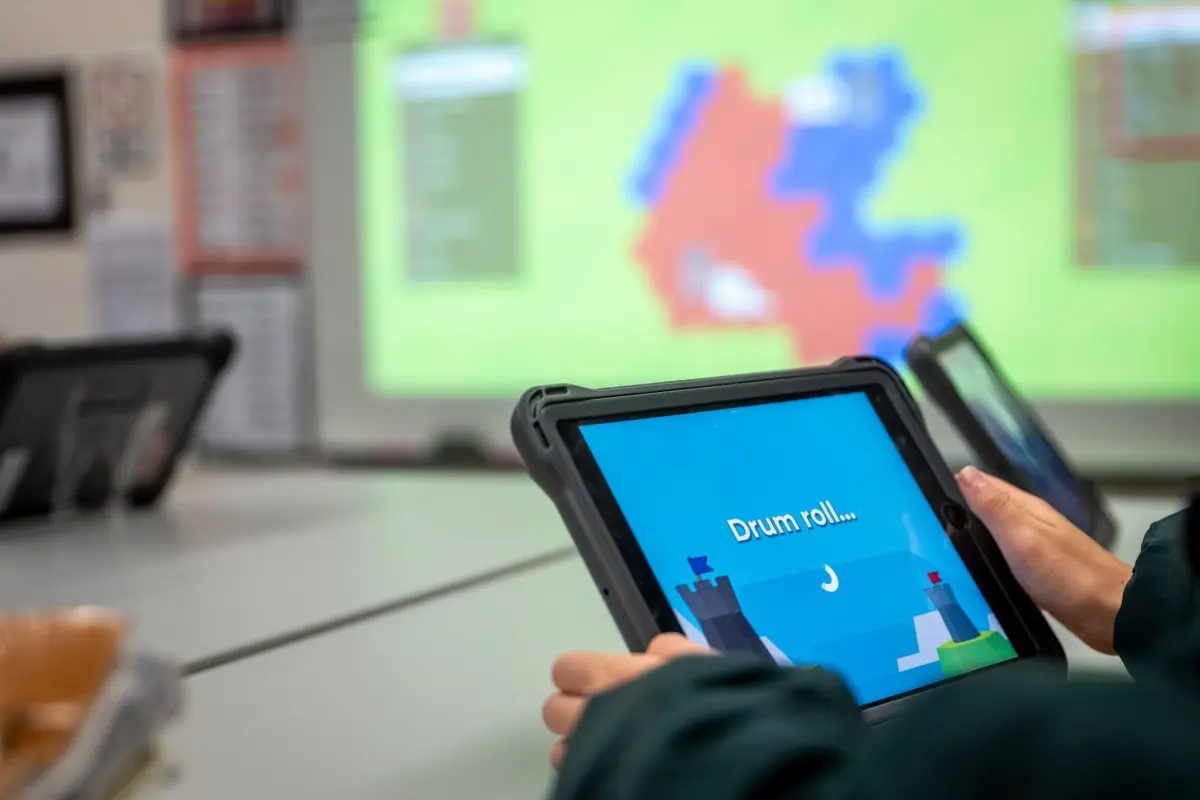
- The Experimental Group (Kahoot! Integration): This cohort replaced traditional drills and review sessions with interactive, game-based quizzes hosted on Kahoot!. Teachers projected quiz questions onto a shared classroom screen, while students utilized their personal smartphones or shared tablets to submit their answers under a competitive time limit.
The Pedagogical Feedback Loop
A critical variable in the experimental design was not merely the use of a digital game, but how the educators utilized the data generated by the platform. During the Kahoot! sessions, the classroom dynamics followed a deliberate pedagogical rhythm:
- The Prompt: A multiple-choice question appeared on the shared display.
- The Response: Students raced against the clock to input their answers on their devices, driven by the platform’s gamified scoring mechanics (which reward both accuracy and speed).
- The Visualization: Immediately following each question, the platform generated a real-time data visualization showing the distribution of responses across the class, alongside the correct answer.
- The Intervention: Rather than simply celebrating the winners and moving forward, the teacher paused whenever a significant portion of the class answered incorrectly. The instructor facilitated a targeted mini-lesson, explaining the correct response, correcting underlying misconceptions, and inviting class discussion before advancing to the next prompt.
Testing Intervals and Tracking Retention
To measure both immediate comprehension and durable memory consolidation, the researchers administered assessments at three distinct milestones:
- Pre-Test: Administered immediately before the instructional unit began.
- Immediate Post-Test: Administered directly following the completion of the three-week instructional sequence.
- Delayed Retention Test: Administered unexpectedly two weeks after the immediate post-test, with no intervening review sessions.
Supporting Context, Metrics, and Data Analysis
The data collected by Boulahnane, Ismaili, and Haddi (2026) offers a compelling quantitative narrative regarding the cognitive benefits of interactive, game-based formative assessments. The results were categorized across two primary axes: academic achievement gains and student engagement metrics.
Cognitive Gains: Immediate vs. Delayed Assessments
When analyzing the score trajectories from the pre-test to the immediate post-test, students utilizing Kahoot! demonstrated exponential growth across all three assessed subjects. Measured on a standardized scale of 0 to 20:
- English Grammar: The Kahoot! cohort exhibited an average improvement nearly double that of the control group, mastering syntactical rules with greater precision during immediate post-instruction checks.
- English Vocabulary: Lexical retention soared. Students exposed to gamified repetition learned and recalled new vocabulary terms at a significantly faster rate than peers relying on traditional textbook memorization.
- Life and Earth Science: Complex scientific terminology and systemic concepts—traditionally prone to rote memorization and rapid forgetting—yielded higher comprehension marks in the interactive environment.
More impressive than the immediate post-test scores, however, was the data gathered during the two-week follow-up assessment. While educational psychology widely acknowledges the existence of the "forgetting curve"—wherein human memory naturally decays over time without reinforcement—the Kahoot! group demonstrated remarkable resilience against memory loss.
At the two-week mark, the Kahoot! class maintained a decisive performance advantage, outperforming the conventional instruction group by 3.3 to 3.7 points (out of 20) across all three subjects. Although both groups experienced a slight downward drift in scores over the unreviewed two-week period—underscoring the absolute necessity of continuous pedagogical review—the baseline retention floor for the game-based group remained markedly higher.
+---------------------------------------------------------------------------------+
|                         SUMMARY OF TEST PERFORMANCE                             |
+----------------------+--------------------+--------------------+----------------+
| Assessment Stage     | Control Group (Avg)| Kahoot! Group (Avg)| Net Advantage  |
+----------------------+--------------------+--------------------+----------------+
| Baseline Pre-Test    | Equivalent         | Equivalent         | 0.0 points     |
| Immediate Post-Test  | Moderate Gains     | Superior Gains     | ~2x Growth     |
| 2-Week Follow-Up     | Pronounced Decay   | High Retention     | +3.3 to 3.7 pts|
+----------------------+--------------------+--------------------+----------------+
Affective Metrics: Quantifying Student Engagement
Cognitive absorption rarely happens in the absence of emotional engagement. To measure the psychological and emotional climate of the classrooms, the researchers administered a validated engagement survey to all participants upon the conclusion of the study.
The survey utilized a 25-point scale to quantify dimensions of student focus, intrinsic motivation, enjoyment, and active participation. The results were stark:
- Kahoot! Cohort Average Engagement: 23.6 out of 25
- Conventional Instruction Cohort Average Engagement: 17.0 out of 25
This delta of 6.6 points highlights a profound psychological shift. Adolescents aged 14 to 15, navigating a notoriously difficult developmental stage characterized by shifting attention spans and self-consciousness, reported feeling vastly more energized, focused, and invested when learning was structured through an interactive, game-based medium.
Official Statements and Academic Perspectives
While the empirical data speaks volumes, educational researchers and pedagogical theorists emphasize that technology alone is not a silver bullet. The success documented by Boulahnane, Ismaili, and Haddi (2026) is deeply rooted in cognitive science principles that have long been championed by learning theorists.
Dr. Elena Vance, a prominent cognitive psychologist specializing in educational technology integration, notes that the study validates two fundamental pillars of cognitive architecture: active retrieval practice and immediate feedback loops.
"When students sit passively listening to a lecture or reading a textbook, they are often lulled into a false sense of competence through passive recognition," Dr. Vance explains. "They look at a page, recognize the words, and assume the information is stored in long-term memory. Platforms like Kahoot! force active recall; students are put on the spot, must retrieve information from memory under mild arousal, and are immediately confronted with the truth of their understanding. That friction is where true synaptic consolidation occurs."
Furthermore, educators involved in the study pointed to the psychological safety fostered by anonymous or gamified response systems. In traditional classrooms, middle school students frequently refrain from answering teacher inquiries out of fear of public humiliation or peer judgment if they are wrong. When answers are submitted via personal devices and displayed in aggregate, the social stigma of an incorrect answer dissipates. The classroom transforms from a high-stakes interrogation room into a collaborative problem-solving arena.
Future Outlook: Integrating Game-Based Learning into Modern Curriculums
As educational institutions worldwide grapple with post-pandemic learning recovery, declining student attention spans, and the rapid evolution of digital pedagogies, studies like the one conducted by Boulahnane, Ismaili, and Haddi offer a clear, actionable roadmap.
Practical Takeaways for Middle School Educators
For teachers navigating language arts, sciences, humanities, or mathematics, the implications of this research do not require a complete overhaul of school infrastructure or expensive software investments. The core mechanics that drove success in the 2026 study can be replicated easily:
- Diagnostic Formative Assessment: Use interactive quiz tools at the midpoint or conclusion of a teaching unit to take the intellectual temperature of the classroom.
- The "Pause and Pivot" Strategy: Resist the urge to treat quiz scores as a final grade. Instead, treat low-performing questions as instructional red flags. When a significant portion of the class misses a concept, pause the activity immediately to deconstruct the misconception.
- Structured Spiraling: Acknowledge that even gamified learning suffers from natural memory decay over time. Schedule follow-up "flash reviews" or recurring game sessions two weeks or a month after initial instruction to reinforce long-term neural pathways.
The Horizon of EdTech Research
Looking forward, educational researchers are calling for expanded longitudinal studies that track game-based learning interventions over entire academic semesters and years, rather than isolated three-week sprints. Additionally, researchers aim to isolate specific variables—such as the exact impact of time-pressure mechanics versus cooperative team play—to fine-tune how digital tools are deployed in middle school environments.
Nevertheless, the 2026 study adds robust, empirical weight to the growing consensus that play and pedagogy are not mutually exclusive. By marrying the structural rigor of middle school curriculums with the dynamic, engaging feedback loops of game-based platforms, educators can pierce the veil of surface-level learning, securing not just short-term classroom participation, but enduring, long-term knowledge retention.

