
Executive Overview
For decades, international comparisons of educational systems have followed a familiar, albeit disheartening, script. Standardized test scores, literacy rates, and math competencies are weighed against one another, and American schools almost universally emerge looking fractured, hyper-accountable, and overburdened by comparison. Yet, these structural post-mortems rarely venture beyond the raw data to examine the daily human cost of how a school system operates—for both the teacher standing at the front of the room and the child sitting at the desk.
In a recent comprehensive interview on the Cult of Pedagogy podcast, educator, author, and literacy advocate Pernille Ripp offered an intimate, ground-level look at this dynamic. Having spent years teaching in the United States before returning to her native Denmark, Ripp possesses a rare, dual-lens perspective on the contrasting realities of transatlantic education. Her insights suggest that the glaring performance and wellness gap between U.S. and Danish schools is not merely a matter of funding, technology, or demographics. Instead, it is born from a fundamental philosophical divide: the American education system is engineered around control, compliance, and endless additions, whereas the Danish model is built on trust, autonomy, and strategic subtraction.
This report synthesizes Ripp’s comparative analysis, dissecting the structural mechanics that make Danish schools more sustainable for educators and more developmentally appropriate for students. More importantly, it outlines actionable, zero-budget strategies for U.S. educators and administrators seeking to import elements of this humane philosophy into their own classrooms.
Detailed Chronology & Context: The Transatlantic Shift
The dialogue between Ripp and podcast host Jennifer Gonzalez builds upon a decade-long professional relationship focused on sustainable literacy and humane classrooms. Ripp’s trajectory—from a celebrated U.S. public school educator and author of Passionate Learners to a teacher within the Danish municipal school system—places her in a unique position to evaluate the systemic friction points plaguing modern American education.
Over the past decade, the U.S. educational landscape has grown increasingly centralized, metric-driven, and litigious. Teachers are routinely handed scripted curricula, rigid pacing guides, and exhaustive lists of performance indicators that effectively strip them of professional agency. Conversely, Denmark’s national educational framework has moved in the opposite direction. Over recent years, the Danish government intentionally pruned its national educational goals from hundreds of hyper-specific metrics down to roughly ten broad, age-based competencies.
This chronological divergence has created two vastly different daily realities. While American classrooms are marked by constant urgency, high-stakes testing, and administrative oversight, Danish schools operate on a foundational premise that has grown increasingly foreign in the U.S.: the system assumes educators are competent professionals until proven otherwise, and it treats students as developing human beings rather than compliance projects.
Supporting Context & Metrics: Trust Versus Control in Daily Operations
To understand why Danish schools consistently report higher teacher retention and student well-being metrics, one must examine the operational details of a typical school day. The divergence manifests across two primary pillars: professional empowerment for teachers and developmental autonomy for students.

The Architecture of Teacher Trust
In the United States, the omnipresence of scripted curricula and mandatory pacing checks communicates an implicit lack of trust. Teachers are treated as middle-management implementers of programs designed by distant textbook publishers or administrative committees.
In Denmark, professional trust is the default baseline. Ripp notes that Danish teachers operate from broad goals and are given total autonomy over how those goals are met. There are no district-wide pacing guides or standardized checkboxes. Decisions are made at the local school level, empowering faculty to select or adapt curricula that directly match the needs of the students sitting in front of them.
Furthermore, physical and operational work conditions reflect this respect. Ripp’s typical work schedule entails a standard 40-hour week, with only 20 hours spent in direct contact with students. The remaining hours are dedicated to preparation, collaboration, and professional reflection in secure, distraction-free environments. When a teacher falls ill, the protocol is remarkably frictionless: a simple call before 7:00 a.m. suffices. There are no frantic, middle-of-the-night scrambles to write intricate substitute plans, as Danish schools utilize permanent, building-embedded substitute teachers who arrive prepared with their own activities.
Developmental Autonomy for Students
The philosophical divide is equally pronounced in how students are treated. American schools often restrict student movement, closely monitor transitions, and supply every conceivable material, effectively insulating children from real-world responsibility.
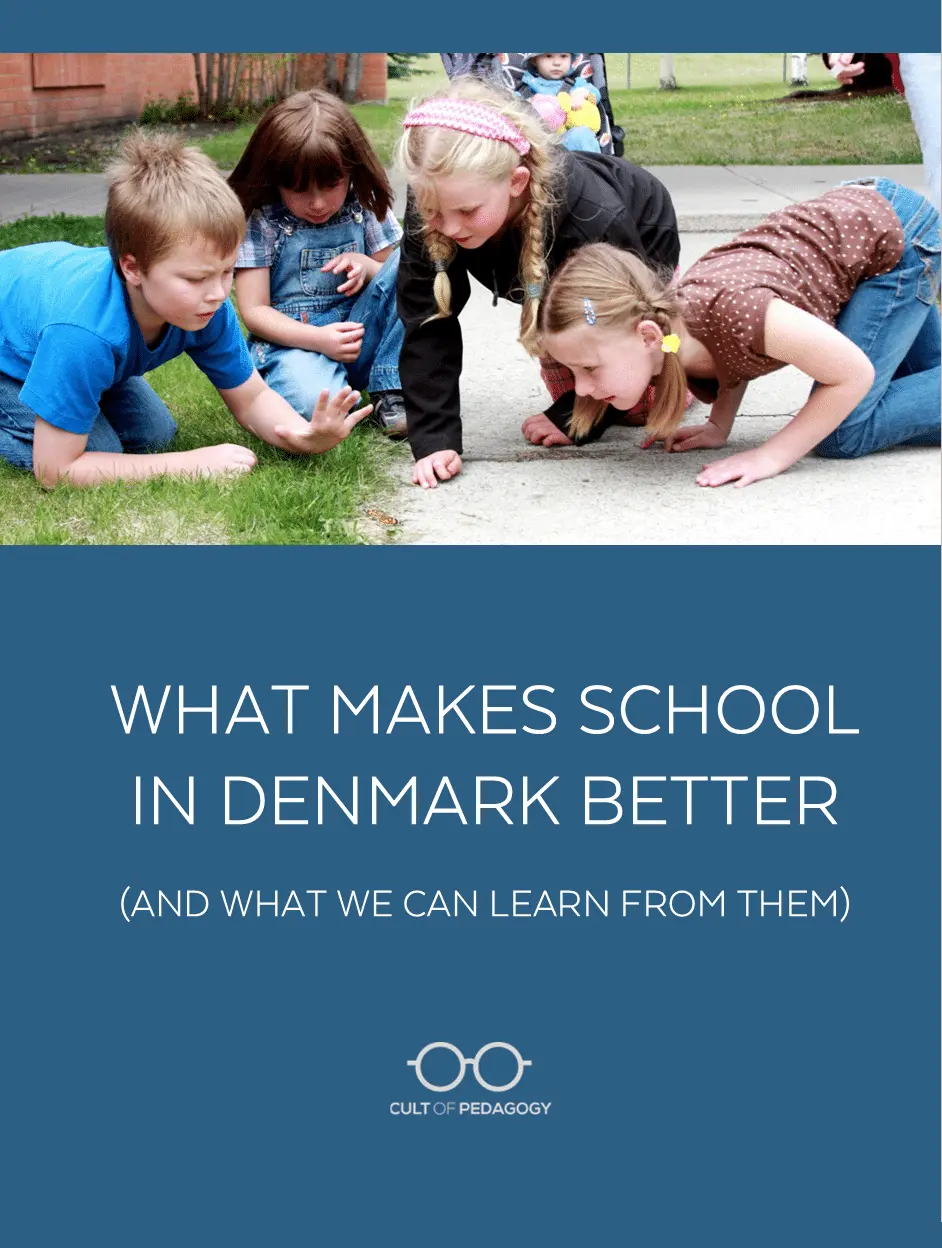
In contrast, Danish schools treat autonomy as a developmental necessity rather than an earned privilege. Students are expected to pack their own backpacks, manage their materials, and navigate their social environments early on. Regulation is built into the physical design of the school day: mandatory outdoor time occurs daily, regardless of weather conditions, and unstructured, high-energy play is viewed as an essential mechanism for emotional and cognitive regulation. Rather than policing minor behavioral infractions or banning snowball fights, schools designate specific zones for robust play, teaching students to manage risk rather than eliminating it entirely.
Academically, the pressure valve is similarly released. Formal reading instruction does not begin until age seven (equivalent to first grade in the U.S.), and grading is delayed until seventh grade. The overarching cultural philosophy champions depth over breadth. If a class spends two extra weeks exploring a science or literature unit because engagement is high, teachers adjust without panic, knowing that deep comprehension supersedes the arbitrary deadlines of a pacing calendar.
Official Perspectives & Expert Insights
The core thesis of Ripp’s comparative analysis centers on a counterintuitive principle: meaningful educational reform does not require massive infusions of capital or the adoption of trendy new software programs. It requires subtraction.

"The system assumes that I know what I’m talking about and that the experience that I have with my students is one that is valid and also valuable," Ripp explains, highlighting the psychological safety of the Danish model.
By removing the endless administrative scaffolding that plagues U.S. schools—such as redundant permission slips, micromanaged lesson plans, and performative classroom decoration—the Danish system preserves the emotional and cognitive energy of its educators.
Gonzalez emphasizes that American educators need not wait for sweeping federal or state policy overhauls to reclaim their profession. Many of the structural adjustments required to humanize a classroom can be initiated at the micro-level by individual teachers and forward-thinking building administrators.
Future Outlook: Bringing the Danish Philosophy to U.S. Schools
Translating the humane mechanics of Danish education into the high-pressure environment of American public schools may seem daunting, but Ripp and Gonzalez outline practical, incremental pathways for change. These strategies require no additional funding—only a willingness to adjust expectations and strip away non-essential tasks.
1. Reclaiming Professional Agency (For Teachers and Administrators)
- Start as a Starting Point, Not a Script: Treat mandated curricula as a menu of options rather than an absolute mandate. Administrators can invite teachers to review required materials and ask: We cannot remove this entirely, but how can we adapt it to fit our students? Test these modifications for six weeks and evaluate the results collaboratively.
- Audit Administrative Red Tape: School leadership should critically evaluate field trip requirements, sign-out policies, and approval processes. Eliminating unnecessary bureaucratic hurdles frees up vital teacher energy and restores professional trust.
- Protect Prep Time: Shield teacher preparation periods from drop-in announcements, coverage requests, and impromptu meetings. Where possible, aggregate scattered 30-minute blocks into longer, uninterrupted periods of deep work.
2. Fostering Student Autonomy and Well-Being
- Cultivate Independent Responsibility: Resist the urge to control every student movement. Allow children to manage their own materials, resolve minor peer conflicts independently, and make daily choices regarding their learning environments. Treat poor choices as teachable moments rather than systemic failures.
- Prioritize Organic Play and Movement: Advocate for extended, unstructured recess and genuine outdoor time. Allow for physical play and tolerate a reasonable degree of roughness, recognizing that children require physical regulation to succeed academically.
- Rationalize Homework Policies: Critically evaluate the purpose of assigned homework, especially in elementary grades. Ask whether an assignment genuinely advances learning or merely serves as compliance theater. Protect evenings as dedicated family time.
- Dedicate Space for Community Voice: Implement regular class meetings untied to academic objectives. Provide students with a dedicated forum to discuss community dynamics, air grievances, and actively participate in shaping their daily school environment.
3. Embracing the Power of "Good Enough"
For individual U.S. teachers operating under crushing institutional weight, Ripp offers a final, liberating piece of advice: practice professional grace.
- Deliberately Slow Down: Even without official permission, educators can choose to pace their units more deliberately, cutting out peripheral content ("killing your darlings") to focus deeply on core concepts.
- Adopt an 80-Percent Mindset: Imagine operating at 80 percent capacity rather than perpetually striving for an unsustainable 100 percent. Identify what can be pruned from the schedule without harming student outcomes, and invest the recovered energy into personal well-being outside of school hours.
By recognizing that educational systems are human constructs capable of being reshaped by human agency, American educators can begin to dismantle the culture of overwork. Through strategic subtraction and a renewed commitment to professional trust, U.S. schools can transform into places that are not merely survivable, but genuinely humane and enriching for all who enter them.

