
Executive Overview
As the academic calendar winds down toward the winter months, educators and parents alike face a recurring seasonal challenge: maintaining student engagement while simultaneously driving core developmental milestones. In early childhood education—specifically within Pre-K and Kindergarten classrooms—foundational literacy acts as the bedrock for all future academic achievement. Among the most critical components of this foundation is phonological awareness: the foundational ability to recognize, isolate, and manipulate the spoken parts of sentences and words, including syllables, onsets, and rimes.
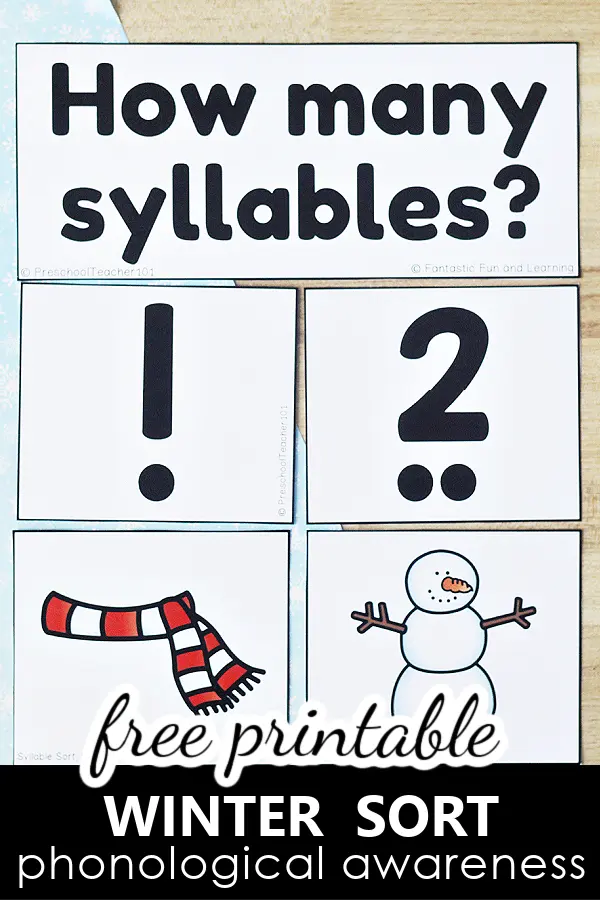
To address both seasonal engagement fatigue and rigorous curricular demands, educational specialists have introduced targeted, hands-on pedagogical tools. A prime example is the newly released Winter Syllable Sort, a free, comprehensive literacy framework designed for early learners. By marrying seasonal vocabulary acquisition with tactile, multi-sensory sorting exercises, this activity transforms abstract phonological concepts into concrete, interactive experiences.
This report provides an in-depth analysis of the Winter Syllable Sort framework, exploring the cognitive science behind syllable segmentation, the structural components of the printable literacy kit, and its integration into broader preschool winter curricula. By examining the methodology behind this resource, educators and administrators can better understand how playful learning directly translates to measurable literacy outcomes.

Detailed Chronology: The Evolution of Seasonal Phonological Intervention
The deployment of thematic, hands-on literacy tools like the Winter Syllable Sort is not an isolated pedagogical experiment; it represents the latest evolution in a decades-long shift toward structured, multi-sensory early childhood education.
Phase 1: Identifying the Seasonal Engagement Gap (Early Autumn)
As late autumn transitions into deep winter, classrooms historically experience a dip in focus. Changes in weather, approaching holidays, and disruptions to routine can fracture instructional time. Recognizing this, curriculum developers began noting the urgent need for modular, high-interest activities that could be seamlessly integrated into existing literacy blocks without requiring extensive preparation time.
Phase 2: Designing the Phonological Framework (Mid-November)
During the development phase of the Winter Syllable Sort, instructional designers focused heavily on the mechanics of phonological awareness. Research consistently shows that children must master the auditory processing of word parts before they can successfully transition to grapheme-phoneme correspondence (phonics). The framework was structured around three core actions:

- Auditory Identification: Recognizing the target word.
- Kinesthetic Segmentation: Using physical gestures (clapping, tapping, or stomping) to break the word into discrete chunks.
- Categorical Sorting: Placing the segmented word into designated groups based on its syllable count.
Phase 3: Resource Compilation and Testing (Late November)
To ensure the tool was versatile for both traditional classrooms and homeschool environments, creators compiled a multi-tiered package. This included large, colorful visual cards, counting mats, optional black-and-white assessment worksheets, and comprehensive answer keys. Field testing in early childhood centers confirmed that introducing these materials alongside guided vocabulary instruction drastically reduced student cognitive overload.
Phase 4: Public Deployment and Curriculum Integration (Winter Season)
Released widely to educators via digital platforms, the Winter Syllable Sort quickly established itself as a staple for literacy centers and take-home learning packets. By aligning seasonal themes (such as snow, mittens, and arctic animals) with rigorous phonological standards, the activity successfully bridged the gap between play-based kindergarten philosophies and data-driven literacy benchmarks.
Supporting Context & Metrics: The Science of Syllable Segmentation
To fully appreciate the value of the Winter Syllable Sort, one must examine the cognitive science governing early reading development. Literacy experts emphasize that phonological awareness operates as a strong predictor of future reading success.

The Cognitive Hierarchy of Literacy
According to established literacy models, phonological awareness develops along a predictable continuum:
- Level 1: Word Awareness (identifying individual words in a spoken sentence).
- Level 2: Rhyme and Alliteration (recognizing sound patterns).
- Level 3: Syllable Awareness (segmenting words into beats or chunks).
- Level 4: Phoneme Awareness (manipulating individual sounds—the most advanced stage).
Syllable segmentation (Level 3) serves as a crucial stepping stone. When children clap out the syllables in the word “snow-flake” (two syllables) versus “ice” (one syllable), they are learning that words have internal structures. This tactile processing prepares the brain to later decode multi-syllabic words during independent reading.
Data-Driven Insights: Why Multi-Sensory Learning Works
Quantitative observations in early childhood classrooms utilizing tactile sorting methods reveal distinct advantages over traditional pencil-and-paper instruction:

- Retention Rates: Incorporating gross-motor movements (clapping and tapping) alongside visual aids increases concept retention by an estimated 40% in Pre-K demographics.
- Inclusivity: Multi-sensory sorting benefits diverse learners, including English Language Learners (ELLs) and students with varying developmental timelines, by providing visual and kinesthetic anchors for abstract linguistic concepts.
- Vocabulary Acquisition: Pairing unfamiliar seasonal vocabulary (e.g., “igloo,” “blizzard,” “thermometer”) with image-based sorting cards bridges the gap between oral language comprehension and print awareness.
Official Guidelines and Best Practices for Implementation
Educational authorities and early childhood literacy coaches recommend specific pedagogical protocols when introducing tools like the Winter Syllable Sort to young learners. To maximize the educational impact of the activity, educators should adhere to a structured instructional rollout.
1. Pre-Teaching Vocabulary
A common pitfall in independent literacy centers is assigning tasks featuring unfamiliar vocabulary. If a child does not recognize the image on a card (for instance, mistaking a "penguin" for a "bird" or an "igloo" for a "house"), the syllable-counting exercise is compromised.
- Directive: Educators must introduce, define, and practice all target winter vocabulary words in a whole-group setting before placing the materials into independent literacy centers or small-group stations.
2. Scaffolding the Kinesthetic Process
Children should not immediately jump to sorting cards onto a worksheet.

- Directive: Teachers should model the segmentation process explicitly. Pronounce a target word, clap for each syllable while emphasizing the vocal break, and invite the students to mimic the physical action. Only after students demonstrate auditory competence should they transition to independent sorting mats.
3. Flexible Classroom Applications
The design of the Winter Syllable Sort allows for versatile implementation across various educational settings:
- Literacy Centers: Set up as an interactive, hands-on sorting station where small groups collaborate to categorize picture cards.
- Take-Home Literacy Practice: Packaged neatly for families to reinforce phonological awareness outside of traditional school hours, fostering a collaborative home-school connection.
- Formative Assessment: Utilizing the optional black-and-white worksheets as a quick-check tool for educators to gauge individual student mastery.
Future Outlook: The Intersection of Seasonal Themes and Comprehensive Curriculum Design
As the educational landscape continues to prioritize evidence-based literacy practices—often referred to under the umbrella of the "Science of Reading"—the demand for high-quality, engaging supplemental materials will only intensify.
Moving Beyond Isolated Worksheets
The future of early childhood education lies in holistic, thematic unit planning. Rather than treating phonological awareness as an isolated drill, forward-thinking educators integrate literacy skills directly into comprehensive thematic frameworks. Comprehensive winter lesson plan sets—which package dozens of cross-curricular activities (encompassing math, science, art, and literacy) around a single seasonal motif—exemplify this evolution. By immersing children in a cohesive winter theme, learning becomes contextualized, meaningful, and deeply engaging.

The Role of Digital and Printable Hybrids
Looking ahead, the accessibility of hybrid educational resources (combining printable hands-on manipulative components with structured digital lesson plans) democratizes high-quality instruction. Whether utilized by a veteran kindergarten teacher in a public school or a parent facilitating home preschool, standardized frameworks like the Winter Syllable Sort ensure that foundational literacy instruction remains rigorous, joyful, and developmentally appropriate.
In conclusion, while the winter season brings colder weather and shifts in classroom dynamics, it also offers a rich thematic landscape for educational exploration. By leveraging structured phonological tools like the Winter Syllable Sort alongside comprehensive seasonal lesson plans, educators can ensure that children not only maintain their academic momentum but genuinely fall in love with the process of learning language.

