
Executive Overview
In the dynamic and ever-evolving landscape of English as a Second Language (ESL) education, the mastery of complex sentence structures remains a formidable milestone for learners transitioning from elementary proficiency to advanced fluency. Bridging the gap between basic communicative competence and sophisticated academic or professional discourse requires targeted pedagogical tools that demystify English syntax.
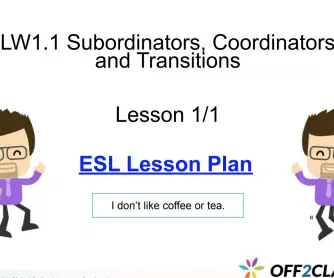
Addressing this critical educational need, educator and curriculum developer Nathan Martin has released a specialized instructional resource: a meticulously designed lesson plan focusing on subordinators, coordinators, and transitions. Hosted on the prominent educational platform BusyTeacher, this resource is tailored specifically for intermediate-level (B1+) students.
The significance of this release extends far beyond a simple grammar worksheet. At its core, the instructional package addresses a pervasive challenge in second-language acquisition: how to guide learners away from fragmented, elementary sentence structures and toward cohesive, fluid, and contextually appropriate discourse. By systematically examining how clauses interact and how transitional words bridge disparate ideas, the lesson plan equips students with the structural scaffolding necessary for both written compositions and spoken registers.
This investigative report provides an in-depth analysis of the new educational resource. Drawing upon metrics from the platform, pedagogical theory, and broader trends in ESL grammar instruction, we will explore the structural components of the lesson plan, the theoretical rationale behind teaching conjunctions and transitions at the intermediate level, and the profound implications this resource holds for educators striving to elevate student writing and speaking proficiency.
Detailed Chronology and Development of the Resource
The journey of modern educational resources—from conceptualization by an instructor to digital dissemination and eventual community refinement—reflects the collaborative nature of contemporary digital pedagogy. While the exact timeline of the resource’s conceptualization by author Nathan Martin remains internal to his curriculum development process, the digital footprint of the artifact reveals key milestones in its release and integration into the global ESL ecosystem.
Phase 1: Conceptualization and Design
The development of targeted grammar materials for intermediate learners requires a delicate balance of cognitive challenge and accessibility. For B1+ students, the foundational mechanics of subject-verb agreement and simple sentence construction are typically mastered. However, the synthesis of multiple thoughts into complex, compound, and complex-compound sentences often leads to frequent errors, such as run-on sentences, comma splices, and the misuse of transitional markers.
Recognizing these instructional bottlenecks, Martin structured the lesson plan to dissect sentence connectors into three distinct yet interrelated categories:
- Subordinators: Words that introduce dependent clauses and establish hierarchical relationships between ideas (e.g., although, because, since, unless).
- Coordinators: Conjunctions that link words, phrases, or independent clauses of equal grammatical rank, famously remembered by the acronym FANBOYS (for, and, nor, but, or, yet, so).
- Transitions: Conjunctive adverbs and phrases that signal logical relationships between sentences or paragraphs, guiding the reader or listener through shifts in thought (e.g., furthermore, consequently, meanwhile, however).
Phase 2: Digital Publication and Metadata Integration
The instructional package was officially cataloged and made available to the global teaching community, securing its place within specialized grammatical archives. Categorized under fundamental structural tags—specifically Adverb Clauses, Noun Clauses, and general Verbs—the resource was indexed to ensure maximum discoverability for educators seeking advanced syntactical materials.
Upon its release, the lesson plan was immediately designated for the Intermediate proficiency tier. This classification is vital, as introducing these concepts too early can overwhelm novice learners, while delaying them leaves upper-level students struggling with fossilized errors in syntax and cohesion.
Phase 3: Community Review and Quality Control
A defining characteristic of modern educational resource platforms is the integration of crowdsourced quality assurance. The platform hosting Martin’s lesson plan incorporates a rigorous revision mechanism. Educators utilizing the materials in live classrooms are empowered to report discrepancies, typos, or conceptual ambiguities through an interactive upload and correction portal (/engine/ajax/upload.revision.php).
This crowdsourced peer-review framework ensures that instructional materials remain error-free and up-to-date. At the time of this writing, the resource has garnered an initial rating of 5 out of 5 stars, evaluated by early-adopting educators who have tested its efficacy in real-world classroom environments.
Supporting Context & Metrics: Analyzing the Digital Footprint
To fully understand the impact of Nathan Martin’s lesson plan, one must examine the quantitative and qualitative metrics surrounding its distribution. In the digital education marketplace, engagement statistics offer invaluable insights into teacher demand, pedagogical pain points, and resource utilization.
Traffic and Engagement Metrics
Despite being a relatively recent addition to the digital curriculum repository, the lesson plan has experienced robust early adoption:
- Total Views: 19,457 views, indicating high initial interest and a strong demand for materials focusing on sentence-level mechanics.
- Target Audience Level: Intermediate (B1+), representing the largest demographic of ESL learners worldwide—those transitioning from basic survival English to professional or academic proficiency.
- User Rating: A flawless 5/5 aggregate score, albeit based on an initial cohort of 1 rating teacher, signaling strong preliminary satisfaction with the instructional clarity and usability of the download.
- File Specifications: Available as a downloadable digital asset (
lw1.pdf), the resource is compact yet comprehensive, with a file size optimized for rapid downloading across diverse global network infrastructures (721.7 KB).
The Pedagogical Significance of B1+ Syntax Instruction
Why do metrics consistently show high demand for materials addressing subordinators, coordinators, and transitions?
In second language acquisition research, the intermediate plateau is a well-documented phenomenon. At this stage, students possess a functional vocabulary and a grasp of core verb tenses, yet their output often sounds disjointed or overly simplistic. They write in a series of short, choppy sentences: I went to the store. I bought apples. I forgot my wallet.
Teaching students how to manipulate subordinating and coordinating conjunctions transforms their output. It allows them to express cause and effect ("I went to the store because I needed apples"), contrast ("I wanted to buy apples, but I forgot my wallet"), and condition ("If I had remembered my wallet, I could have bought apples").
Furthermore, the inclusion of transitions elevates student writing from conversational storytelling to formal expository and academic discourse. Without transitions, essays lack cohesive flow. By integrating words like consequently, in addition, and on the other hand, intermediate learners bridge the gap between spoken registers and formal written texts.
Official Guidelines and Pedagogical Implementation
A successful lesson plan must do more than simply present definitions and lists of vocabulary; it must provide actionable methodological guidelines for the instructor. Martin’s lesson plan emphasizes a crucial directive for educators: contextual appropriateness.
Navigating Formal vs. Informal Contexts
One of the primary pitfalls in teaching English connectors is treating them as universally interchangeable. However, native usage dictates strict boundaries regarding where and when specific words and phrases should be deployed.
- Informal Contexts (Spoken and Conversational): In everyday speech, speakers frequently rely on simple coordinators (and, but, so) and casual transitions (anyway, plus, so). Overusing formal academic transitions (such as furthermore or conversely) in casual conversation sounds stilted and unnatural.
- Formal Contexts (Written and Academic Registers): Conversely, relying exclusively on conversational connectors in academic essays or business reports results in poor stylistic register. Students must learn that written English—particularly academic prose—demands precise subordinators and sophisticated transitions to maintain an authoritative tone.
Instructional Strategies for the Classroom
To effectively deliver the concepts outlined in the lesson plan, educators are encouraged to implement a multi-staged instructional approach:
- Diagnostic Identification: Begin by presenting students with a paragraph devoid of connectors or filled with repetitive, choppy sentences. Ask them to read it aloud and identify why it feels unnatural.
- Categorical Sorting: Introduce subordinators, coordinators, and transitions through sorting activities. Have students categorize various connecting words based on their function (addition, contrast, cause/effect, time sequence).
- Sentence Combining Exercises: Provide isolated simple sentences and challenge students to combine them using appropriate subordinators or coordinators, paying careful attention to punctuation (e.g., the necessity of commas before coordinating conjunctions joining independent clauses, or semicolons preceding certain transitional adverbs).
- Register Shifting Tasks: Give students a short, informally written paragraph and ask them to rewrite it for an academic audience by upgrading the transition words and adjusting the clause structures. This directly addresses Martin’s core recommendation regarding spoken versus written registers.
Future Outlook: The Evolution of Grammar Pedagogy in the Digital Age
As we look toward the future of English language teaching, the role of static worksheets and downloadable lesson plans is undergoing a significant transformation. How will resources like Nathan Martin’s lesson on subordinators, coordinators, and transitions adapt to the changing educational landscape?
The Integration of Artificial Intelligence in Syntax Training
While traditional lesson plans provide the foundational framework, the future of grammar instruction lies in the intersection of structured pedagogical design and generative artificial intelligence.
In the coming years, we can anticipate that static PDF worksheets will increasingly serve as springboards for interactive, AI-driven practice. For instance, an AI language model could be programmed with the exact parameters of Martin’s lesson plan, generating limitless, personalized sentence-combining exercises tailored to an individual student’s specific error patterns. If a student consistently struggles with concessive subordinators (although, even though), the AI can dynamically adjust subsequent exercises to reinforce those specific structures.
The Shift Toward Multimodal Literacy
Modern communication is no longer confined to traditional print essays. Today’s intermediate ESL learners must navigate digital communication mediums—ranging from professional emails and Slack channels to academic research papers and multimedia presentations.
Future iterations of transition and conjunction lesson plans will likely expand their scope to address digital registers. Teaching students how to use transitional phrases effectively in business emails, where brevity and clarity are paramount, differs vastly from teaching transitions for a 2,500-word university research paper. Integrating these modern communicative contexts will ensure that grammar instruction remains relevant and immediately applicable to students’ real-world needs.
Collaborative Curriculum Development
Platforms that host community-driven resources, such as the one featuring Martin’s work, point the way forward for teacher professional development. The ability for educators worldwide to download, test, review, and suggest revisions to a lesson plan creates a global laboratory for pedagogical innovation. As these collaborative networks expand, the quality, cultural adaptability, and inclusivity of ESL materials will continue to rise.
Conclusion
Nathan Martin’s lesson plan on subordinators, coordinators, and transitions represents a vital contribution to intermediate ESL pedagogy. By targeting the syntactical bottlenecks that trap learners in the intermediate plateau, the resource provides educators with a clear, structured pathway to guide students toward greater fluency, cohesion, and stylistic awareness.
With its strong emphasis on distinguishing between formal and informal registers, spoken and written modalities, and grammatical categories, the lesson plan transcends rote memorization. It empowers students to construct sentences that are not only grammatically correct but also rhetorically effective. As digital educational platforms continue to evolve through community feedback and technological integration, resources of this caliber will remain foundational stones in the global architecture of English language education.

