
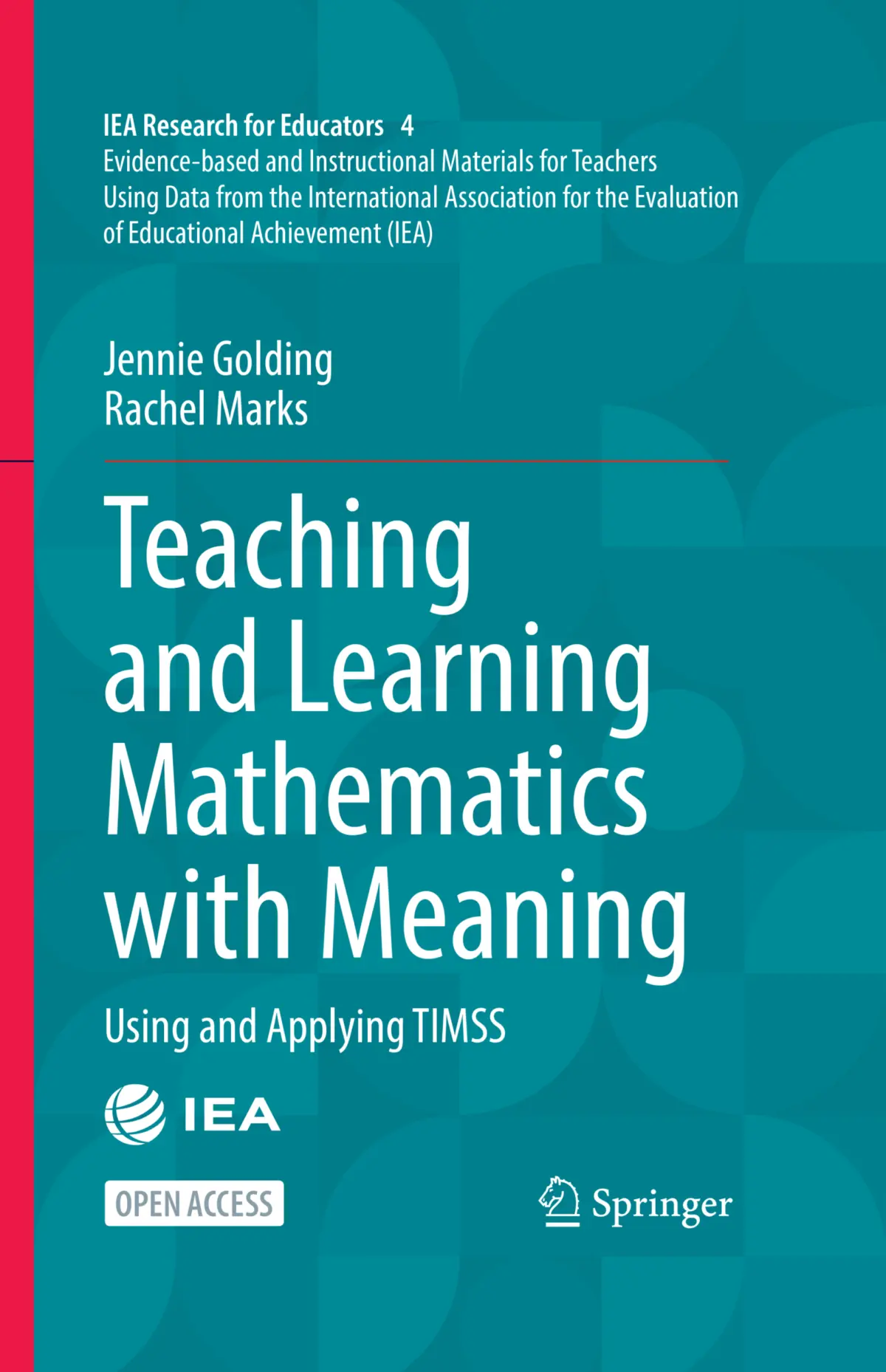
Executive Overview: A New Era for Evidence-Based Mathematics
In the landscape of global education, the "Trends in International Mathematics and Science Study" (TIMSS) has long been regarded as the gold standard for comparative assessment. However, for decades, a persistent criticism has shadowed these massive data sets: the disconnect between high-level statistical findings and the daily realities of the classroom teacher. The upcoming 2026 release of Teaching and Learning Mathematics with Meaning: Using and Applying TIMSS, authored by renowned educators Jennie Golding and Rachel Marks, marks a definitive shift in this paradigm.
Published as Volume 4 of the IEA (International Association for the Evaluation of Educational Achievement) Research for Educators series by Springer, this seminal work seeks to transform cold metrics into warm pedagogy. At its core, the publication addresses a critical crisis in modern education—the mechanical "rote" learning of mathematics versus the deep, conceptual "meaning-making" required for 21st-century problem-solving. By synthesizing decades of TIMSS data into actionable, open-access resources, Golding and Marks provide a roadmap for teachers and teacher trainers to move beyond test scores and toward a holistic understanding of mathematical reasoning.
This article explores the investigative journey behind this publication, the metrics that necessitate such a shift, and the potential for these resources to redefine how mathematics is taught across diverse geopolitical landscapes.
Detailed Chronology: From Data Collection to Classroom Application
The Genesis of the IEA Research for Educators Series
The journey toward Volume 4 began with a realization within the IEA leadership. Since its inception in 1995, TIMSS has provided a "fever chart" for global education, allowing nations to benchmark their students’ performance against international standards. Yet, while policymakers used these rankings to adjust national curricula, the actual practitioners—the teachers—often felt the data was too abstract to influence their lesson plans.
In the early 2020s, the IEA launched the "Research for Educators" series specifically to bridge this gap. The goal was to take the massive longitudinal data from TIMSS and PIRLS (Progress in International Reading Literacy Study) and distill it into thematic volumes that focus on "how" to teach rather than just "what" was measured.
The Development of Volume 4 (2023–2025)
The selection of Jennie Golding and Rachel Marks as lead authors was a strategic move. Based at the UCL Institute of Education, both scholars have spent their careers investigating the intersection of curriculum policy and classroom practice. Between 2023 and 2025, the authors engaged in a rigorous synthesis of TIMSS cycles, specifically looking at the "cognitive domains" of the assessment: Knowing, Applying, and Reasoning.
Their research focused on a recurring trend in the data: students often perform well in the "Knowing" domain (recalling facts and procedures) but see a significant drop-off in the "Reasoning" domain (analyzing, generalizing, and integrating knowledge). This "Reasoning Gap" became the catalyst for the book’s focus on meaning-making.
The 2026 Release and the Open Access Mandate
Scheduled for formal release in 2026, the publication is set to be a cornerstone of the Springer IEA series. Crucially, the decision was made to offer the resources as "Open Access." This investigative look into the publication’s history reveals that the IEA and Springer prioritized global equity, ensuring that educators in low-income regions have the same access to these high-level pedagogical strategies as those in high-performing educational hubs like Singapore or Finland.
Supporting Context & Metrics: The "Reasoning Gap" by the Numbers
To understand the necessity of this book, one must look at the underlying metrics provided by the TIMSS 2019 and 2023 cycles. These statistics highlight a global "meaning-making" deficit that Volume 4 intends to rectify.
The Cognitive Domain Disparity
In the TIMSS Grade 4 and Grade 8 assessments, questions are categorized by cognitive demand. A cross-national analysis of the last decade shows a startling trend:
- The "Knowing" Proficiency: Approximately 75-80% of students in participating countries can successfully perform routine mathematical procedures.
- The "Reasoning" Deficit: Less than 30% of students in the same cohort can successfully complete tasks that require non-routine problem solving or justifying their mathematical conclusions.
The Socio-Economic Variable
TIMSS data consistently shows that students from disadvantaged backgrounds are more likely to be taught via "direct instruction" focused on rote memorization, whereas students in high-SES (Socio-Economic Status) environments are more likely to engage in "inquiry-based" learning. Volume 4 explicitly targets this inequality by providing structured, evidence-based resources that bring high-level reasoning to all classrooms, regardless of the school’s zip code.
Teacher Confidence Metrics
IEA teacher questionnaires revealed that while 90% of teachers feel "very confident" in teaching basic arithmetic, only 55% feel "very confident" in teaching students how to generalize mathematical patterns or conduct abstract reasoning. This 35% "confidence gap" is the primary target of the professional development resources included in the Golding and Marks volume.
Official Statements: Perspectives from the Vanguard
The publication has already garnered significant attention from the global educational community. While the book is a technical resource, the philosophy behind it is deeply humanistic.
Jennie Golding, Lead Author and Associate Professor at UCL:
"Mathematics is not a collection of recipes to be followed; it is a language for describing the world. Our goal with Volume 4 was to take the vast evidence provided by TIMSS and show teachers that ‘meaning-making’ isn’t an elective luxury—it is the foundation upon which all mathematical fluency is built. If a student doesn’t understand ‘why’ a formula works, they don’t truly know the mathematics."
Rachel Marks, Co-Author and Expert in Mathematics Education:
"We observed through the TIMSS data that there is often a fear of ‘problem-solving’ in the classroom because it feels unpredictable. This book provides a scaffolded approach. We aren’t just giving teachers a list of problems; we are giving them a framework for how to facilitate mathematical talk and how to encourage students to take risks in their reasoning."
IEA Leadership Statement:
"The IEA is committed to ensuring that our research doesn’t just sit on a shelf in a ministry of education. By partnering with Springer for this series, we are putting the power of international data directly into the hands of the people who matter most: the teachers. Volume 4 represents our most ambitious effort yet to translate data into better learning outcomes for children worldwide."
Future Outlook: Transforming the Global Classroom
As we look toward the 2026 launch and beyond, the impact of Teaching and Learning Mathematics with Meaning is expected to ripple through several layers of the education sector.
1. The Redefinition of Teacher Training
The volume is designed not just for individual teachers, but for teacher trainers. We expect to see these resources integrated into university-level Initial Teacher Education (ITE) programs. By standardizing the "meaning-making" approach based on TIMSS evidence, the next generation of educators will enter the workforce with a more sophisticated understanding of how to bridge the gap between theory and practice.
2. Influencing Curriculum Reform
As nations prepare for the TIMSS 2027 cycle, the frameworks established in Volume 4 will likely influence national curriculum reviews. Governments that have struggled to move their students into the "Advanced International Benchmark" will look to the Golding and Marks model as a blueprint for shifting from a content-heavy curriculum to a process-heavy one.
3. The Role of Artificial Intelligence in Mathematics
The future of math education is inextricably linked to AI. As large language models become capable of solving routine "Knowing" and "Applying" tasks, the human element of mathematics—Reasoning and Meaning-Making—becomes more valuable than ever. Volume 4 positions students to thrive in an AI-driven world by focusing on the very skills that machines cannot yet replicate: original mathematical thought and the ability to contextualize abstract data.
4. Open-Access Equity
Perhaps the most significant future impact is the democratization of pedagogical expertise. By being open-access, Volume 4 ensures that a teacher in a rural school in sub-Saharan Africa or a remote village in Southeast Asia can access the same evidence-based strategies as a teacher in London or New York. This is a vital step toward closing the global achievement gap.
Conclusion
The release of Teaching and Learning Mathematics with Meaning: Using and Applying TIMSS is more than just a book launch; it is a call to action for the global education community. By turning the lens of TIMSS away from mere assessment and toward active instruction, Golding and Marks have provided a vital service. In a world increasingly defined by data, the ability to find meaning within that data—to reason, to argue, and to solve—is the most essential skill we can pass on to the next generation. As 2026 approaches, the educational world waits with anticipation for a tool that promises to turn the "dreaded math class" into a sanctuary of understanding.

