
Executive Overview
Every educator knows the quiet, sinking feeling of watching a math classroom split in two. On one side are the students who have fully grasped the current unit’s prerequisites, eagerly racing ahead into new material. On the other side are the students who missed crucial foundational skills two or three grade levels prior, leaving them stranded as today’s grade-level content attempts to build on shaky ground.
For decades, the challenge of differentiated instruction has never been a lack of teacher effort, but rather the sheer logistical impossibility of being truly responsive within a single, unified lesson. When a teacher faces twenty-five students, they are effectively managing twenty-five distinct learning paths, sequences, and personal confidence levels. Crafting a customized curriculum for every individual learner has long been considered the Holy Grail of education—and one of its most elusive.
Enter Kahoot! Math Games and Math Missions, a robust suite of digital learning tools designed to tackle these exact instructional bottlenecks. By combining gamified, target-specific interventions with adaptive self-paced practice, Kahoot! is redefining how educators diagnose conceptual gaps, scaffold difficult topics, and deliver personalized learning at scale—all without burying teachers in mountains of prep work or endless worksheets.
Detailed Chronology & Pedagogical Evolution
The development of Kahoot!’s targeted math ecosystem did not happen in a vacuum. It represents a deliberate evolution in EdTech, moving away from generic, high-stakes trivia games toward deep, concept-specific skill building.
Phase 1: Identifying the Classroom Divide
As educational standards shifted toward deeper conceptual understanding rather than rote memorization, teachers found themselves dealing with widening achievement gaps. Traditional drills could quickly show who got an answer wrong, but they failed to explain why. Educators needed diagnostic tools that could pinpoint specific cognitive hurdles—such as confusing a count with a quantity, or failing to visualize multiplication as arrays—before those hurdles manifested into chronic math anxiety.
Phase 2: Building Targeted Interventions
To address this, the creators of Kahoot! developed specialized game modes designed to isolate and conquer fundamental math misconceptions. Rather than offering one-size-fits-all quizzes, developers created dedicated modules:
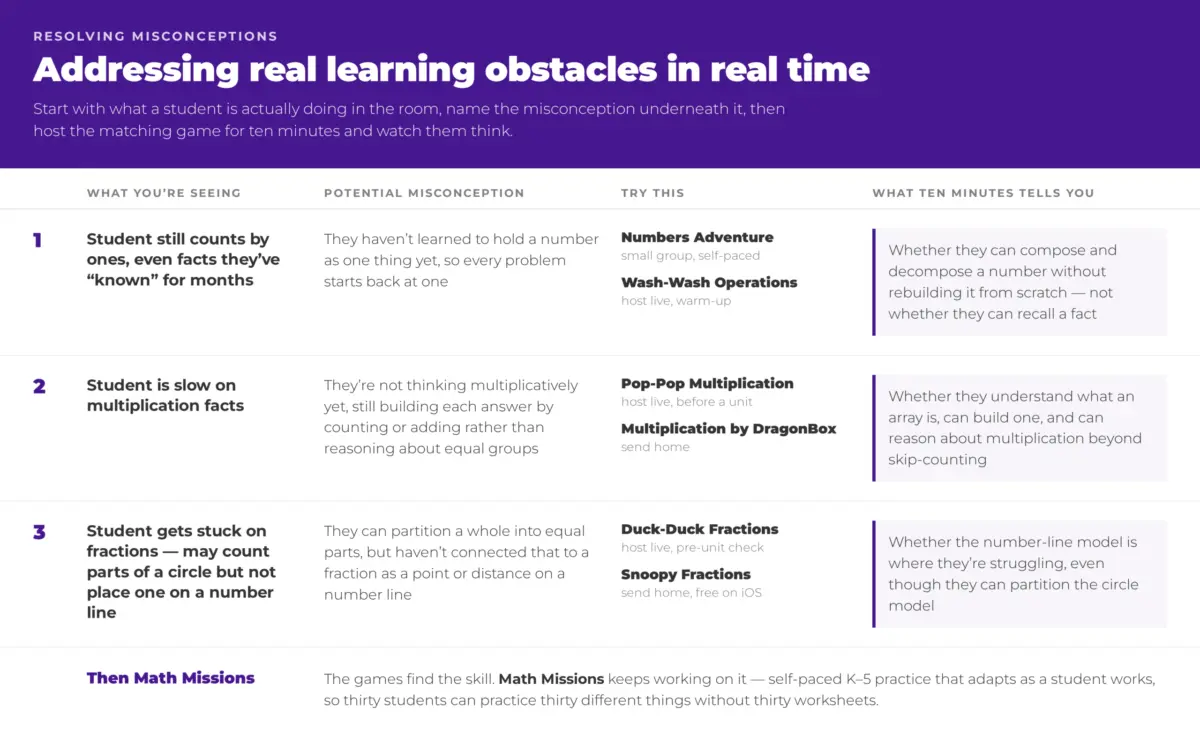
- Numbers Adventure: Focused on low-pressure, level-based counting and quantity comparison.
- Pop-Pop Multiplications: Utilizing visual array structures to teach multiplication as equal groups.
- Duck-Duck Fractions: Bridging the conceptual gap between slicing geometric shapes and plotting points on a number line.
Phase 3: The Introduction of Adaptive Practice (Math Missions)
Recognizing that isolated game sessions are only part of the puzzle, Kahoot! introduced Math Missions—a self-paced, K-5 practice environment that dynamically adapts to a student’s real-time performance. This allowed teachers to transition from reactive teaching to proactive, continuous scaffolding, turning independent practice time into an engine for personalized growth.
Supporting Context & Metrics: Tackling the Three Core Math Misconceptions
To understand the efficacy of Kahoot!’s approach, it is vital to examine the specific mathematical stumbling blocks the platform targets, along with the psychological and pedagogical reasons traditional methods fall short.
Misconception One: A Number Is a Count, Not a Quantity
When a student struggles to hold a true sense of quantity in their head, every subsequent mathematical operation demands exponentially more time, mental effort, and emotional capital. A fourth-grader who still relies on finger-counting possesses an unfinished foundation that will inevitably destabilize their journey into multiplication, division, and fractions.
- The Kahoot! Solution: Educators can deploy Numbers Adventure for small groups or individual students. Because the game utilizes a world-and-level progression, students who need to reinforce early-stage counting can do so privately, free from peer comparison. For whole-class settings, Wash-Wash Operations serves as a high-engagement, five-minute live warm-up covering all four operations.
- Pedagogical Impact: Both tools force students to physically manipulate quantities rather than mechanically recall isolated facts. Because Numbers Adventure operates as a solo experience, vulnerable learners can rebuild their fundamental number sense without an audience.
Misconception Two: Multiplying Without Thinking in Groups
When students fail to visualize multiplication as a collection of equal groups, every single multiplication fact becomes an isolated piece of trivia to memorize rather than a logical relationship they can reason through. Slow recall at this stage creates a cascading failure point that later sabotages both algebraic thinking and fraction operations.
- The Kahoot! Solution: Teachers can host Pop-Pop Multiplications live as a ten-minute diagnostic check before launching a new division unit. In this game, students drag characters into a shared play area to construct visual arrays, forcing them to interact with multiplication as a physical structure. Following this, educators can assign Kahoot! Multiplication by DragonBox for targeted at-home practice.
- Pedagogical Impact: The array model instantly separates the student who simply hasn’t memorized their flashcards from the student who fundamentally misunderstands what multiplication represents. Traditional timed drills are structurally incapable of making this distinction.
Misconception Three: Splitting a Shape Is Not the Same as Placing a Point
A vast majority of elementary students can successfully cut a circle or a rectangle into equal fractional parts long before they can accurately plot that same fraction as a discrete point on a number line. This exact cognitive disconnect is where fractional anxiety typically begins.
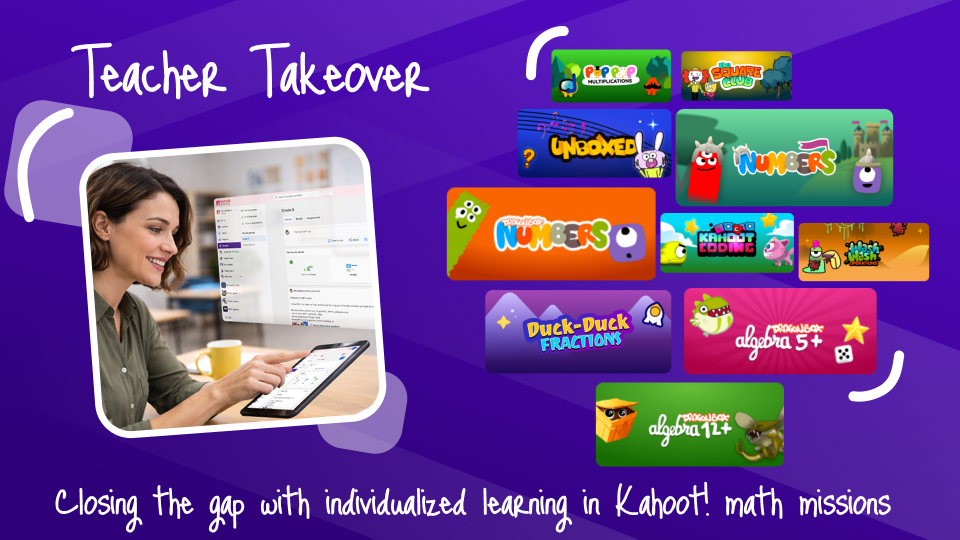
- The Kahoot! Solution: Hosting Duck-Duck Fractions live acts as an invaluable pre-unit check. Teachers can run a ten-minute playlist where students join via a standard game PIN. By observing where students hesitate—whether they stumble on circular models or linear number lines—teachers gain immediate insight into distinct conceptual errors. Afterward, Snoopy Fractions can be assigned for independent practice.
- Pedagogical Impact: These games explicitly train students in the exact kind of representational flexibility demanded by modern math standards, allowing educators to map out their instructional units based on real-time classroom data rather than post-test post-mortems.
Official Statements and Educator Insights
The real-world viability of any EdTech tool ultimately rests in the hands of classroom teachers. If a resource requires hours of daily preparation, it rarely survives a full academic teaching week. Fortunately, educators utilizing Kahoot! Math Games and Math Missions have reported transformative results.
"Math Missions can be useful for identifying which concepts students have understood and which areas may need further explanation or practice," notes Ika M., a Kahoot! Ambassador based in Indonesia, who frequently deploys the tool for post-lesson reviews.
Ika emphasizes that the platform fundamentally alters the student experience of practicing mathematics:
"It makes mathematics practice feel more like an active learning experience rather than a traditional worksheet or quiz. Best of all, it can be integrated into a lesson without requiring a lot of additional preparation."
By removing the administrative friction typically associated with differentiated instruction, teachers are empowered to reclaim valuable planning time while providing students with hyper-targeted, autonomous learning opportunities.
The Role of Math Missions in Autonomous Learning
While targeted live games provide incredible diagnostic snapshots, Math Missions serves as the structural glue that holds independent practice together. Operating as a self-paced K-5 environment, Math Missions continuously adapts to each individual user as they work through problems.
Integrating a fifteen-minute Math Missions session into the wrap-up of a daily lesson allows educators to meet every single student precisely where they are—without the exhausting task of designing fifteen distinct worksheets. Whether utilized during rotating learning centers or assigned as independent review work, this targeted time fosters true student autonomy.
Furthermore, Math Missions transforms independent practice from a passive chore into an active diagnostic feedback loop. Teachers no longer have to wait for graded assignments to discover who is falling behind; the platform’s detailed reporting features provide continuous, actionable data streams.
Future Outlook: The Next Generation of Differentiated Classrooms
As educational technology continues to mature, the demand for sophisticated, adaptable pedagogical tools will only accelerate. The era of the monolithic, one-size-fits-all classroom is rapidly giving way to flexible, data-driven learning environments where students progress based on mastery rather than age or arbitrary pacing schedules.
Tools like Kahoot! Math Games—available across web browsers and mobile apps, with advanced standards-tagging and robust reporting suites accessible via Kahoot! EDU and Kahoot!+ plans—point the way forward. By seamlessly blending gamified engagement with rigorous, standards-aligned cognitive science, platforms are proving that differentiated instruction does not have to be an impossible dream for hardworking educators.
Actionable Takeaway for Educators:
To begin transforming your own mathematics instruction, identify the single misconception you suspect is currently holding your students back—whether it lies in number sense, multiplication fluency, or fraction comprehension. Host the corresponding Kahoot! game live before launching your next unit of study, and let Math Missions carry the torch of adaptive, personalized practice from there.

