
Executive Overview
For generations, the realm of chemistry education has faced a formidable psychological barrier among young learners. Mention terms like "titration," "hydrogen ions," or "pH scales" in a standard classroom, and educators are frequently met with a chorus of groans and disengaged sighs. Chemistry is too often perceived as an abstract, textbook-bound discipline fraught with intimidating jargon and hazardous substances best left behind high-school or university laboratory doors.
However, a paradigm shift is underway within modern STEM (Science, Technology, Engineering, and Mathematics) education. Forward-thinking educators, curriculum developers, and parental advocates are proving that foundational chemical concepts—specifically the study of acids and bases—do not require sterile, intimidating laboratories to be understood. Instead, these principles can be masterfully unraveled using common household items, culinary experiments, and visually arresting hands-on activities.
This comprehensive report explores the pedagogical necessity of introducing chemical literacy at an early age, breaks down the core scientific mechanisms governing acids and bases, and details five engaging, field-tested projects designed to transform passive learners into enthusiastic young scientists. By bridging the gap between theoretical chemistry and everyday kitchen science, this educational movement is actively dismantling the fear of STEM and fostering a lifelong curiosity about the physical world.
Detailed Chronology: The Evolution of Acid-Base Chemistry and Its Pedagogical Turn
To understand why modern educators are shifting toward hands-on chemistry, it is helpful to examine how our understanding of acids and bases has evolved historically, and how teaching methodologies have adapted to meet the needs of contemporary students.
The Historical Framework of Chemical Understanding
- Pre-17th Century (Empirical Observations): Early alchemists and natural philosophers classified substances based entirely on sensory perception and empirical utility. Substances that tasted sour were generally grouped together, while those that felt soapy or slippery were categorized separately. There was little understanding of the atomic or molecular underpinnings causing these traits.
- 1661 (The Robert Boyle Era): Pioneering chemist Robert Boyle introduced some of the earliest systematic criteria for identifying acids and bases. He observed that acids change the color of certain natural plant extracts (such as syrup of violets), laying the foundational concept for chemical indicators.
- 1887 (The Arrhenius Theory): Swedish physicist and chemist Svante Arrhenius revolutionized the field by proposing the first ion-based definition of acids and bases. According to Arrhenius, acids are substances that dissociate in water to yield hydrogen ions ($H^+$), while bases yield hydroxide ions ($OH^-$). This marked the transition of chemistry from a descriptive art into a quantitative science.
- 1923 (Brønsted-Lowry and Lewis Expansions): Johannes Nicolaus Brønsted and Thomas Martin Lowry independently advanced a broader definition based on proton transfer, while Gilbert N. Lewis introduced an electron-pair perspective. These advanced models formed the bedrock of modern chemical education.
- Late 20th to Early 21st Century (The Experiential Revolution): Recognizing a growing deficit in STEM engagement, educational researchers began advocating for constructivist learning models. Rather than memorizing the Arrhenius or Brønsted-Lowry definitions from static textbooks, students were encouraged to experience proton transfers and ion concentrations through tactile, inquiry-based experimentation.
Today, this pedagogical evolution culminates in kitchen-counter laboratories, where students recreate the spirit of historical discovery using lemon juice, baking soda, and red cabbage.
Supporting Context & Metrics: The Science of Acids, Bases, and the pH Scale
Before diving into hands-on projects, educators and students must grasp the underlying chemical architecture that dictates how acids and bases behave.
What Are Acids and Bases?
At their core, acids and bases are solutions defined by their microscopic components: ions. Ions are atoms or molecules that have gained or lost one or more valence electrons, giving them a net electrical charge.
- Acids: Characterized by a high concentration of hydrogen ions ($H^+$). In dietary contexts, acids provide a sharp, tangy, or sour flavor profile. Naturally occurring acids are ubiquitous in our daily lives; citrus fruits such as lemons, limes, and oranges owe their tartness to citric acid, while tomatoes contain malic and citric acids.
- Bases (Alkaline Solutions): Characterized by a high concentration of hydroxide ions ($OH^-$). When dissolved in water, basic solutions typically feature a slick, slimy, or slippery tactile sensation. Common household bases include baking soda (sodium bicarbonate), hand soaps, and the chalk used to line athletic fields. Edible bases often carry a bitter taste profile.
While many acids and bases are benign or even essential to human life, others demand extreme caution. Concentrated sulfuric acid found in automobile batteries can instantly disintegrate textiles, and volatile bases like ammonia emit fumes that pose respiratory hazards, particularly for individuals with asthma or compromised lung function.
The Anatomy of the pH Scale
To systematically measure and compare the relative strength of acidity and alkalinity, scientists utilize the pH scale (potential of Hydrogen).
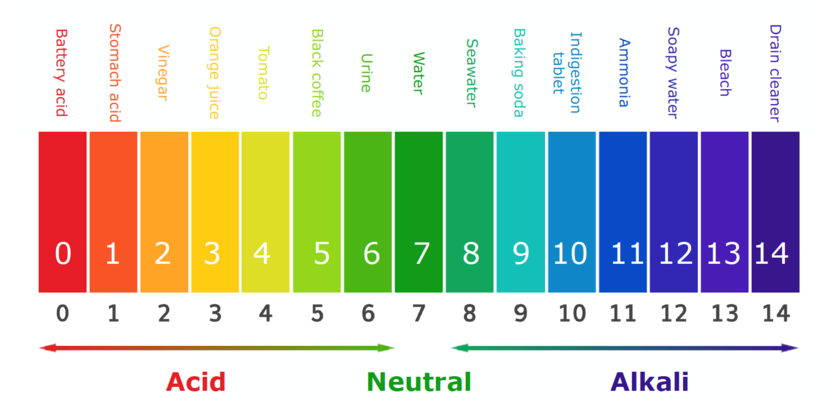
[0 ---- Acidic ---- 6] [7 Neutral] [8 ---- Basic/Alkaline ---- 14]- The Acidic Spectrum (0 to 6.9): The lower the number on the scale, the stronger the acid and the higher the concentration of free hydrogen ions. Strong battery acid sits near the bottom (0–1), while milder culinary acids like vinegar and tomato juice hover in the middle ranges (3–4).
- Neutrality (7.0): Pure water represents the exact equilibrium point, where hydrogen ions and hydroxide ions exist in balanced proportions.
- The Basic Spectrum (7.1 to 14): As numbers climb above 7, solutions become increasingly basic, featuring rising concentrations of hydroxide ions. Baking soda typically measures around 9, while heavy-duty household drain cleaners can push toward the upper limits of 13 or 14.
The Role of Indicator Solutions
Because human biological sensors (taste and touch) are unreliable and frequently dangerous when interacting with concentrated chemicals, scientists rely on indicators. An indicator is a chemical substance—often harvested from nature—that undergoes a distinct, visible color change when it encounters varying concentrations of hydrogen or hydroxide ions.
Classic examples include litmus paper, which is infused with organic dyes derived from lichens. Blue litmus paper transforms into a warm red hue in the presence of an acid, whereas red litmus paper shifts to a cool blue when exposed to a base.
Official Statements & Expert Perspectives
Educational leaders and STEM advocates increasingly emphasize the necessity of early, tactile scientific exposure. Dr. Elena Vance, a prominent cognitive scientist specializing in childhood STEM development, notes:
"Children are natural empiricists. From the moment they mix mud in the backyard or watch soap bubbles expand, they are conducting intuitive physics and chemistry. When we lock chemistry behind impenetrable mathematical formulas and dry theoretical lectures too early, we alienate minds that are primed for visual and tactile learning. Introducing acid-base chemistry through color-changing indicators and physical reactions bridges the gap between innate curiosity and rigorous scientific methodology."
Furthermore, industrial chemists emphasize that an intuitive grasp of pH dynamics forms the foundation for countless modern industries, ranging from environmental conservation and wastewater management to culinary arts and pharmacology.
"Understanding how buffers work, how neutralization occurs, and why pH matters in biological systems is not merely an academic exercise," explains Marcus Thorne, a senior chemical engineer. "It is the literal language of keeping our drinking water clean, our soil fertile for agriculture, and our bodies in a state of chemical homeostasis. Teaching these concepts early through playful experimentation plants the seed for tomorrow’s technological innovations."
Five Hands-On Projects to Teach Acids and Bases
Translating theory into practice requires active participation. Below are five rigorously tested, highly engaging classroom or household projects designed to illuminate the properties of acids, bases, and pH indicators.
1. Red Cabbage Juice as a Natural pH Indicator
Instead of purchasing expensive laboratory litmus paper, students can manufacture their own high-sensitivity pH indicator using an ordinary head of red cabbage. Red cabbage contains a water-soluble pigment molecule called anthocyanin, which changes color depending on the acidity of its environment.
Materials Needed:
- One head of red cabbage
- Distilled water
- A pot and stove (or electric hot plate)
- Strainer and clear glass containers
- White index cards
- Assorted test liquids (e.g., lemon juice, milk, vinegar, baking soda solution, cola)
Procedure:
- Extraction: Coarsely chop the red cabbage and place it in a pot with simmering water. Allow it to heat until the water turns a deep, rich purple/magenta hue as the anthocyanin leaches out.
- Cooling and Straining: Remove the pot from the heat source and allow the liquid to cool completely. Strain the liquid, retaining the vibrant purple juice. (Pro tip: The boiled cabbage can be reserved and seasoned for dinner).
- Making Test Strips: Dip several plain white index cards into the cooled cabbage juice until saturated. Lay them flat on a drying rack. Once dry, cut the cards into neat testing strips.
- Conducting the Test: Pour various household liquids into clear glasses. Before dipping your homemade indicator strips, encourage students to formulate hypotheses: Will milk turn the paper red or blue? What about pickle juice? Dip the strips and observe the color transformations. Anthocyanin turns red/pink in strong acids, purple in neutral solutions, and blue, green, or yellow in basic solutions.
2. Edible Chemical Reactions: Crafting Fizzy Sherbet
Chemical reactions are often visualized as violent explosions in test tubes, but they can also be a delightfully subtle culinary experience. When an acid and a base combine, they neutralize one another, often releasing carbon dioxide gas in the process. Students can safely experience this reaction inside their own mouths by crafting homemade sherbet.
Materials Needed:
- 2 tablespoons of powdered sugar (for texture and flavor)
- 1/2 teaspoon of citric acid (the acid component, safely edible)
- 1/2 teaspoon of baking soda (the base component)
- Flavorings (such as unsweetened flavored gelatin powder or powdered drink mix)
- A mixing bowl or sealable plastic sandwich bag
Procedure:
- Combine the powdered sugar, citric acid, baking soda, and flavoring agent in the mixing bowl or sealable bag.
- Thoroughly mix or shake the dry ingredients until a uniform powder is achieved.
- Instruct students to taste a tiny pinch of the mixture on their tongue.
The Science:
As the dry powder meets the saliva in the mouth, water dissolves the solid crystals, allowing the citric acid and the basic baking soda to interact. This triggers an immediate neutralization reaction, releasing tiny bubbles of carbon dioxide gas ($CO_2$). The resulting effervescence creates a characteristic "fizzy" sensation on the palate, offering a visceral, multisensory demonstration of acid-base dynamics.
3. The Great Penny Shine Challenge
Copper-plated coins left in circulation quickly accumulate tarnish—a dark layer of copper oxide formed when copper reacts with oxygen and other elements in the environment. Acidic and basic solutions interact with metals in vastly different ways, making pennies an ideal medium for exploring chemical reactivity.
Materials Needed:
- Several tarnished, oxidized pennies
- 4 to 5 clear glass cups or bowls
- A selection of testing liquids (e.g., fresh lemon juice, cola, baking soda dissolved in water, liquid dish soap, plain water as a control)
- Notebooks for recording hypotheses and results
Procedure:
- Arrange the clear glasses in a row and fill each with a different testing solution.
- Have students examine the tarnished pennies and record their initial appearance. Ask them to predict which liquid will strip away the copper oxide layer and restore the coin’s brilliant shine most effectively.
- Drop one or two pennies into each glass, ensuring they are fully submerged.
- Allow the coins to soak for 15 to 30 minutes, periodically observing any chemical changes occurring at the metal-liquid boundary.
The Science:
Acidic solutions (such as lemon juice and cola, which contains phosphoric and carbonic acid) rapidly react with the copper oxide tarnish, dissolving the copper compounds and exposing the bright, polished metal underneath. Basic solutions may behave differently or fail to cut through the oxide layer, allowing students to contrast the efficacy of different chemical properties.
4. Making an Eggshell Disappear (The "Rubber Egg" Experiment)
The structural integrity of a bird’s egg depends on its hard outer shell, which is composed primarily of calcium carbonate ($CaCO_3$). By introducing an acid, students can witness the systematic dissolution of a mineral matrix.
Materials Needed:
- A raw chicken egg
- A clear glass jar or beaker
- White vinegar (dilute acetic acid)
Procedure:
- Carefully lower a raw chicken egg into the glass jar to prevent cracking.
- Pour white vinegar over the egg until it is completely submerged.
- Observe the immediate formation of tiny carbon dioxide bubbles clinging to the shell’s surface—the initial sign of a chemical reaction.
- Leave the setup undisturbed for 24 to 48 hours. Carefully pour out the old vinegar and replace it with fresh vinegar if necessary.
- After the shell has fully dissolved, gently remove the remaining contents. The egg will be encased only in its semi-permeable inner membrane, transforming it into a bouncy, translucent "rubber egg." (Note: Due to potential bacterial contamination from raw eggs, students should thoroughly wash their hands and avoid ingesting the experimental specimen).
The Science:
The acetic acid in the vinegar reacts directly with the solid calcium carbonate shell, breaking it down into calcium ions, water, and carbon dioxide gas. The soft, flexible protein membrane beneath remains intact, providing a striking visual metaphor for how acids interact with structural minerals.
5. Neutralization: Combining Acids and Bases
What happens when an aggressive acid meets an equally powerful base? Rather than escalating in danger, they engage in neutralization, moving toward the neutral center (pH 7) of the scale.
Materials Needed:
- A clear glass of vinegar (acid)
- Baking soda (base)
- Litmus paper or homemade red cabbage indicator strips
- A spoon
Procedure:
- Test the initial pH of the vinegar using your indicator paper; record the acidic color result.
- Slowly spoon small amounts of baking soda into the vinegar. Observe the dramatic bubbling and foaming reaction as carbon dioxide gas is violently expelled.
- Once the bubbling subsides, test the resulting solution again with a fresh indicator strip.
The Science:
The addition of the base (baking soda) neutralizes the excess hydrogen ions present in the acidic vinegar. The resulting solution shifts closer to a neutral pH, demonstrating that opposing chemical forces can balance one another out to create a stable equilibrium.
Future Outlook
As educational frameworks continue to modernize, the integration of interactive, inquiry-based chemistry will play an increasingly vital role in cultivating scientifically literate generations. The outdated paradigm of rote memorization is rapidly being replaced by dynamic, experiential learning models that honor the natural curiosity of young minds.
By leveraging accessible household materials—such as red cabbage, vinegar, baking soda, and citrus fruits—educators and parents can democratize chemical education. No longer restricted by financial barriers or sophisticated laboratory infrastructure, students everywhere can safely investigate the fundamental laws governing matter and energy.
Ultimately, teaching children that acids and bases are not terrifying theoretical abstractions, but rather tangible, observable phenomena found in their kitchens and backyards, changes the educational trajectory. It transforms science from a daunting academic hurdle into an endless playground of discovery, laying a robust foundation for the scientists, engineers, and critical thinkers of tomorrow.

