

By Global Cybersecurity Desk
Published Post-Black Hat USA 2026
Executive Overview
The deployment of Artificial Intelligence (AI) across the digital ecosystem has radically transformed the economics of cybersecurity. Fresh research findings released around the Black Hat USA 2026 conference reveal a sobering reality: rather than birthing entirely alien, science-fiction-style vectors of destruction, AI is dramatically accelerating the speed, scale, and sophistication of the familiar cyber attacks security teams already face.
While defenders race to implement machine learning models to secure cloud perimeters, malicious actors are leveraging the same technologies to automate reconnaissance, compress exploitation timelines, and discover systemic weaknesses at an industrial scale.
Chief among the disclosures from the conference is the unprecedented capability of autonomous vulnerability-research systems. In one notable study, an AI-driven system analyzed thousands of open-source projects over a two-month window, identifying tens of thousands of flaws—the vast majority of which were previously unknown to maintainers. Concurrently, new threat intelligence reports highlight how attackers are weaponizing enterprise AI infrastructure, weaponizing identity systems, and utilizing direct-to-IP command-and-control communications to bypass legacy DNS-monitoring controls.

The overarching takeaway for enterprise security leaders is clear: the window for incident response has narrowed to a razor-thin margin. While foundational risks—such as phishing, credential theft, exposed services, misconfigurations, and software supply-chain vulnerabilities—remain the primary vectors of compromise, AI acts as an exponential multiplier, turning standard network incursions into lightning-fast breaches.
Detailed Chronology of Findings & Threat Evolution
To understand how the threat landscape arrived at its current inflection point, it is necessary to examine the compounding technological shifts leading up to and highlighted during Black Hat USA 2026.
Phase 1: The Automation of Reconnaissance
In the early iterations of cyber-automated tooling, scripts were rigid and limited to pre-defined logic paths. Threat actors relied heavily on manual scanning or simplistic scripts to locate exposed servers or outdated software.
By late 2024 and through 2025, generative and frontier AI systems began lowering the technical barrier to advanced software analysis. Attackers no longer needed elite reverse-engineering skills to unearth zero-day or N-day vulnerabilities; they could deploy LLM-driven agents to parse complex codebases, map logic flaws, and construct tailored exploits with minimal human intervention.
Phase 2: Industrialized Vulnerability Hunting (The NOVA Milestone)
The tipping point of this automated arms race was underscored at Black Hat 2026 by Palo Alto Networks Unit 42. Their research into NOVA, an autonomous vulnerability-research system, demonstrated the staggering velocity at which machine intelligence can audit software.
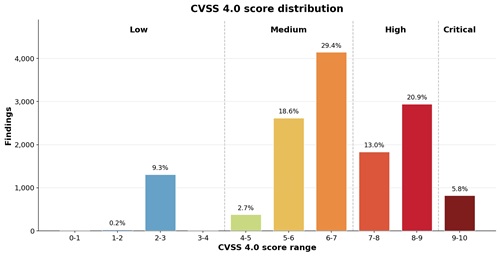
Over a compressed two-month period, NOVA scrutinized 3,915 open-source projects and systematically confirmed 14,090 distinct vulnerabilities. The sheer magnitude of this discovery—of which 99.4% were entirely unreported prior to the study—shattered historical assumptions about how long software flaws can remain hidden in plain sight. Nearly 40% of these discoveries were classified as High or Critical severity under the CVSS 4.0 framework.
This milestone marked a profound shift: vulnerability discovery is no longer bound by the cognitive and time constraints of human security researchers. Automated systems can now map the attack surface of entire programming ecosystems simultaneously, leaving maintainers scrambling to patch flaws faster than AI can generate them.
Phase 3: Compression of the Breakout Window
As automated systems supercharge initial access, downstream activity inside compromised networks has accelerated commensurately. Modern threat intelligence indicates that attacker "breakout times"—the duration it takes for an adversary to move from initial compromise to lateral movement within a network—have plummeted below 30 minutes in many targeted intrusions.
This compression leaves virtually zero room for human-only monitoring and alert triage. Cloud and infrastructure teams are forced to rely on automated detection and response systems simply to keep pace with adversaries who operate at machine speed.
Supporting Context & Metrics: The Anatomy of Modern Incursions
The empirical data released around Black Hat USA 2026 offers a granular look at the mechanics of contemporary cyber attacks. Analysts broke down the underlying trends into several core operational categories.
1. The Dominance of Identity and Privilege
Despite the focus on advanced exploits, foundational identity layers remain the primary battleground. Identity or privilege factors were highlighted in 75% of completed forensic investigations presented by researchers at the conference.
Rather than breaking heavily fortified cryptographic perimeters, modern adversaries increasingly prefer to log in rather than break in. By abusing enterprise authentication mechanisms, leveraging stolen session tokens, and exploiting misconfigured role-based access controls (RBAC), attackers seamlessly turn legitimate credentials into authorized paths for lateral movement and data exfiltration.

2. Direct-to-IP Malware and DNS Evasion
A specialized study by Unit 42 illuminated how modern malware families are evolving to evade traditional network telemetry. Traditionally, command-and-control (C2) infrastructure relied heavily on domain names, making DNS monitoring and Pi-hole or enterprise DNS-filtering services vital defensive tools.
However, researchers examining more than 4 million dynamic-analysis reports found that malware is increasingly bypassing DNS infrastructure entirely. Among samples actively communicating with C2 servers:
- 45.32% made at least one direct-to-IP connection.
- Even after filtering out bulk scanning noise, 41.97% of malware actively maintained direct IP communications.
- Direct-to-IP traffic accounted for an alarming 23.17% of all command-and-control connection attempts observed in the dataset.
This behavioral shift renders traditional domain-reputation blocking and DNS logging partially blind, forcing security teams to implement advanced NetFlow analysis and behavioral endpoint telemetry to detect anomalous outward-bound connections.
3. Language-Specific Vulnerability Trends
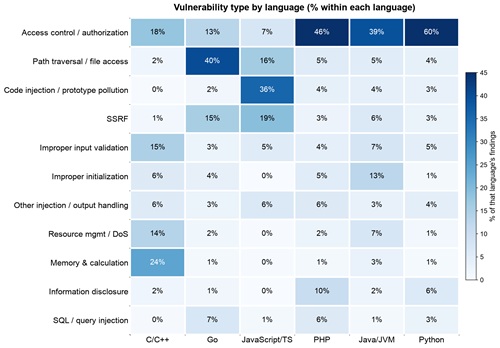
The Unit 42 frontier AI study also mapped how vulnerability archetypes cluster across different programming language ecosystems. The research revealed distinct structural vulnerabilities inherent to specific languages:

- Access-Control Flaws and Path Traversal frequently plagued certain backend web ecosystems.
- Code Injection and Server-Side Request Forgery (SSRF) clustered around dynamic scripting environments.
- Prototype Pollution remained a persistent structural risk within modern JavaScript and Node.js frameworks.
By identifying these ecosystem-specific weak points, autonomous AI systems can tailor their exploit generation strategies to the precise linguistic nuances of the target software stack.
Official Statements & Industry Perspectives
The discourse at Black Hat USA 2026 reflected a mixture of alarm and pragmatic adaptation among industry leaders, researchers, and enterprise CISOs.
"We are no longer discussing a theoretical future where AI alters the cyber threat landscape," noted one lead threat intelligence researcher during a technical briefing. "The future arrived simultaneously for both sides of the cyber divide. Defenders are using AI to triage millions of alerts, while attackers are deploying autonomous agents to find every unpatched edge case in open-source and proprietary software alike."
Security architects emphasized that while the tools are new, the underlying hygiene failures remain painfully traditional. Phishing, weak or reused credentials, unpatched edge devices, and neglected software dependencies continue to account for the vast majority of initial access vectors.

"AI isn’t inventing brand-new ways to compromise a network," observed a prominent cloud security consultant at the event. "Instead, it is acting as a force multiplier for laziness and scale. If an enterprise leaves an API endpoint exposed or a cloud bucket misconfigured, an AI-driven scanner will find it within seconds, whereas a human attacker might have missed it or taken days to locate it."
Furthermore, experts pointed to the emerging threat of poisoned software dependencies and the abuse of enterprise AI infrastructure itself. As companies rapidly integrate large language models and retrieval-augmented generation (RAG) pipelines into their operational workflows, these very systems are being subverted into vectors for data leakage, prompt injection, and unauthorized internal privilege escalation.
Future Outlook: Securing the Enterprise at Machine Speed
As the cybersecurity industry digests the revelations of Black Hat USA 2026, the path forward requires a fundamental evolution in defense strategy. Organizations can no longer rely on perimeter-based security or manual incident response workflows that operate on human timescales.
1. Embracing Autonomous Defense
To counter AI-driven offense, enterprise security must transition toward autonomous, AI-driven defense mechanisms. Security Orchestration, Automation, and Response (SOAR) platforms and Extended Detection and Response (XDR) tools must evolve from alert aggregators into active, real-time remediation engines capable of neutralizing threats within the sub-30-minute breakout window.

2. Hardening Identity and Access Management (IAM)
Given that 75% of investigations involve identity compromises, organizations must treat identity as the primary perimeter. Implementing continuous user behavior analytics (UBA), phishing-resistant multi-factor authentication (MFA), and rigorous just-in-time (JIT) privileged access management is no longer optional.
3. Proactive Software Bill of Materials (SBOM) and AI Auditing
With autonomous systems discovering thousands of zero-days in open-source code, development teams must adopt rigorous Software Bill of Materials (SBOM) tracking. Furthermore, organizations must audit their own codebases using the same automated vulnerability research techniques that threat actors are employing, finding and patching flaws before external adversaries can exploit them.
4. Overhauling Network Monitoring
The rise of direct-to-IP malware necessitates a shift away from purely DNS-centric security models. Security operations centers (SOCs) must implement deep packet inspection, encrypted traffic analysis (ETA), and behavior-based egress filtering to catch unauthorized direct IP communications before data exfiltration occurs.
Conclusion
The findings from Black Hat USA 2026 serve as a definitive wake-up call. Artificial intelligence has not rewritten the rulebook of cybersecurity; rather, it has turned the pages at a blinding speed. For enterprise security teams, surviving this new era demands an embrace of automation, a zero-trust mindset centered relentlessly on identity, and an unwavering commitment to foundational cyber hygiene executed at machine speed.

