
Executive Overview
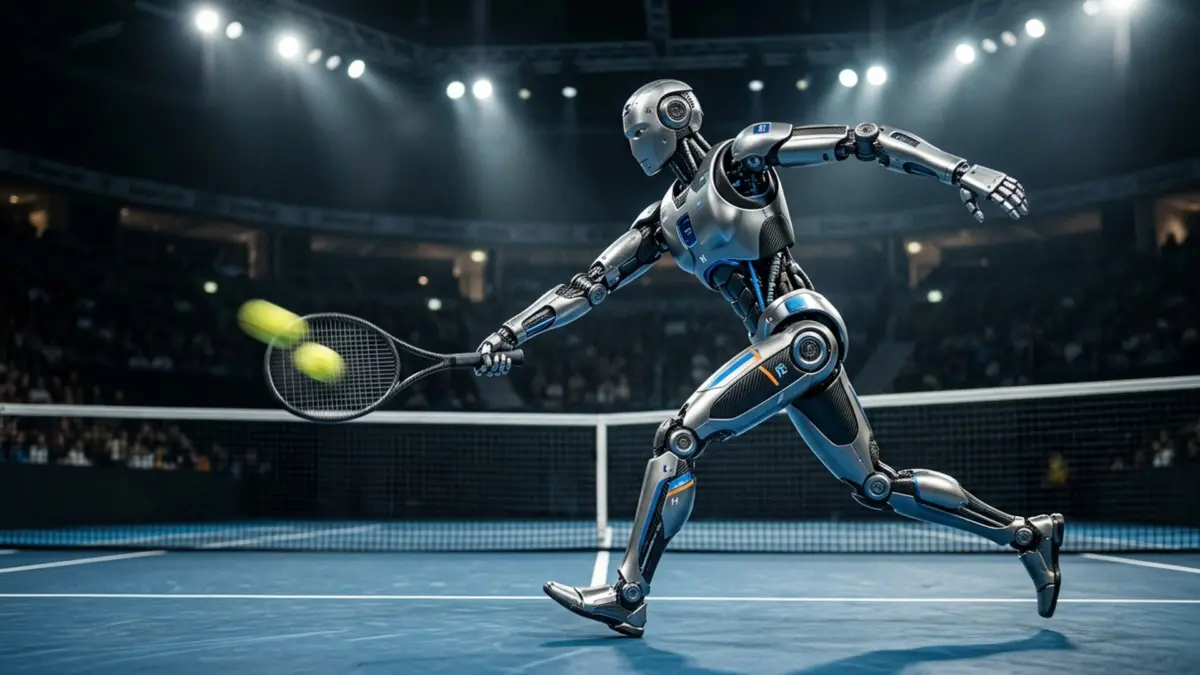
On August 23, 2026, the global robotics landscape witnessed a watershed moment during the opening ceremony of the second World Humanoid Robot Games in Beijing. Beijing-based embodied artificial intelligence developer Galbot orchestrated what is being heralded as a world record in athletic robotics: a live, fully autonomous tennis match featuring humanoid robots squaring off against human athletes.
The exhibition, broadcast globally, was not a standard scripted choreography or a teleoperated showcase. Instead, Galbot’s humanoid systems engaged in a grueling exchange consisting of more than 100 consecutive rallies. The robots tracked high-speed balls, navigated the court dynamically, executed precise serves, forehands, backhands, and volley returns, and seamlessly integrated into doubles partnerships alongside human tennis champions.
This milestone represents a profound paradigm shift in embodied AI. While previous robotic spectacles have largely relied on pre-programmed walking routines, tethered mobility, or remote-controlled human interventions, Galbot’s performance highlighted the maturation of real-time perception, whole-body dynamic control, and adaptive decision-making. By transitioning from the sterile confines of a research laboratory to an open, high-speed, adversarial sports arena, Galbot has provided a visceral proof-of-concept for the physical agility and computational speed required of next-generation automation.
Yet, as the industry celebrates this leap forward, analysts urge a balanced perspective. While the capability to sustain a 100-rally exchange under live conditions is a formidable engineering achievement, the controlled environment of a tennis court leaves a distinct gap between athletic exhibition and general-purpose workplace utility. This report examines the technological breakthroughs behind Galbot’s demonstration, analyzes the mechanics of the event, unpacks official claims, and evaluates the broader implications for the future of humanoid robotics.
Detailed Chronology of the Event
The landmark demonstration unfolded under the intense spotlight of the second World Humanoid Robot Games opening ceremony, drawing international media attention and industry scrutiny. The timeline of the exhibition underscores the robust operational stability of the robotic systems under pressure:
- Pre-Match Calibration: Prior to the opening ceremony, technical teams performed standard systems checks. Unlike past demonstrations that required extensive external motion-capture infrastructure or manual calibration for every lighting shift, Galbot’s systems relied on onboard perception stacks to map the court dimensions and calibrate tracking parameters.
- The Singles Opening: The match commenced with the humanoid robots facing human athletic opponents. Observers noted the immediate departure from traditional slow-moving robotic gaits. The human players initiated play with high-velocity serves, testing the robots’ reflex speeds and spatial calculation algorithms.
- The 100-Consecutive-Rally Milestone: As the match progressed through baseline rallies, deep cross-court shots, and net play, the robotic units maintained uninterrupted play. Breaking through the 100-consecutive-rally threshold, the match established a new benchmark for sustained machine-versus-human athletic interaction.
- The Doubles Integration Phase: Following the singles exchanges, the format transitioned to a doubles configuration. Galbot’s humanoids partnered with elite human tennis players. This phase required the algorithms to process not only incoming opponent trajectories but also the dynamic, shifting positions of their human teammates to avoid collisions and maintain optimal court coverage.
- Unassisted Recovery Incidents: During high-speed lateral movements, at least one robot experienced a balance disruption. According to company reports and live footage, the unit autonomously executed an unassisted recovery maneuver—re-centering its center of mass, regaining footing, and resuming play without human intervention or a system reset.
- Post-Match Analysis: Following the conclusion of the exhibition, the event transitioned into the broader multi-day competition schedule of the World Humanoid Robot Games, where Galbot’s underlying technologies became a primary talking point among global engineering delegations.
Technological Breakthroughs: Solving the Whole-Body Control Problem
To understand why a tennis match is uniquely difficult for humanoid robots, one must examine the computational physics of the sport. Tennis is a continuous, physical, and partially observed domain. Unlike structured board games such as chess or Go—where state spaces are discrete and fully visible—tennis forces an autonomous system to operate in a high-entropy, real-time physical continuum.
1. The Perceptual and Computational Load
During a fast-paced rally, a humanoid robot must perform multiple complex tasks within a fraction of a second:
- Ball Tracking: Calculating the trajectory, spin, velocity, and landing point of a tennis ball traveling at speeds upwards of dozens of kilometers per hour using onboard vision systems.
- Predictive Kinematics: Anticipating where the ball will be several hundred milliseconds in the future, accounting for environmental factors like air resistance and court friction.
- Whole-Body Coordination: Unlike a robotic arm fixed to a factory workbench, a humanoid must coordinate locomotion (running, pivoting, sliding) with manipulation (adjusting the racket angle, controlling swing velocity, and managing impact shock).
- Adversarial Adaptation: Adjusting strategy based on the opponent’s positioning and shot selection, transitioning dynamically between offense and defense.
Galbot’s success in these areas demonstrates a significant leap away from the scripted walking and dancing routines that have historically dominated the humanoid robot demo circuit. By relying on autonomous processing rather than teleoperation—where a human operator remotely pilots the machine—the robots proved that onboard edge-computing and AI models can handle high-frequency sensory input and motor output simultaneously.
2. The Significance of AstraTennis and the 100-Rally Metric
In the realm of robotics, a single successful maneuver can often be attributed to luck, fortunate lighting, or heavily edited promotional footage. Sustained performance, however, is the ultimate arbiter of engineering reliability.
Galbot’s branding of the event as AstraTennis emphasizes this focus on endurance and repeatability. Sustaining 100 consecutive rallies without a system crash, tracking failure, or catastrophic loss of balance implies that the underlying software stack—encompassing sensor fusion, path planning, and motor control—possessed high fault tolerance.
Furthermore, the doubles component introduced the challenge of collaborative spatial awareness. Sharing a physical space with human partners requires predictive social intelligence: the robot must infer the human’s intentions, cover the court efficiently, and adapt its defensive and offensive postures dynamically. This mirrors the unstructured cooperation necessary for robots deployed in human-centric workspaces.
Supporting Context & Metrics: The Company and the Venue
The Venue: The World Humanoid Robot Games
The setting of the match—the second World Humanoid Robot Games in Beijing—is emblematic of China’s rapidly accelerating footprint in humanoid robotics. The multi-day competition has evolved into a premier international stage where research institutions and commercial entities vie for supremacy in embodied AI. In an ecosystem heavily saturated with state-backed initiatives and venture capital, spectacles like the AstraTennis match serve as vital public relations tools, signalling technological maturity to both investors and regulators.
The Company: Beijing Galbot Co., Ltd.
While the tennis match captured the public’s imagination, Galbot is fundamentally an industrial and commercial robotics enterprise rather than a sports-entertainment outfit. Formed as Beijing Galbot Co., Ltd., the company has gained prominence for its specialized hardware architectures, notably the G1 humanoid robot.
The G1 features a wheeled dual-arm humanoid configuration specifically engineered for structured and semi-structured commercial environments. Galbot’s stated commercial roadmap focuses heavily on three primary verticals:
- Retail: Inventory management, shelf stocking, and customer assistance.
- Industrial Manufacturing: Component assembly, parts sorting, and factory floor logistics.
- Healthcare: Pharmacy automation, medication distribution, and clinical supply handling.
Viewed through this lens, the tennis match was not merely a novelty; it was a stress test for the fundamental perception, control, and decision-making systems that Galbot intends to monetize in commercial sectors. The reflexes required to intercept a tennis ball are structurally analogous to the real-time adjustments a factory robot must make when dealing with moving conveyor belts, fragile components, or unpredictable human coworkers.
Official Statements and Industry Reactions
The announcement of the world record generated widespread discussion across global robotics forums, artificial intelligence research groups, and financial markets.
Representatives for Galbot emphasized the philosophical and architectural milestones crossed during the exhibition. In their official press release, company spokespeople framed the event as a validation of their core embodied-AI philosophy:
"The achievement of over 100 consecutive autonomous rallies against elite human athletes marks a definitive transition for humanoid robotics. We are no longer merely teaching machines how to walk in a laboratory; we are empowering them to perceive, adapt, and conquer dynamic, unstructured environments in real-time. AstraTennis proves that our whole-body control and perception stacks are robust enough to withstand the chaos of the physical world."
Independent robotics researchers, while acknowledging the visual and technical impressiveness of the feat, offered nuanced commentary comparing the milestone to historical benchmarks in artificial intelligence.
Many analysts drew parallels to DeepMind’s historic victory over Go champion Lee Sedol in 2016 via AlphaGo. However, industry experts were quick to point out the crucial differences: while AlphaGo conquered a fully observed, rules-bounded digital environment with discrete states, Galbot’s robots faced a continuous, physical, and partially observed domain governed by momentum, friction, and biological unpredictability.
At the same time, critics cautioned against overextending the implications of the demo. Prominent roboticists noted that a tennis court is, by design, an idealized testing ground: the floor is flat, uniform, and well-lit; the ball is high-contrast and easily tracked by computer vision; and the rules of engagement are absolute. Consequently, while the match successfully demonstrated advanced dynamic balance and reflex speeds, it did not fully solve the semantic complexity of real-world labor.
What the Exhibition Does—and Does Not—Establish
To maintain analytical rigor, it is essential to delineate the exact boundaries of what Galbot’s demonstration proved and what remains speculative.
What Is Established:
- Autonomous Dynamic Control: The demonstration confirms that Galbot’s humanoid architecture can process high-speed visual input and translate it into complex, whole-body motor responses without human teleoperation.
- Robust Balance Recovery: The ability of the robots to experience a balance disruption during a high-speed athletic exchange and execute an unassisted recovery demonstrates tangible progress in dynamic stability control.
- Endurance and Repeatability: The 100-consecutive-rally metric provides credible evidence that the software and hardware stacks do not suffer from immediate thermal throttling, sensory overload, or algorithmic divergence under live stress.
What Remains Unproven:
- Generalization to Unstructured Workspaces: As noted earlier, a pristine tennis court bears little resemblance to a cluttered hospital pharmacy, a dynamic retail floor, or a chaotic manufacturing cell. The ability to hit a tennis ball does not automatically translate to the ability to handle deformable objects, occluded workspaces, or fragile, irregularly shaped inventory.
- Adversarial Intensity at Professional Tiers: While the human athletes provided formidable competition, the exhibition did not characterize whether the players were operating at full professional velocity or moderating their play to accommodate the current physical limits of humanoid hardware.
- Independent Verification of Edge Cases: While company announcements and live broadcasts provided compelling visual evidence, the broader scientific community awaits peer-reviewed data detailing exact ball speeds, latency metrics, intervention rates, and failure distributions.
Future Outlook: The Road from the Court to the Commercial Floor
The success of Galbot’s AstraTennis exhibition serves as a bellwether for the broader humanoid robotics industry as it barrels toward the latter half of the 2020s. The convergence of generative AI, high-performance edge computing, and advanced motor design is compressing development timelines at an unprecedented rate.
Moving forward, the verifiable checkpoints for Galbot and its competitors will depend heavily on performance metrics gathered during the scenario-based events of the World Humanoid Robot Games. Competitions focusing on household, industrial, and service tasks will offer a clearer, more pragmatic indication of how much of the tennis court’s agility generalizes to commercial utility.
For the robotics sector at large, the message from Beijing is clear: the era of static, tethered, and heavily scripted robot demonstrations is rapidly drawing to a close. As companies increasingly push their hardware into high-speed, adversarial, and unpredictable environments, the boundary between machine capability and human physical dexterity continues to narrow. Whether these athletic breakthroughs can be successfully translated into profitable, general-purpose labor solutions remains the ultimate test—one that will define the commercial viability of the humanoid robotics industry for the coming decade.

