
Executive Overview
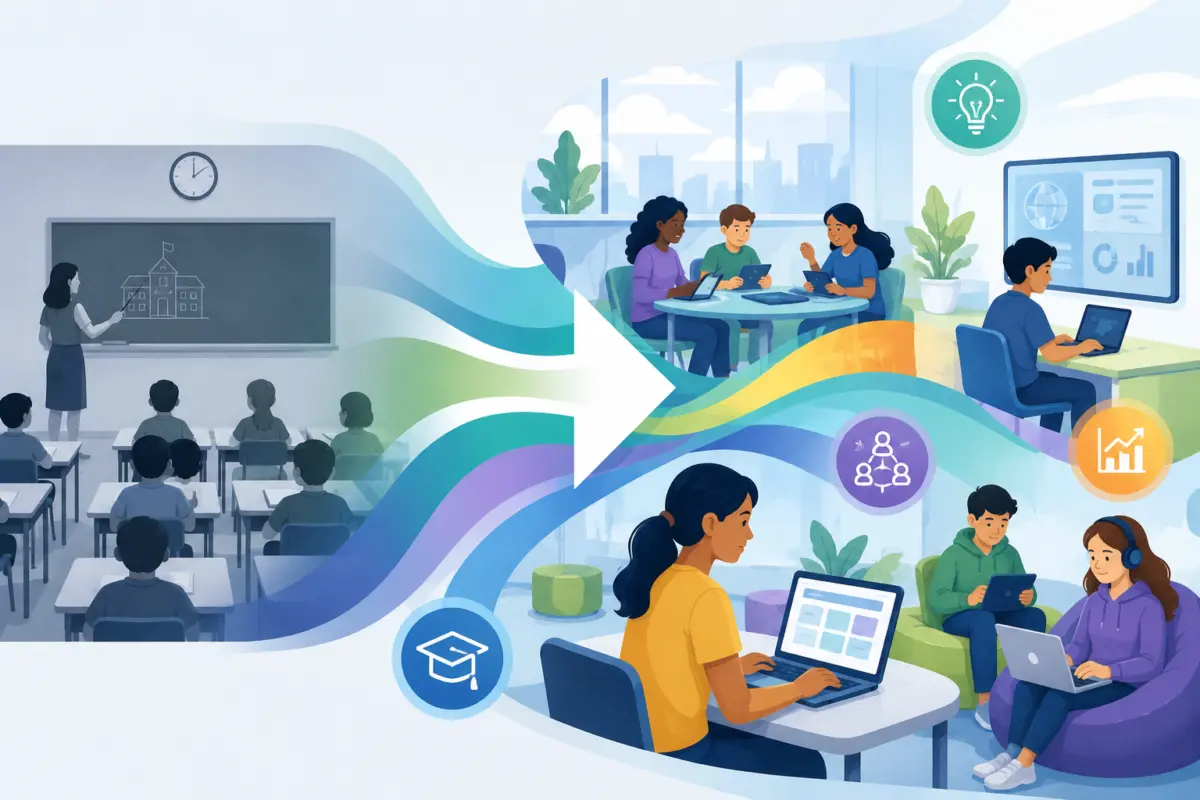
Step into almost any public or private high school in America today, and you will encounter an educational architecture designed around a singular core imperative: consistency. From the morning bell to the standardized end-of-year assessment, the system operates on uniform pacing, standardized curricula, and identical expectations for every student sitting in a given row. For more than a century, this industrial-era framework delivered unprecedented mass literacy and basic educational access across a rapidly expanding nation.
Today, however, a quiet crisis is brewing inside these standardized classrooms. America’s most ambitious, driven, and academically advanced learners are hitting an artificial ceiling. This bottleneck is not the result of a lack of student aptitude, nor is it caused by a deficit in teaching talent. Rather, it is the predictable outcome of an educational model that measures progress by time spent in a chair rather than mastery of the material.
Across the United States, millions of high-achieving youth—ranging from high schoolers taking advanced college coursework to elite student-athletes and performing artists—are outgrowing the structural boundaries of traditional schooling. As research reveals alarming rates of academic stagnation among high-performing students, a paradigm shift is accelerating. Families are increasingly leaving rigid, seat-time-dependent school districts in favor of flexible, competency-based, online, and hybrid learning environments designed to unlock individual potential rather than enforce average performance.
Detailed Chronology: The Evolution of Standardization and the Acceleration Crisis
To understand why high-performing students are encountering barriers in traditional settings, one must trace the development of the American educational structure over the past century and examine how recent catalyst events have disrupted it.
+-----------------------------------------------------------------------------------+
| HISTORICAL EVOLUTION OF U.S. SECONDARY EDUCATION PACING                           |
+-----------------------------------------------------------------------------------+
| 1906: Establishment of the Carnegie Unit (Seat-time linked to academic credit)   |
| 1983: "A Nation at Risk" report triggers standardized core requirements           |
| 2001: No Child Left Behind (NCLB) focuses systemic resources on floor proficiency |
| 2010s: Dual enrollment expands; >2.5M students seek outside academic acceleration |
| 2020–Present: Post-pandemic rise of flexible online/hybrid competency models      |
+-----------------------------------------------------------------------------------+
The Industrial Foundation (1906–1980s)
The modern structure of the American high school was largely codified in 1906 with the introduction of the Carnegie Unit—a metric that defined secondary education credit in terms of raw instructional hours (120 hours of classroom contact time per course per year). Designed to standardize high school instruction for university admissions and accommodate an expanding industrial workforce, the model prioritized predictable schedules, age-based cohort tracking, and centralized physical attendance.
The Era of Minimum Standards and Remediation (1980s–2000s)
Following the publication of A Nation at Risk in 1983 and the subsequent passage of the No Child Left Behind Act (NCLB) in 2001, state and federal policy focused intensely on baseline proficiency. While these initiatives aimed to close equity gaps and lift lower-performing students, they inadvertently incentivized school districts to concentrate resources, instructional time, and remedial focus on students struggling to reach minimum state thresholds. High-achieving students, frequently presumed to be "fine on their own," were increasingly left with static, one-size-fits-all curricula that capped their progress at grade level.
The Acceleration Explosion (2010–2019)
Recognizing the limitations of the traditional high school track, advanced learners began seeking external outlets. Over the 2010s, participation in Advanced Placement (AP), International Baccalaureate (IB), and dual-enrollment programs surged. High school students increasingly cross-enrolled in community colleges and universities to access mathematics, sciences, and humanities courses unavailable in their local districts.
The Pandemic Pivot and the Modern Paradigm Shift (2020–Present)
The emergency shift to remote learning during the COVID-19 pandemic unexpectedly laid bare the mechanical inefficiencies of traditional classroom pacing. High-achieving students discovered they could complete traditional schoolwork in a fraction of the traditional six-hour school day. As schools reopened, thousands of families declined to return to rigid, full-time seat-time requirements. Instead, they embraced dedicated online academies, hybrid micro-schools, and asynchronous learning models that detach intellectual growth from physical presence and fixed schedules.
Supporting Context & Metrics: Quantifying the Stagnation at the Top
The momentum moving families away from traditional classroom models is driven by concrete academic data and systemic metrics. National research demonstrates that the conventional educational model frequently fails to extend the trajectory of high-ability students.
===================================================================================
                         ACADEMIC ACCELERATION & GROWTH DATA
===================================================================================

[Dual Enrollment Growth]
National High School Student Participation in College Courses:
  * 2.5+ Million Students Annually (Source: NCES)
  * Represents one of the fastest-growing segments in U.S. K-12 education.

[The "Growth Deficit" Among High Achievers]
Performance Metrics for Top-Decile Elementary & Secondary Students:
  * Up to 50% of high-achieving students fail to maintain their growth trajectory.
  * A significant percentage make LESS than one year's academic growth in a standard
    academic year (Source: Thomas B. Fordham Institute).

===================================================================================
The Dual-Enrollment Surge
According to data from the National Center for Education Statistics (NCES), more than 2.5 million U.S. high school students now enroll in college-level courses each year through dual-enrollment programs. This metric underscores a broader structural disconnect: millions of teenagers require instruction beyond the upper boundaries of their local high school offerings before they even receive a high school diploma.
The Learning Stagnation Gap
Research published by the Thomas B. Fordham Institute highlights a troubling reality within standard educational environments: high-achieving students regularly make less than a full year’s worth of academic growth within a standard nine-month academic year. Because traditional classroom instruction must cater to the average learning pace of a 25-to-30-student classroom, advanced learners spend significant time waiting for peers to catch up, reviewing content they have already mastered, or executing repetitive tasks.
The Cost of Rigid Seat Time
The traditional Carnegie Unit model creates three distinct points of friction for advanced learners:
- Temporal Friction: Students who master a concept in two days are forced to remain engaged with that same concept for two weeks to fulfill state attendance and contact-hour mandates.
- Access Friction: Rural or under-resourced districts often lack the enrollment numbers required to fund advanced specialized courses, such as linear algebra, organic chemistry, or specialized world languages.
- Opportunity Friction: Elite student-athletes, professional young performers, and nascent entrepreneurs find that rigid 8:00 AM–3:00 PM physical attendance requirements directly conflict with high-level training, competing, or practical real-world execution.
Official Statements & Educational Insights
Educational leaders and institutional researchers emphasize that this growing gap is not a critique of educator competence, but rather a diagnostic finding on institutional design.
"Walk into almost any classroom in America, and you’ll see a system designed for consistency: same lesson, same pace, same expectations for every student," explains Allison Altvater, Dean of Middle and High School at Laurel Springs School, an accredited online private school specializing in personalized learning pathways. "For decades, that model has served millions well. But today’s learners are changing, and some of the most driven among them are quietly outgrowing the structure meant to support them."
Altvater stresses that the friction experienced by high achievers should not be misconstrued as an instructional failure on the part of classroom teachers.
"This isn’t a failure of teachers or schools," Altvater notes. "It’s a reflection of how the system was built. Traditional education was designed for an earlier era, one that prioritized standardization, efficiency, and preparing students for a more predictable workforce. It made sense when access and consistency were the primary goals. But today’s world demands something different: adaptability, creativity, and highly individualized pathways."
This sentiment is echoed by educational policy analysts who argue that true academic rigor must be redefined. Rather than defining rigor as "more homework" or "faster coverage" within a rigid timetable, progressive educators define it as keeping students continuously at the leading edge of their personal baseline capability.
"Rigor, in this emerging model, isn’t about moving faster for the sake of speed," Altvater adds. "It’s about meeting students where they are at the edge of their ability and helping them grow from there. When we expand what school can look like, we create space for more students to thrive… We’re not lowering standards. We’re raising the ceiling for all."
Future Outlook: Reimagining the Architecture of American K–12 Education
As alternative educational models shift from niche options to established pathways, the broader K–12 landscape is approaching a structural turning point. Observers, policymakers, and educational technology experts project several key trends over the coming decade:
+-----------------------------------------------------------------------------------+
| FUTURE OUTLOOK: TRANSITION FROM FIXED TO ADAPTIVE K-12 LEARNING                   |
+-----------------------------------------------------------------------------------+
|                                                                                   |
|  TRADITIONAL MODEL                                NEXT-GEN MODEL                  |
|  -----------------                                --------------                  |
|  * Carnegie Seat-Time Credits    =========>       * Competency & Mastery Credit   |
|  * Fixed Daily Schedule (8am-3pm)=========>       * Asynchronous / Hybrid Flex    |
|  * Batch Pacing by Age Cohort    =========>       * Personal Adaptive Pacing      |
|  * Geographic Course Constraints  =========>       * Global Digital Course Access  |
|                                                                                   |
+-----------------------------------------------------------------------------------+
1. Legislative Uncoupling of Funding from Seat Time
State legislatures across the country are increasingly reviewing policies that tie district funding strictly to physical, daily headcounts. States such as Florida, Arizona, and New Hampshire have pioneered flexible funding frameworks, student-centered learning accounts, and policy changes that reward competency-based course completion rather than physical attendance.
2. The Normalization of Hybrid and Micro-School Frameworks
The boundary between "traditional brick-and-mortar" and "fully online" education is dissolving. The future K–12 ecosystem will feature expanded hybrid micro-schools—small-footprint physical learning communities where students gather 2–3 days per week for collaborative social projects, lab work, and extracurriculars, while leveraging self-paced, high-rigor online platforms for core academic acceleration.
3. AI-Driven Personalization and Dynamic Pacing
The integration of generative AI and adaptive learning software is poised to streamline personalized learning. Rather than relying on a single human teacher to differentiate instruction across 30 different capability levels simultaneously, dynamic platforms can automatically recalibrate challenge levels, evaluate student comprehension in real time, and route advanced students directly to higher-tier learning modules.
4. Redefining High School Success Metrics
As elite post-secondary institutions increasingly look beyond standardized test scores and standard GPAs, early proof of mastery—such as capstone research projects, professional certifications, real-world internships, and university credits earned during high school—will become primary differentiators in university admissions and career readiness.
Conclusion
American education stands at a pivotal junction. The century-old consensus that all children of the same age should learn the same material at the exact same pace is giving way to a flexible, student-centric framework. Addressing the needs of high-achieving learners does not mean abandoning public education’s foundational commitment to baseline literacy and broad access; rather, it requires expanding the model so that no student’s intellectual growth is capped by the limits of a master schedule. By moving past rigid seat-time requirements and embracing flexible, mastery-based alternatives, the educational ecosystem can raise the ceiling of opportunity for every learner.

