

Executive Overview
In the dynamic ecosystem of modern education, the quality of classroom instruction remains inextricably linked to the intentionality of its preliminary architecture. For educators at all stages of their careers—ranging from pre-service novices to seasoned veterans—the task of unit planning frequently oscillates between an inspiring creative exercise and a daunting administrative hurdle. Recognizing the necessity for a systematic, repeatable framework, education thought leaders are increasingly turning back to fundamentals: structured, reliable design methodologies that demystify instructional planning.
This comprehensive guide launches a four-part series designed to deconstruct the anatomy of effective instruction. By exploring the macro-level view of unit creation, this initiative offers a practical, step-by-step roadmap tailored for educators seeking to build robust instructional units from scratch or overhaul historically underperforming curricula. The strategy hinges upon "backward design"—a pedagogical approach that prioritizes student mastery by aligning learning objectives, summative assessments, and daily lessons into a cohesive, purposeful trajectory.
Developed through more than a decade of research, classroom observation, and interviews with educational experts, this methodology serves as the conceptual anchor for Mastering the Lesson Plan, a comprehensive online professional development course. Whether implemented in a community education setting or a complex public school system, the principles outlined below provide the structural integrity required to foster genuine, demonstrable student learning.
Detailed Chronology: The Evolution of Instructional Design
To understand the modern approach to curriculum development, it is essential to trace how instructional planning has evolved from reactive teaching to proactive design. Historically, many educators fell into the trap of planning lessons day-by-day—often the evening prior to delivery—and subsequently assembling a final examination based solely on the material fortuitously covered. This fragmented approach frequently led to misaligned assessments, gaps in student understanding, and curriculum fatigue.
The Paradigm Shift: Backward Design
The modern antidote to reactive planning took root significantly in 1991 with the publication of Understanding by Design by Grant Wiggins and Jay McTighe. Their framework, universally known as backward design, inverted the traditional planning sequence. Instead of starting with content delivery (the lessons), backward design initiates the process by identifying desired results (the standards and objectives), determining acceptable evidence of learning (the assessment), and then planning the learning experiences and instruction (the lessons).

Over the past three decades, this three-step framework has undergone continuous refinement. Modern educators have adapted backward design to accommodate diverse student demographics, rigorous state and national standards, and the integration of formative digital tools. The current pedagogical movement emphasizes that "teaching to the test" is not inherently detrimental—provided the "test" is an authentic, thoughtfully constructed assessment of high-quality learning objectives generated by the educator, rather than an arbitrary, disconnected multiple-choice exam.
Supporting Context & Metrics: Defining Standards, Curriculum, and Units
Before an educator can successfully draft a unit plan, establishing a shared professional lexicon is paramount. Confusion frequently arises around the interchangeable use of terms like "standards," "curriculum," and "units." Clarifying these definitions ensures that instructional goals translate accurately into daily classroom activities.
Deconstructing the Instructional Hierarchy
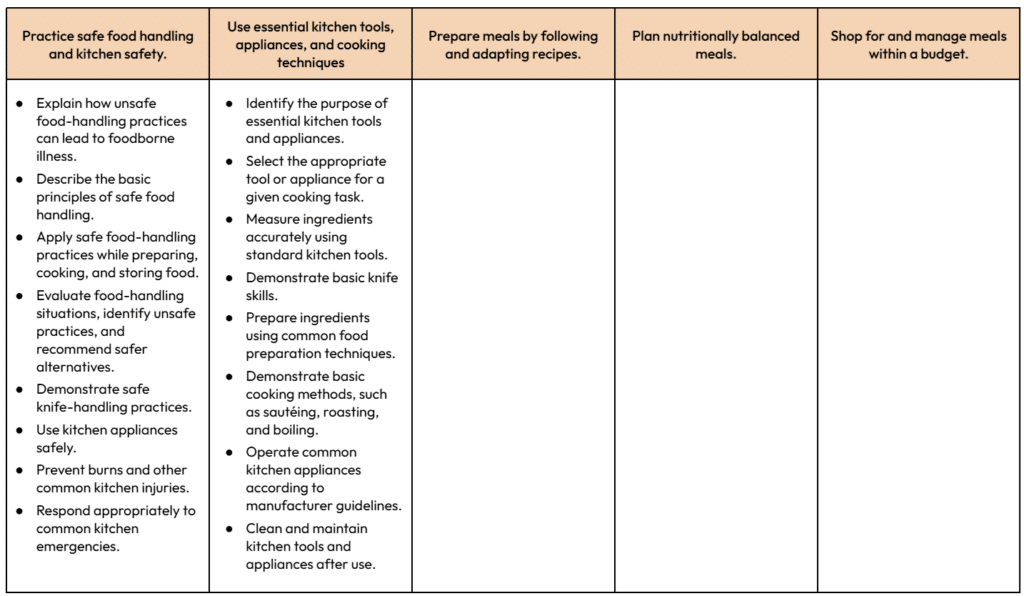
To illustrate this hierarchy, consider a hypothetical eight-week community education course titled Cooking Fundamentals, designed for adults seeking independent culinary competence.
- Standards (The Destination): Standards represent the broad, overarching goals of a course. In a public school system, these are mandated by state or local governing bodies. In our culinary example, the instructor establishes five core goals, such as practicing safe food handling, mastering essential kitchen tools, and executing fundamental cooking techniques. Each broad goal branches out into a complex matrix of specific subtopics, knowledge points, and mechanical skills.
- Curriculum (The Map): A curriculum provides the overarching blueprint that organizes and sequences the vast landscape of standards into manageable clusters. It dictates the macro-timeline of the academic year, determining how topics are grouped and ordered across multiple instructional blocks. While some educators receive fully scripted curricula replete with textbooks and pre-determined pacing guides, others possess the autonomy to structure their own sequences.
- Units (The Waypoints): A unit is a cohesive collection of individual lessons clustered around a specific subset of knowledge and skills, typically lasting anywhere from several days to a few weeks. Within a single semester, an educator might navigate between five and ten distinct units.
The 3-Step Unit Design Framework
Applying backward design to unit creation involves a rigorous, three-phase sequence:
Step 1: Establishing Measurable Objectives
Once content standards are identified, the educator translates them into measurable learning objectives. Crucially, an objective must describe a student performing an observable action, moving away from abstract internal processes (such as "understanding" or "appreciating") toward demonstrable behaviors (such as "identifying," "demonstrating," or "explaining"). For a short, three-to-four-day unit on food safety, objectives might include differentiating between safe and unsafe thawing methods, identifying cross-contamination risks, and explaining temperature danger zones. This phase also benefits immensely from framing the unit with a compelling title (e.g., "Safe Food Handling") and a thought-provoking, open-ended essential question (e.g., "How do your choices in the kitchen affect the safety of the food you prepare?").
Step 2: Designing the Summative Assessment
With precise objectives established, the educator determines how students will prove mastery. This requires asking fundamental evaluation questions: If students have truly mastered this material, what must they be able to produce, perform, or articulate? For our culinary food safety unit, a time-constrained open-response test featuring real-world preparation scenarios serves as an ideal summative tool. Students analyze fictional cooking scenarios, identify safety violations, explain the associated microbiological risks, and prescribe corrective actions. This ensures that the assessment measures authentic application rather than rote memorization.
Step 3: Planning the Daily Lessons
The final step involves backward mapping the daily instructional activities, formative checks, and learning experiences that systematically bridge the gap between baseline student knowledge and final assessment readiness. By determining the destination and the proof of arrival first, every subsequent lesson plan gains undeniable purpose and structural integrity.
Official Statements and Pedagogical Perspectives
Industry experts and veteran educators consistently emphasize the compounding value of systematic unit planning. Far from being a administrative redundancy, rigorous design serves as a professional anchor.
"Planning a unit of instruction can be a daunting task, but utilizing a step-by-step framework allows educators to navigate complexity with confidence," notes curriculum specialist and educational podcaster Mandy Froehlich. "Whether you are a pre-service teacher entering your first classroom or a twenty-year veteran looking to revitalize a stale curriculum, returning to the fundamentals of backward design reinforces what works and repairs areas that have eroded over time."
Furthermore, educational researchers highlight that structured unit design directly combats teacher burnout. When lessons are organically linked to a overarching summative assessment and clear standards, daily instructional prep becomes streamlined. Educators spend less time scrambling for disjointed activities and more time refining engagement strategies, differentiating for diverse learners, and providing targeted feedback.
Future Outlook: The Next Steps in Instructional Mastery
As education continues to evolve in response to technological integration, shifting student demographics, and changing academic standards, the demand for clear, resilient instructional frameworks has never been higher. Mastering the art of unit design is not a static achievement but an ongoing cycle of reflection, revision, and refinement.
This initial overview marks the beginning of a four-part series designed to transform instructional practices:
- Week 1 (Current): Establishing the big picture of unit-level planning and backward design.
- Week 2: Zooming in on assessment architecture, exploring the strategic integration of diagnostic, formative, and summative evaluations.
- Week 3: Constructing high-impact, engaging daily lesson plans that directly serve unit objectives.
- Week 4: Implementing advanced strategies for differentiating instruction to meet the diverse needs of every learner in the classroom.
For educators eager to dive deeper into this methodology, comprehensive professional development initiatives—such as the self-paced online course Mastering the Lesson Plan—provide the practical tools, templates, and guided frameworks necessary to bridge the gap between theoretical pedagogy and daily classroom success. By embracing a disciplined, systematic approach to unit design, teachers can reclaim their planning time, elevate instructional quality, and empower students to achieve profound, lasting academic growth.

