
Executive Overview
The landscape of digital education is undergoing a profound paradigm shift. For the better part of the past decade, the heartbeat of educational technology has been defined by velocity. Educators, instructional designers, and institutional leaders have sprinted to keep pace with an unrelenting tide of new platforms, modalities, software updates, and, most recently, hyper-accelerated advancements in artificial intelligence (AI). A tool that felt revolutionary at an academic conference two years ago can easily be perceived as legacy infrastructure today.
Yet, as higher education prepares for the upcoming Online Learning Consortium (OLC) Accelerate conference in Orlando this November, a distinct psychological and strategic pivot is taking place across the academic community. The narrative is decisively shifting. For years, the headline of digital learning was simply change itself—the breathless adoption of whatever new technology landed on the doorstep of the campus IT department. Today, however, educators are stepping back from the frantic rush of rapid experimentation to ask a much harder, more essential set of questions: What is actually meaningful? What is sustainable? And how do we keep the human experience at the center of teaching and learning?
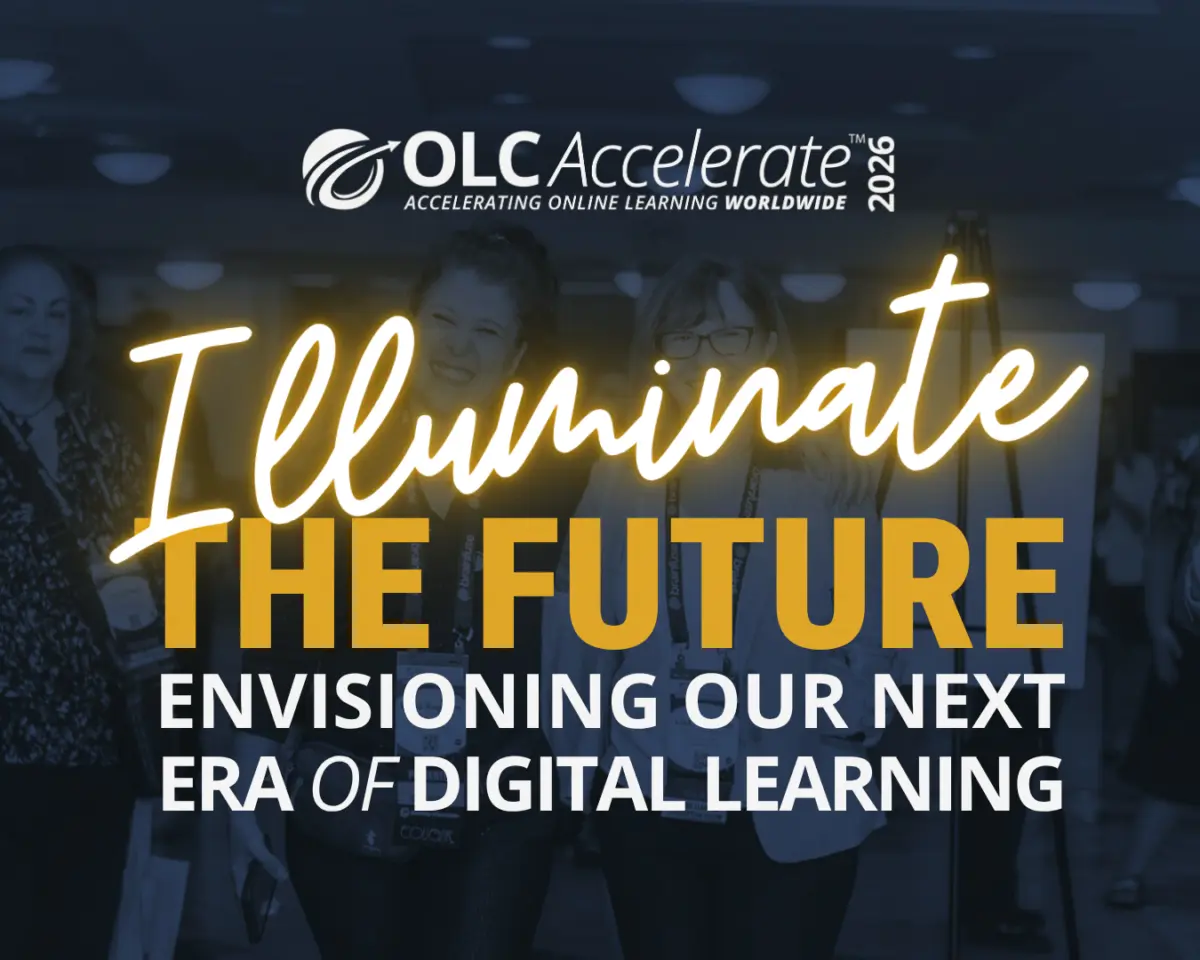
This year’s conference theme, “Illuminate the Future: Envisioning Our Next Era of Digital Learning,” captures this maturation of the field. Spearheaded by thought-provoking sessions like Alex Goryachev’s keynote address, “Educating for the Unknown,” the higher education community is confronting the reality that we are preparing students for jobs that do not yet exist, leveraging tools that may have materialized only months ago, to solve systemic challenges we cannot yet fully anticipate.
Rather than viewing technology as a replacement for human educators, the vanguard of digital learning is utilizing innovation to fortify the human connections that render education transformative. This article explores how institutions are navigating the intersection of rapid technological evolution and timeless pedagogical purpose, marking a transition from passive technological adoption to active, values-driven leadership.
Detailed Chronology: The Acceleration Curve of Educational Technology
To understand where digital learning is headed, it is vital to examine how rapidly the ground has shifted beneath the feet of educators over recent years.
Phase One: The Reactive Pivot and the Explosion of Modalities
The immediate post-pandemic era forced educational institutions into a posture of emergency response. The primary objective was survival and continuity: migrating thousands of courses online overnight, acquiring enterprise licenses for video conferencing software, and standing up makeshift virtual classrooms. During this phase, success was measured by operational resilience. Technology was a lifeline, keeping the lights of academia burning during unprecedented global disruption.
Phase Two: The Tech-Infatuation and the AI Boom
As emergency measures stabilized, higher education entered an era of unbridled fascination with emerging tools. Adaptive learning platforms, automated proctoring software, immersive extended reality (XR) environments, and, ultimately, generative artificial intelligence flooded the market.
At conferences like OLC Accelerate just two short years ago, attendees routinely walked away energized by software demonstrations that mapped out the theoretical future of online classrooms. At the time, these tools felt like the bleeding edge. Yet, because artificial intelligence and machine learning have evolved at a breathtaking, exponential pace, those exact same platforms are already being re-evaluated, upgraded, or replaced. This hyper-acceleration delivered a stark wake-up call to the academic community: in digital learning, standing still is functionally equivalent to moving backward.
Phase Three: The Pivot to Purpose and Strategic Maturity
Today, the education sector is entering its third and most mature phase. The novelty of technological disruption has given way to critical evaluation. Presenters and researchers submitting work for this year’s OLC conference are demonstrating a notable shift in tone. While topics like AI literacy, accessible design, and automated assessment remain front and center, the nature of the inquiry has evolved.
Instead of asking, “How do we implement the newest tool?” institutions are asking, “What works, for whom, and under what conditions?” This represents a move away from technology-first adoption and toward pedagogy-first integration, where software and algorithmic systems are strictly subordinated to student success, equity, and well-being.
Supporting Context & Metrics: Navigating the Unknown Future
The challenges facing modern online learning are as complex as they are urgent. According to recent higher education analytics and trends monitored by instructional leadership networks, institutions are grappling with several compounding pressures:
- The Velocity Gap: The average lifecycle of a consumer-facing or enterprise software tool in education has compressed from roughly five to seven years down to 12 to 18 months, driven primarily by generative AI iterations.
- The Skills Mismatch: Labor market economists project that a significant percentage of the workforce over the next decade will occupy roles that have not yet been invented, requiring institutions to shift away from static content memorization and toward durable cognitive skills, critical thinking, and adaptability.
- The Human Deficit: Despite—or perhaps because of—the hyper-connectivity of digital tools, students report rising levels of isolation and academic disengagement. Designing online spaces that foster genuine a sense of belonging has become an institutional imperative rather than a secondary perk.
Alex Goryachev’s keynote, Educating for the Unknown, directly confronts these metrics by challenging institutional leaders to build organizational resilience. The overarching consensus among academic leaders is that universities cannot buy their way out of future uncertainty by simply purchasing the latest enterprise software suite. Resilience is not a product; it is an institutional capacity built on faculty support, intentional course design, and collaborative community networks.
Official Perspectives and Expert Insights
The discourse surrounding OLC Accelerate and the broader trajectory of digital education highlights a unified front among instructional designers, administrators, and faculty leaders.
On the Role of Artificial Intelligence
Artificial intelligence undeniably represents both the single greatest challenge and the most monumental opportunity facing online learning today. However, institutional leaders emphasize that the technology must be handled with rigorous ethical oversight.
"The presentations this year don’t simply ask how we can use AI. They challenge us to think more deeply about how we can use it responsibly and strategically, in ways that genuinely enhance teaching and learning."
Rather than signaling the twilight of the human instructor, current innovations are sparking a renewed focus on empowering educators. AI can automate administrative friction, assist in drafting formative feedback, and provide personalized scaffolding for struggling students—thereby freeing up human faculty to focus on mentorship, emotional intelligence, and deep intellectual discourse.
On the Shift from Novelty to Meaning
The philosophical center of gravity in instructional design has shifted from an obsession with novelty to a deep commitment to meaningful impact. As leaders note:
"Instead of asking, ‘What’s new?’ educators are increasingly asking, ‘What’s meaningful?’ Instead of focusing on adoption, we’re focusing on impact. Instead of being captivated by possibility alone, we’re taking a closer look at responsibility, sustainability, and the human experience at the center of teaching and learning."
This evolution indicates that the academic community is no longer dazzled by Silicon Valley marketing pitches. Higher education is reclaiming its authority as a critical consumer and co-creator of technology, demanding transparency, equity, and pedagogical soundness from every digital tool introduced into the learning ecosystem.
On the Power of Collective Wisdom
Innovation has never occurred in a vacuum. One of the recurring themes from veteran attendees of digital learning consortia is that the most enduring breakthroughs do not happen during formal keynote presentations—they happen in the interstitial spaces.
The hallway conversations after a session, the spontaneous debates over coffee, and the shared commiseration over common institutional hurdles provide the relational glue that sustains educators through constant change. No single university, department, or instructor possesses all the answers to the complex future of education. It is only through open sharing, collective experimentation, and cross-institutional collaboration that the field can build actionable strategies.
Future Outlook: Illuminating the Next Era
As educators, instructional designers, and institutional executives pack their bags for Orlando this November, the horizon of digital learning looks both exhilarating and demanding.
The future will not be defined by artificial intelligence, cloud platforms, or virtual reality headsets in isolation. It will be defined by the intentional choices made by the human beings operating within those systems. The upcoming era will test our collective ability to answer several critical operational and philosophical questions:
- Experience Design: How do we construct digital environments that are not only textually and visually engaging, but emotionally resonant and psychologically safe?
- Belonging and Equity: How do we systematically dismantle barriers to access and foster genuine communities of belonging in remote and asynchronous spaces?
- Workforce Readiness: How do we structurally redesign curricula to prepare students for an ambiguous economic landscape where lifelong learning and rapid reskilling are the baseline norms?
- Faculty Well-being: How do we support, compensate, and protect the mental health of educators who are navigating perpetual technological disruption?
These are not questions that can be solved in isolation, nor can they be outsourced to an algorithm. They require a maturing community of practice willing to embrace vulnerability, share failures openly, and build upon one another’s successes.
Ultimately, the takeaway for the higher education community is clear: the future of digital learning is not a passive destination waiting for us around the corner. It is an active construction site. The tools will inevitably change; new platforms will emerge, and current best practices will be superseded. But the foundational commitments—to human connection, student empowerment, equity, and the relentless pursuit of knowledge—will remain untouched.
As the OLC Accelerate community gathers to Illuminate the Future, the message to educators is one of profound agency: the next era of digital learning is not something we inherit. It is something we build, refine, and illuminate together. Our greatest opportunity is not simply to adapt to the future, but to lead it.

