
Executive Overview
In an era defined by rapid technological advancement and complex global problem-solving, the frameworks we use to tackle challenges matter more than ever. Whether designing next-generation aerospace vehicles, developing life-saving medical devices, or troubleshooting a malfunctioning household appliance, professionals rely on a systematic blueprint known as the Engineering Design Process (EDP).
Far from being confined to corporate R&D laboratories or high-tech manufacturing plants, this iterative, step-by-step methodology is deeply embedded in human behavior. Every time we encounter an everyday obstacle—improving a flawed gadget or creating a functional system entirely from scratch—we instinctively apply core concepts from mathematics, science, and engineering. We analyze constraints, conceptualize workable solutions, formulate actionable plans, and test ideas in real time.
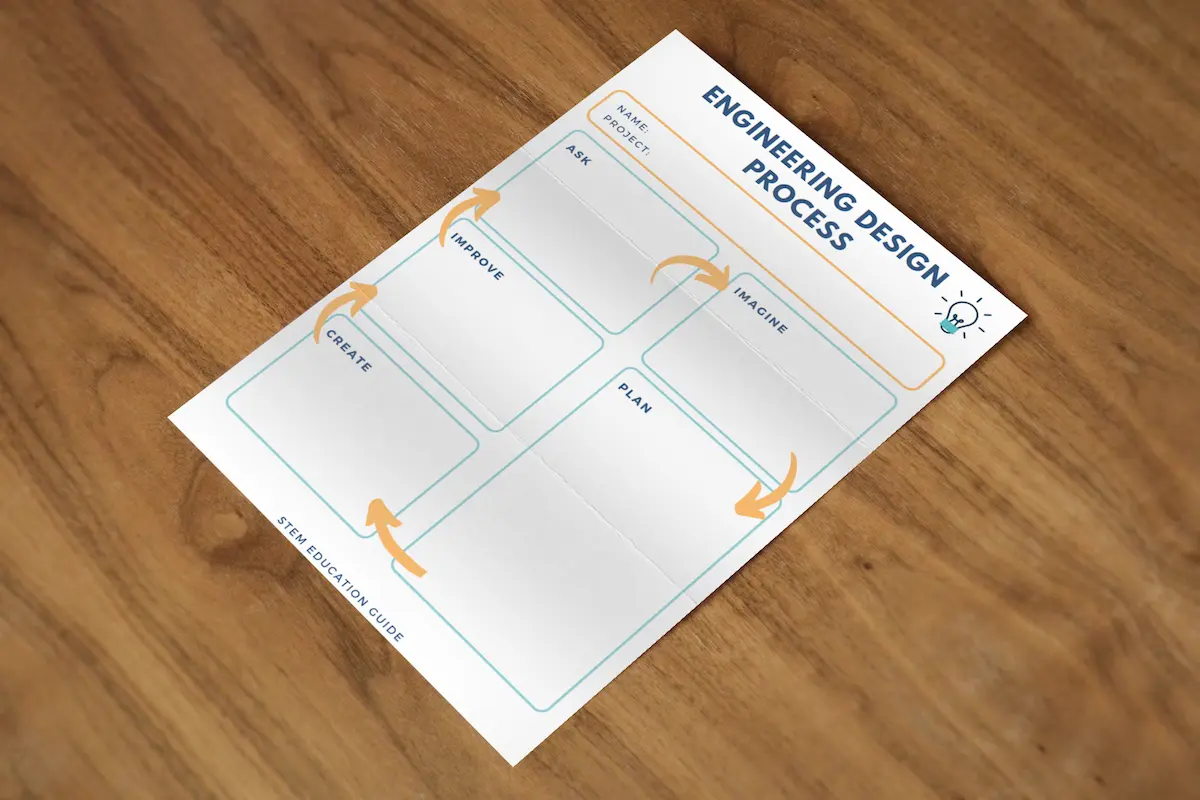
While academic and industrial literature sometimes expands the EDP into sprawling flowcharts with ten or more distinct milestones, the core framework universally distills down to five foundational phases: Ask, Imagine, Plan, Create, and Improve.
Crucially, the EDP is not linear; it operates as a continuous, circular feedback loop. Once a prototype is realized, creators evaluate its shortcomings, refine their design, and re-enter the cycle. To demystify this process for students, educators, and lifelong learners alike, this report examines how the five-step engineering framework operates in a universally relatable scenario: preparing a family meal under tight constraints. Furthermore, we explore how the EDP diverges from—and complements—the traditional Scientific Method, highlighting the distinct roles that scientists and engineers play in driving human progress.
Detailed Chronology: The Engineering Design Process in Action
To understand how abstract engineering principles translate into tangible outcomes, it helps to examine the EDP through a real-world simulation. Consider a common domestic challenge: a busy household where the daily routine has left little time for grocery shopping, resulting in an empty refrigerator and a house full of hungry family members.
By mapping this culinary challenge to the five phases of the Engineering Design Process, we can observe how systematic problem-solving unfolds in real time.
Step 1: Ask (Defining the Problem and Establishing Criteria)
Every successful engineering project begins by clearly articulating the problem statement and identifying the operational parameters. In our domestic scenario, a rushed kitchen meeting reveals an urgent need: everyone is hungry, nobody planned dinner, and commercial food delivery is off the table.
The engineering team (the family) must establish constraints and requirements. What resources are available? A quick inventory of the refrigerator, freezer, and pantry yields a baseline of raw materials. What are the constraints? Time is short, the weather is warm (ruling out heavy, heat-generating oven recipes like roasted meats), and multiple dietary preferences must be accommodated. By framing these questions accurately, the family lays the groundwork for targeted problem-solving.
Step 2: Imagine (Brainstorming and Researching Solutions)
With the parameters defined, the family moves into the divergent-thinking phase. Brainstorming yields a potential solution: a garden-fresh vegetable stew utilizing a bounty of produce gifted by grandparents. However, vegetables alone lack sufficient nutritional balance. The team recognizes a critical system gap—the need for a robust protein source.
At this juncture, the team conducts preliminary research. Utilizing internet resources, family members investigate complementary protein options that pair well with garden vegetables without requiring extensive preparation times. This phase prioritizes quantity of ideas over immediate feasibility, allowing the team to explore various culinary architectures before committing resources.
Step 3: Plan (Designing and Prototyping Blueprints)
Brainstorming must eventually yield to a concrete execution plan. The family compiles a definitive bill of materials (ingredients), selecting a wide array of vegetables: potatoes, carrots, tomatoes, zucchini, summer squash, turnips, green beans, beets, and peas. For proteins, the roster includes dried kidney beans, tofu, and eggs.
![What is the Engineering Design Process? [Plus, a Free Worksheet] - STEM Education Guide](https://stemeducationguide.com/wp-content/uploads/2020/04/enginereering-design-process-worksheet.png)
A major design conflict arises during planning: individual stakeholders have divergent preferences regarding protein sources. Rather than forcing a homogenized compromise that pleases no one, the engineering team adopts a modular approach. They decide to construct three parallel sub-systems: three separate pots of stew, each tailored with a distinct protein vector.
Step 4: Create (Fabrication and Team Execution)
With blueprints established, the physical creation phase begins. Division of labor is organized according to safety and skill level: younger family members handle preparatory tasks such as shelling peas, snapping green beans, and cutting soft produce with table knives, while adults utilize specialized equipment (sharper knives) for denser root vegetables.
The family divides into three distinct operational teams, each taking full ownership of a specific soup pot. Teams introduce water, foundational herb and spice profiles, and their assigned vegetables and proteins. (Certain delicate proteins, such as eggs, are held back in reserve for late-stage integration).
Step 5: Improve (Testing, Evaluation, and Iterative Adjustment)
As cooking progresses, aromatic feedback fills the kitchen, signaling that the prototypes are nearing completion. However, rigorous evaluation reveals unforeseen design flaws:
- Structural Integrity Failure: In one pot, the tofu cubes are breaking apart and turning mushy due to over-simmering.
- Chemical Contamination of Aesthetics: In another pot, red beets are leaching pigments into the broth, turning the potatoes, turnips, and liquid an unexpected shade of pink.
Immediate engineering adjustments are required. The team swiftly extracts the beets from the broth to halt further dye migration, substituting them with stable carrots. Meanwhile, a team member removes the degrading tofu with a slotted spoon; a supervising adult quickly pan-sears fresh tofu cubes to a golden-brown crisp before reintroducing them to the soup as a structurally sound component.
Additionally, the team managing the egg-protein pot introduces six eggs near the final stages of cooking, observing how thermal energy rapidly coagulates the albumen to encase the yolks. Taste-testing protocols reveal that the pot containing dried kidney beans requires extended thermal processing because the legumes remain unacceptably firm. Adjustments are made—burners are manipulated, heat is regulated, and processes are timed until all three culinary prototypes achieve optimal readiness.
Supporting Context & Metrics: Engineering vs. Science
As the family sits down to evaluate their completed culinary project over a meal of hearty soup and bread, a natural educational pivot occurs. How does the structured methodology they just utilized compare to the traditional Scientific Method taught in school?
While both frameworks represent foundational pillars of STEM (Science, Technology, Engineering, and Math) education, their ultimate objectives and operational pathways diverge significantly.
| Metric / Dimension | The Scientific Method | The Engineering Design Process |
|---|---|---|
| Primary Goal | To discover new knowledge and explain natural phenomena. | To create functional solutions, products, or systems to meet human needs. |
| Starting Point | An inquisitive question about the natural or physical world. | A defined problem, challenge, or human requirement. |
| Core Action | Formulating hypotheses, conducting controlled experiments, and analyzing data. | Brainstorming, designing, building prototypes, testing, and iterating. |
| Handling Failure | Failure disproves a hypothesis, prompting theory revision. | Failure is a vital data point that drives immediate redesign and improvement. |
| Final Output | Empirical conclusions, research papers, peer-reviewed studies, and expanded theory. | Tangible products, optimized technologies, structural designs, and functional systems. |
The Scientist’s Pursuit vs. The Engineer’s Application
Scientists are predominantly concerned with descriptive inquiry. They operate within laboratories and natural field environments to decode the fundamental mechanics of the universe. When a scientist completes an investigation, their primary deliverable is codified knowledge—published papers, peer-reviewed books, and empirical data designed to help humanity understand why things occur.
Engineers, conversely, are prescriptive and constructive. They leverage existing scientific discoveries to invent novel products, construct infrastructure, or fine-tune pre-existing technologies. When an engineer completes a project, their deliverable is a functional artifact or system deployed to solve a practical problem.
Case Study: The Dual Nature of Beets
To illustrate this intersection, consider the humble beet from both a scientific and engineering perspective.
![What is the Engineering Design Process? [Plus, a Free Worksheet] - STEM Education Guide](https://stemeducationguide.com/wp-content/uploads/2020/04/Engineering-Design-Process.png)
During the family’s culinary engineering project, the EDP revealed that unrefined beets introduced unwanted aesthetic and structural side-effects (pink broth) when combined improperly with other root vegetables. However, viewed through a culinary lens, that same characteristic forms the basis of borscht, a globally celebrated traditional beet soup.
Simultaneously, scientific research sheds light on the biological properties of beets. Through clinical trials governed by the Scientific Method, researchers have demonstrated that dietary beet juice contains inorganic nitrates. Human metabolic processes convert these molecules into nitric oxide, which dilates blood vessels, enhances oxygen delivery to the brain and muscles, and assists in regulating hypertension.
Thus, while the engineer utilizes empirical data to decide whether beets belong in a specific stew prototype, the scientist utilizes controlled experimentation to unlock the biochemical mechanisms that make beet consumption beneficial to human health as a whole.
Official Statements and Educational Perspectives
Educational authorities and STEM advocacy groups increasingly emphasize the integration of the Engineering Design Process into foundational curricula, arguing that early exposure to iterative problem-solving fosters critical cognitive flexibility.
Dr. Aris Thorne, a prominent researcher in cognitive development and STEM pedagogy, notes:
"The beauty of the Engineering Design Process lies in its complete reframing of failure. In traditional academic testing, an incorrect answer is an endpoint. In the Engineering Design Process, an unexpected outcome—such as mushy tofu or pink broth—is simply valuable diagnostic data. It tells the innovator precisely what needs to be optimized during the ‘Improve’ phase. Cultivating this resilience is essential for the next generation of innovators."
Furthermore, curriculum standards across North America and Europe have elevated engineering design practices to parity with scientific inquiry. Industry leaders echo this sentiment, pointing out that modern workforce demands require professionals who can navigate ambiguity, collaborate across multidisciplinary teams, and rapidly prototype solutions under real-world constraints.
Future Outlook
As global challenges become increasingly complex—spanning sustainable energy transition, urban infrastructure resilience, automated food production, and public health logistics—the reliance on structured methodologies like the Engineering Design Process will only intensify.
Future iterations of the EDP will likely incorporate advanced digital tools, including AI-driven predictive modeling, virtual prototyping, and automated material simulation. These technologies will allow engineers to compress the "Imagine" and "Create" phases within digital environments before physical resources are ever committed.
Yet, at its core, the essence of engineering will remain deeply human. Whether orchestrating a complex industrial robotics system or coordinating a family meal in a busy household kitchen, the fundamental imperative endures: identify the problem, imagine possibilities, plan meticulously, build boldly, and continuously strive to improve.

