The Velocity Multiplier: How Artificial Intelligence is Accelerating Familiar Cyber Threats
rifanmuazin September 19, 2026 28 views 0 Comments
Executive Overview
The landscape of global cybersecurity has entered a volatile new epoch defined not by the birth of unprecedented attack paradigms, but by the radical, algorithmic acceleration of legacy threats. Emerging research and technical telemetry released in alignment with the Black Hat USA 2026 conference reveal a stark reality: artificial intelligence is fundamentally transforming the velocity and scale of enterprise cyber attacks. Rather than inventing entirely novel vectors, malicious actors and autonomous systems are weaponizing AI to supercharge familiar playbooks—phishing campaigns, credential theft, network misconfigurations, exposed services, and software supply-chain vulnerabilities—compressing the operational window for defenders to mere minutes.
The findings, compiled from extensive industry research, autonomous red-teaming telemetry, and empirical analyses from prominent security firms such as Palo Alto Networks Unit 42, paint a sobering picture of modern threat dynamics. Autonomous vulnerability-research systems are now capable of discovering tens of thousands of security flaws across open-source ecosystems at machine speed. Concurrently, criminal syndicates are leveraging automated cloud-aware tools that achieve network breakout in under half an hour. Furthermore, sophisticated malware is increasingly adopting stealth mechanisms—such as direct-to-IP communications—to bypass traditional defense perimeters like DNS-based monitoring.
For chief information security officers (CISOs), cloud infrastructure engineers, and enterprise security teams, these developments signal the obsolescence of manual remediation cycles. As AI serves as an equalizing velocity multiplier for both offense and defense, the margin for human error has evaporated. This report synthesizes the principal findings, empirical metrics, and strategic implications emerging from the recent wave of Black Hat disclosures, offering a comprehensive look at the state of AI-driven cyber conflict.
Detailed Chronology: The Escalation of Machine-Speed Threats
To understand how the threat landscape arrived at its current inflection point, it is necessary to examine the precise operational mechanics and milestones documented by researchers leading up to and during Black Hat USA 2026. The convergence of generative AI, autonomous agent architectures, and deeply entrenched legacy enterprise vulnerabilities has created a compounding security deficit.
The Rise of Autonomous Vulnerability Discovery
Historically, vulnerability research has been a labor-intensive, cognitive endeavor requiring deep domain expertise to parse source code, identify logical flaws, and construct proof-of-concept exploits. The paradigm shifted dramatically with the deployment of autonomous vulnerability-research systems operating at software scale.
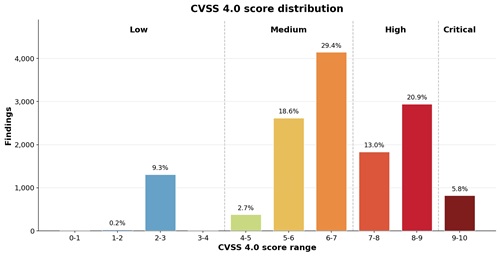
During a heavily scrutinized two-month evaluation period highlighted at the conference, an autonomous research system designated NOVA—developed and monitored by Palo Alto Networks Unit 42—systematically analyzed 3,915 open-source software projects. The scale of the system’s output overwhelmed traditional metrics of vulnerability discovery. NOVA successfully confirmed 14,090 distinct security flaws. Most alarming to software maintainers was the revelation that 99.4% of these discovered vulnerabilities were previously entirely unreported, sitting dormant as zero-days within widely utilized software supply chains. Furthermore, nearly 40% (39.7%) of these newly surfaced flaws were classified under the Common Vulnerability Scoring System (CVSS) 4.0 framework as either "High" or "Critical," highlighting immediate systemic risk to downstream enterprise consumers.
Compression of the Attack Lifecycle
While automated vulnerability discovery represents a potent force multiplier for identifying software flaws, a parallel acceleration has taken root within active intrusion operations. Empirical data presented by incident response and threat intelligence teams revealed that attacker "breakout times"—the duration required for an adversary to move laterally from an initial compromised endpoint to internal network infrastructure—have plummeted below the 30-minute threshold in a significant percentage of targeted engagements.
This hyper-compression of the cyber kill chain is directly attributable to the automation of reconnaissance and credential-abuse workflows. Adversaries are no longer relying on slow, manual probing techniques. Instead, AI-driven enumeration scripts scan enterprise perimeters for exposed cloud APIs, misconfigured identity providers, and shadow IT assets instantaneously, executing credential-stuffing and privilege-escalation routines before security operations center (SOC) analysts can triage automated alerts.
The Evolution of Evasion: Direct-to-IP Malware Communications
As defensive architectures have grown more sophisticated—particularly through the deployment of centralized Domain Name System (DNS) sinkholing, monitoring, and filtering—malware authors have adapted by eliminating traditional domain-name resolution dependencies.
A specialized study by Unit 42 examining over four million dynamic-analysis reports uncovered a widespread shift toward direct-to-IP command-and-control (C2) communication. The researchers discovered that 45.32% of malware samples actively communicating with C2 infrastructure bypassed DNS queries entirely, establishing direct socket connections via IP addresses. Even after filtering out broad, indiscriminate bulk-scanning traffic, a staggering 41.97% of targeted malware relied on direct-to-IP connections. In aggregate, this traffic accounted for nearly a quarter (23.17%) of all observed C2 connection attempts, demonstrating a calculated effort by threat actors to evade DNS-centric perimeter visibility and threat-intelligence feeds.
Supporting Context & Metrics: Deconstructing the Threat Data
The empirical metrics released around the Black Hat conference provide deep granular insight into where enterprise defenses are breaking down and how malicious actors are successfully executing campaigns.
Identity as the Primary Attack Surface
Identity and privilege management have long been cited as the perimeter of the modern enterprise, but recent telemetry indicates that identity has simultaneously become the primary vector for exploitation. According to completed forensic investigations and incident response reports, identity or privilege-related vulnerabilities were highlighted in 75% of all finalized cases.
Rather than executing complex binary exploits or zero-day malware attacks against hardened operating systems, modern threat actors consistently target the human and systemic elements of authentication. Attackers utilize AI-generated spear-phishing to harvest credentials, exploit misconfigured single sign-on (SSO) integrations, and abuse enterprise AI infrastructure. By turning legitimate authentication mechanisms and administrative pathways into clandestine highways for unauthorized access, adversaries can operate with near-total stealth, masquerading as authorized corporate users.
Language Ecosystem Vulnerabilities and Severity Distributions
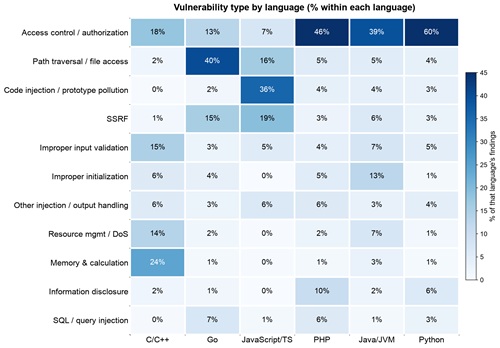
The Unit 42 frontier AI vulnerability study underscored that security flaws are not distributed evenly across the software development landscape; rather, specific programming-language ecosystems exhibit distinct vulnerability profiles. The research documented wide variances in the prevalence of specific flaw types—including access-control failures, path traversal vulnerabilities, code injection vectors, prototype pollution, and server-side request forgery (SSRF)—depending on whether the underlying codebase was written in memory-safe languages, interpreted scripting languages, or legacy enterprise frameworks.
+--------------------------------------------------------------------------+
|                       CVSS 4.0 SEVERITY BREAKDOWN                        |
+--------------------------------------------------------------------------+
| [■■■■■■■■■■■■■■■■■■■■] High & Critical (39.7%)                           |
| [■■■■■■■■■■■■■■■■■■■■■■■■■■■■■■■■■■■■■■■■] Low, Medium & Other (60.3%)  |
+--------------------------------------------------------------------------+
*Note: Data derived from Palo Alto Networks Unit 42 autonomous research (NOVA).*
Furthermore, the CVSS 4.0 score distribution of the 14,090 confirmed vulnerabilities illustrated that automated systems do not merely unearth trivial bugs; they routinely identify architectural flaws capable of severe remote code execution and systemic compromise. The concentration of High and Critical ratings (39.7%) serves as an indictment of legacy software development life cycle (SDLC) practices that fail to integrate rigorous automated security testing prior to code publication.
Official Statements and Industry Perspectives
Security researchers, institutional leaders, and threat intelligence experts speaking at and around the Black Hat USA 2026 conference emphasized that the cybersecurity industry must abandon sensationalist narratives regarding artificial intelligence and focus on operational realities.
Industry analysts noted that while media discussions often center on speculative scenarios—such as fully autonomous AI cyber weapons operating without human intervention—the immediate danger is far more pragmatic. AI is acting as an economic and operational accelerator, lowering the technical barrier to entry for lower-tier cybercrime syndicates while allowing advanced persistent threat (APT) groups to scale their operations exponentially.
"Artificial intelligence is not rewriting the fundamental laws of cybersecurity; rather, it is removing the friction from the attacker’s workflow. When an autonomous system can discover thousands of previously unknown software flaws in weeks, and an adversary can pivot through a cloud environment in under thirty minutes, the traditional asymmetry of defense becomes unsustainable through human effort alone," noted enterprise security researchers in their post-conference technical briefs.
Furthermore, cloud infrastructure architects have issued urgent warnings regarding the enterprise adoption of internal AI pipelines. As organizations rapidly deploy large language models (LLMs), retrieval-augmented generation (RAG) systems, and specialized vector databases, these novel components are frequently integrated without adequate security baselines. Threat actors are actively weaponizing enterprise AI infrastructure itself—turning model training pipelines, API endpoints, and agentic workflows into vectors for data exfiltration and prompt-injection-based persistence.
Future Outlook: Navigating the AI-Accelerated Threat Horizon
As the cybersecurity community digests the implications of the Black Hat 2026 disclosures, the path forward requires a fundamental recalibration of defensive strategies. Organizations can no longer rely on reactive, signature-based detection mechanisms or periodic vulnerability assessments that operate on monthly or quarterly cycles.
1. Embracing Autonomous Defense
To counter machine-speed attacks, defenders must deploy symmetric capabilities. Just as adversaries are utilizing autonomous systems to discover software flaws and execute lateral movement, enterprise security teams must integrate AI-driven automated remediation, continuous red-teaming, and autonomous posture management. Human analysts must be elevated from the burden of alert triage to strategic threat hunting and architectural hardening.
2. Hardening Identity and Zero Trust Architecture
With 75% of investigations underscoring identity and privilege as core vectors, traditional network perimeter security is dead. Enterprises must rigorously enforce Zero Trust principles, implement continuous behavioral authentication, mandate phishing-resistant multi-factor authentication (MFA), and strictly monitor least-privilege access across all cloud and on-premises environments.
3. Securing the Software Supply Chain and Enterprise AI
The staggering volume of unreported zero-day vulnerabilities uncovered by automated research systems mandates an immediate overhaul of software supply chain security. Organizations must demand comprehensive Software Bills of Materials (SBOMs), implement automated static and dynamic application security testing (SAST/DAST) integrated directly into CI/CD pipelines, and thoroughly vet all third-party dependencies. Concurrently, security teams must treat internal enterprise AI deployments as high-risk assets, subjecting them to the same rigorous access controls and monitoring applied to core databases and authentication servers.
Ultimately, the revelations of Black Hat USA 2026 demonstrate that artificial intelligence has permanently altered the speed of cyber conflict. Whether this era results in widespread systemic instability or a renaissance in resilient software engineering will depend entirely on how rapidly enterprises adapt their defenses to match the velocity of the machine-age adversary.