
By Lia Milgram, Managing Editor for ACTE
Published in partnership with the Association for Career and Technical Education (ACTE)
Executive Overview
As the Association for Career and Technical Education (ACTE) proudly marks a monumental century of service, advocacy, and educational leadership, the foundational questions driving Career and Technical Education (CTE) have never felt more urgent or profound. From September 2025 through May 2026, Techniques magazine—ACTE’s flagship publication—embarked on an intensive journalistic exploration. Following educators, visionary program leaders, and tireless advocates, the publication dug deep into some of the most enduring and complex challenges facing modern education:
- What does it genuinely take to build educational pathways that successfully reach every single learner, leaving no demographic behind?
- How do physical and virtual learning spaces, combined with immersive experiences, actively shape what students believe is possible for their futures?
The best CTE stories have never been exclusively about programs, spreadsheets, or funding allocations. They are, and always have been, about the people inside those classrooms and workshops—what they built, what they believed, and what they stubbornly refused to give up on. Across an academic year marked by centennial celebrations, Techniques curated an essential archive of resilience, transformation, and pedagogical innovation.
This retrospective examines eight defining features published between September 2025 and May 2026. Together, these stories paint a vivid, comprehensive portrait of a century-old movement rapidly reinventing itself to meet the demands of an evolving workforce.

Detailed Chronology: A Year in Review
September 2025: Skills Over Stigma
High-quality CTE functions as a promise to students: learn a trade, master a craft, and secure a viable economic future. However, for justice-impacted learners—individuals navigating the reentry process following incarceration—the stakes of that promise are exponentially higher, and the systemic barriers are painfully real.
The September 2025 issue opened with a powerful, deeply personal perspective. Written by an author who is themselves justice-impacted and now dedicates their life to education and reentry advocacy, the article offers a rare inside look at what is truly at risk when society refuses to look past a criminal record. It delivers a compelling, evidence-based argument for building educational pathways that prioritize tangible skills over lingering social stigma. By dismantling the barriers to credential attainment inside and outside correctional facilities, programs can transform the revolving door of recidivism into a one-way path toward stable employment and community contribution.
October 2025: Leading the Change
The cultural narrative surrounding CTE is undergoing a massive paradigm shift, and much of that momentum is being driven by alumni of the NextLevel Postsecondary CTE Fellowship. Coming from diverse corners of the country and representing institutions of all sizes—from sprawling community college districts to specialized technical institutes—these emerging leaders are rewriting the rules of vocational education.
In the October feature, these change-makers shared a unifying insight: their greatest teachers have consistently been their own students. By challenging outdated perceptions that historically relegated vocational tracks to "fallback options," these fellowship alumni are designing dynamic, rigorous pathways that command industry respect and student enrollment alike. They stand at the forefront of a nationwide movement proving that postsecondary CTE is a primary engine of economic mobility.

November–December 2025: Student-Centered Work-Based Learning
Work-based learning (WBL) is frequently touted as the gold standard of CTE, but its true efficacy depends entirely on implementation. The November–December double issue explored the reality that meaningful career exploration cannot follow a rigid, one-size-fits-all conveyor belt.
Instead, effective WBL requires giving learners the freedom to explore their authentic interests, question their assumptions, refine their goals, and, when necessary, completely redirect their focus. Because individual students develop at different paces and possess unique aspirations, program designers must build flexible frameworks. This article examined how educators are successfully crafting student-centered experiences that meet learners exactly where they are, giving them the runway they need to discover where they want to go.
January 2026: High-Quality CTE By Design
Wraparound supports—such as mental health counseling, housing assistance, food security programs, childcare, and academic tutoring—are far too often treated as supplemental safety nets, utilized only after a student begins to struggle. The January 2026 issue flipped this narrative on its head, arguing that wraparound services must be central to program design from day one.
When institutions embed holistic support systems directly into the architecture of their CTE programs, the institutional culture shifts dramatically. Retention rates climb, credential completion surges, and local communities—which desperately rely on a steady influx of skilled labor—reap the long-term benefits. This feature provided a blueprint for making that structural shift, proving that supporting the whole student is inseparable from teaching the trade.

February 2026: Designing for Meaningful Student Experiences
The strongest CTE programs are built upon a clear curricular vision, and the physical spaces housing them must reflect that philosophy. The February 2026 issue offered a remarkably practical roadmap for facilities design. Crucially, the author emphasized that modernizing learning environments rarely requires breaking ground on expensive new construction projects.
Instead, transformation can begin with a fresh, imaginative look at what is already available on campus. The overarching goal is simple yet profound: to help students walk into a room and instantly see themselves succeeding in a future career. The right physical environment acts as a silent instructor, making aspirations feel attainable from the moment a student crosses the threshold.
March 2026: A Century of Storytelling and Advocacy
Data is indispensable when making the policy and budgetary case for CTE; it provides the cold, hard metrics lawmakers demand. However, it is stories that make people remember why those metrics matter. As ACTE marked its centennial anniversary in March 2026, Techniques explored how the Association has leveraged the human touch of documentary film as a powerful tool for advocacy.
By capturing the raw, emotional, and economic reality of students, educators, and communities, documentary storytelling makes the impact of CTE visible and deeply relatable. This centennial feature connected a century of visionary educational leadership directly to the contemporary individuals currently writing the next chapter of the movement.

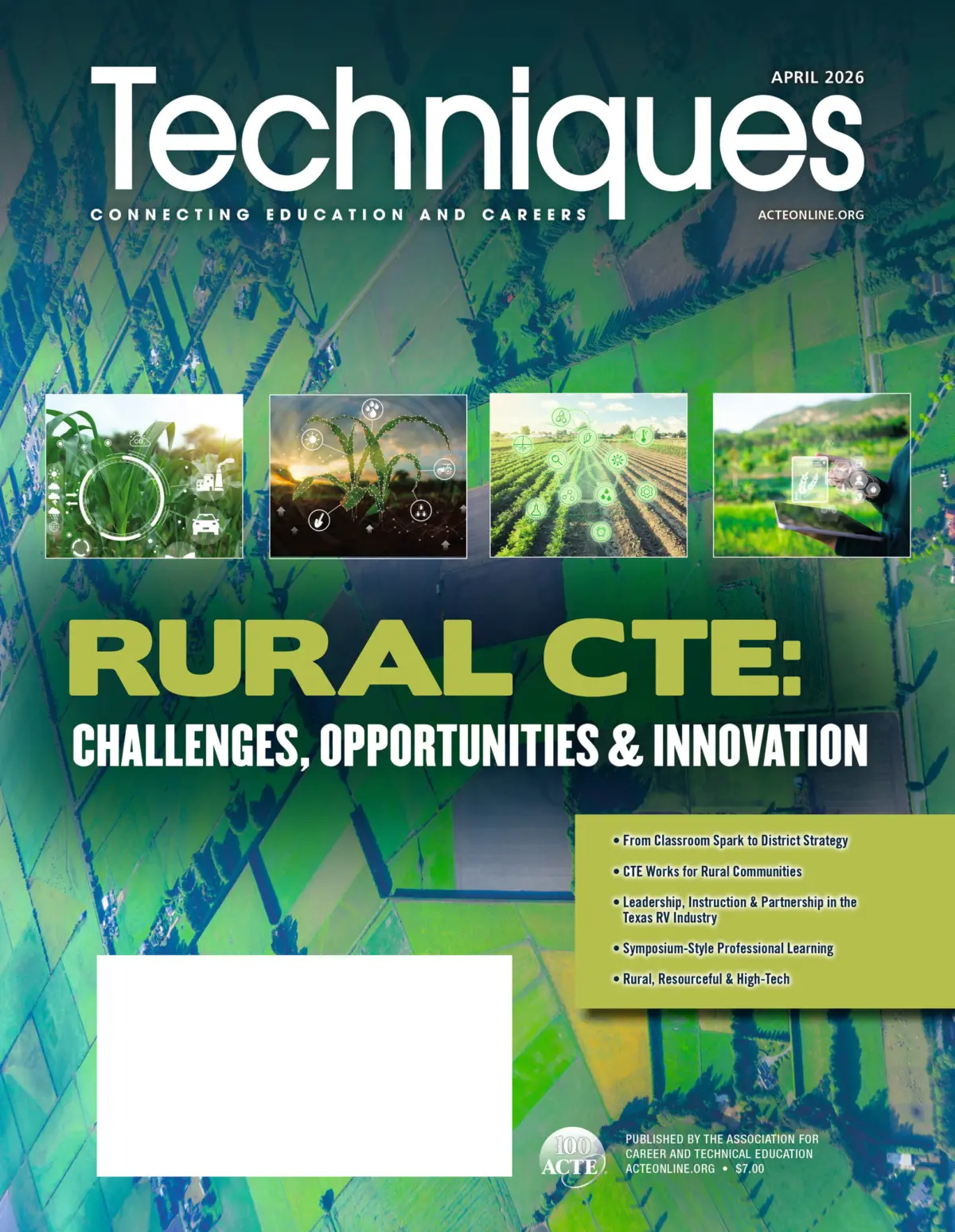
April 2026: Overcoming Rural Challenges & Maximizing ROI
Rural CTE programs face a unique and punishing array of headwinds. Plummeting local populations, shrinking tax bases, dwindling workforce numbers, and severely limited support services mean rural schools often operate under the constant threat of consolidation or closure.
The April 2026 issue addressed these crises head-on, offering school administrators a practical framework for translating program impact into hard data. By calculating and communicating true Return on Investment (ROI), rural leaders can demonstrate their indispensable value to state legislatures and local stakeholders. The resulting framework goes far beyond traditional metrics like graduation day counts, directly tying student success to regional workforce development and multi-decade community investment.
May 2026: Stopping the Revolving Door of Teacher Turnover
Consider the classic cautionary tale: an accomplished professional leaves a lucrative career in industry—say, insurance or advanced manufacturing—to enter the classroom as a CTE teacher. Just two days into the chaotic start of the school year, overwhelmed and unsupported, they resign.
The May 2026 issue used this painful scenario to examine a systemic retention crisis that plagues vocational education nationwide. Drawing on original research, the author presented CTE leaders with a clear, actionable blueprint for keeping industry experts inside the classroom. The core finding was striking: when teacher induction is treated as an ongoing, supportive professional experience rather than a bureaucratic checklist, industry professionals stay. And when they stay, students, programs, and local industries thrive.

Supporting Context & Metrics: The State of CTE at ACTE’s Centennial
To fully appreciate the insights gathered by Techniques during its 2025–2026 publishing cycle, one must view them against the broader macroeconomic and educational backdrop. As American industries grapple with persistent labor shortages in healthcare, advanced manufacturing, information technology, and the trades, the demand for high-quality CTE has reached a historical peak.
- Enrollment Trends: Postsecondary and secondary CTE enrollments have rebounded strongly post-pandemic, with particular spikes in hybrid programs that combine rigorous technical certifications with general education credits.
- The Equity Imperative: As highlighted in the September and November features, modern CTE is increasingly viewed as an engine for equity. Programs serving justice-impacted individuals and rural populations are demonstrating that targeted interventions yield some of the highest employment placement rates in the country.
- The Pedagogical Shift: The transition from traditional, rote vocational training to dynamic, competency-based career pathways requires substantial investment in physical infrastructure (February 2026) and wraparound student services (January 2026), moving education away from rigid models toward student-centered ecosystems.
Official Statements and Editorial Insights
Reflecting on a year defined by milestone coverage and deep investigative reporting, ACTE leadership emphasized the enduring mission of the Association as it crosses its 100-year threshold.
"The best stories in career and technical education have never been just about institutional programs or funding streams," noted editorial representatives during the centennial rollout. "They are fundamentally about human tenacity—what educators built, what they believed possible against all odds, and what they stubbornly refused to give up on. As we look back across a century of service, these eight articles serve as our collective memorandum of a movement that refuses to stand still."
Furthermore, the integration of diverse voices—ranging from justice-impacted scholars and rural administrators to industry experts transitioning into teaching—underscores ACTE’s commitment to inclusive dialogue. By opening its pages to frontline practitioners, Techniques continues to serve as an authoritative clearinghouse for pedagogical innovation and policy reform.

Future Outlook: The Next Century of Career and Technical Education
As ACTE closes the book on its centennial year and looks toward the horizon, the lessons synthesized by Techniques between September 2025 and May 2026 will serve as a foundational roadmap for the future of education.
The challenges highlighted across this retrospective—retaining industry professionals in the classroom, securing rural program viability through robust ROI metrics, embedding wraparound services into baseline design, and dismantling stigmas for justice-impacted learners—are not temporary hurdles. They are the defining structural questions of modern workforce development.
Yet, the overarching takeaway from a century of storytelling is one of profound optimism. Armed with data, driven by human-centric narratives, and supported by intentional facilities and flexible work-based learning frameworks, the community of educators, leaders, and advocates championed by Techniques is more than prepared for the next hundred years.
Want to see your work, research, or program highlighted in the next chapter of CTE history? Learn more about writing for Techniques by visiting the ACTE Techniques Editorial Calendar.

