
Executive Overview
In an era dominated by microchips, artificial intelligence, and automated software, the fundamental physical principles governing our world often go unnoticed. Yet, the foundation of all modern engineering rests entirely on six classical simple machines: the lever, the inclined plane, the wedge, the screw, the wheel and axle, and the pulley. Far from being antiquated relics of ancient history, these devices are the core building blocks of every complex mechanism, industrial assembly line, and compound machine in existence today.
Educators, parents, and curriculum developers are increasingly recognizing that tactile, hands-on learning is critical for bridging the gap between abstract physics concepts and real-world application. By moving away from rote memorization and toward dynamic, project-based STEM (Science, Technology, Engineering, and Math) initiatives, students can witness firsthand how physical force transforms into mechanical advantage.
This article explores the physics of "work," deconstructs the six foundational simple machines through engaging classroom and home projects, debunks persistent mechanical misconceptions, and highlights the broader educational methodologies shaping the next generation of engineers and problem-solvers.
Detailed Chronology: The Evolution of Simple Machines in Education
The formal study of simple machines dates back to antiquity, credited largely to Greek philosopher Archimedes around the 3rd century BCE, who famously proclaimed, "Give me a place to stand, and I shall move the Earth," in reference to the mechanical advantage of the lever. For centuries, these concepts were understood purely through the lens of monumental construction—how the pyramids of Egypt were raised, how aqueducts spanned valleys, and how cathedrals stretched toward the sky.
However, the pedagogical approach to teaching these mechanical principles has undergone a dramatic transformation over the last century.
- The Mid-20th Century (Industrial Model): Physics education relied heavily on textbook diagrams, static classroom models, and mathematical formulas. Students memorized the equation for work without physically experiencing the trade-off between force and distance.
- The Late 20th Century (The Rise of Constructivism): Influenced by educational theorists like Jean Piaget and Seymour Papert, classrooms shifted toward constructivist learning. Educators began integrating basic building blocks, LEGO bricks, and simple household items to allow children to construct their own understanding of mechanical advantage.
- The 21st Century (The Modern STEM Movement): Today, simple machines have been re-contextualized as the gateway to advanced robotics, mechatronics, and complex engineering design processes. The emphasis has shifted from simply identifying a pulley to engineering functional Rube Goldberg machines, integrating recycled materials with modern kits, and utilizing subscription-based STEM learning boxes to foster continuous, inquiry-based experimentation at home.
Supporting Context & Metrics: Defining Work and Mechanical Advantage
To truly understand why simple machines are indispensable, one must first deconstruct the scientific definition of "work." In everyday language, "work" can mean sitting at a desk, typing on a computer, or carrying groceries. In physics, however, work is strictly defined as the application of a force to move an object over a specific distance.
The mathematical formula governing this principle is deceptively simple:
$$mathbfW = mathbfF times mathbfd$$
Where W represents work, F represents force, and d represents distance.
The Law of Conservation of Energy
A common misconception is that simple machines reduce the total amount of work required to perform a task. In reality, energy cannot be created or destroyed. A simple machine does not decrease the total work; instead, it changes the way that work is executed. By trading distance for force, simple machines provide a mechanical advantage, allowing a human to lift a heavy elevator or split a dense log by applying a smaller amount of force over a greater distance or time.
Quantitative Impact of STEM Engagement
According to recent educational metrics and STEM advocacy reports:
- Early Exposure: Children who engage in hands-on building and mechanical experimentation before the age of ten demonstrate a 35% higher retention rate of core physics concepts in middle and high school.
- Collaborative Problem Solving: Group-based STEM projects increase student engagement by up to 50% compared to traditional lecture-based physics instruction.
- The Maker Movement: The proliferation of educational subscription boxes and maker spaces has driven a 40% increase in parental involvement in home-based science projects over the past decade.
Official Educational Frameworks: 6 Fun, Hands-On Simple Machine Projects
Bringing physics principles to life requires interactive experimentation. Educators recommend the following six hands-on projects—one for each category of simple machine—designed for both classroom settings and home-based engineering labs.
1. The DIY Pulley: Harnessing Gravity and Tension
Pulleys alter the direction of an applied force, making it significantly easier to lift heavy loads.
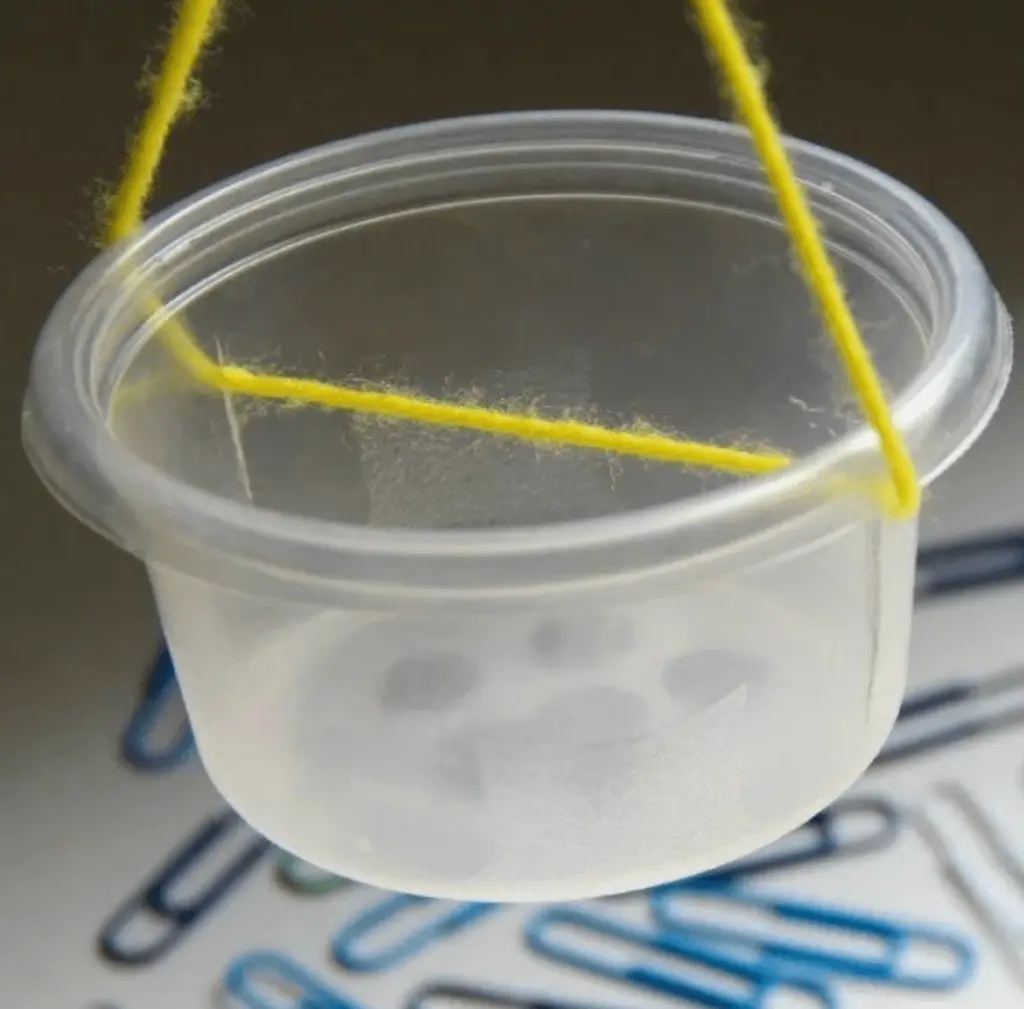
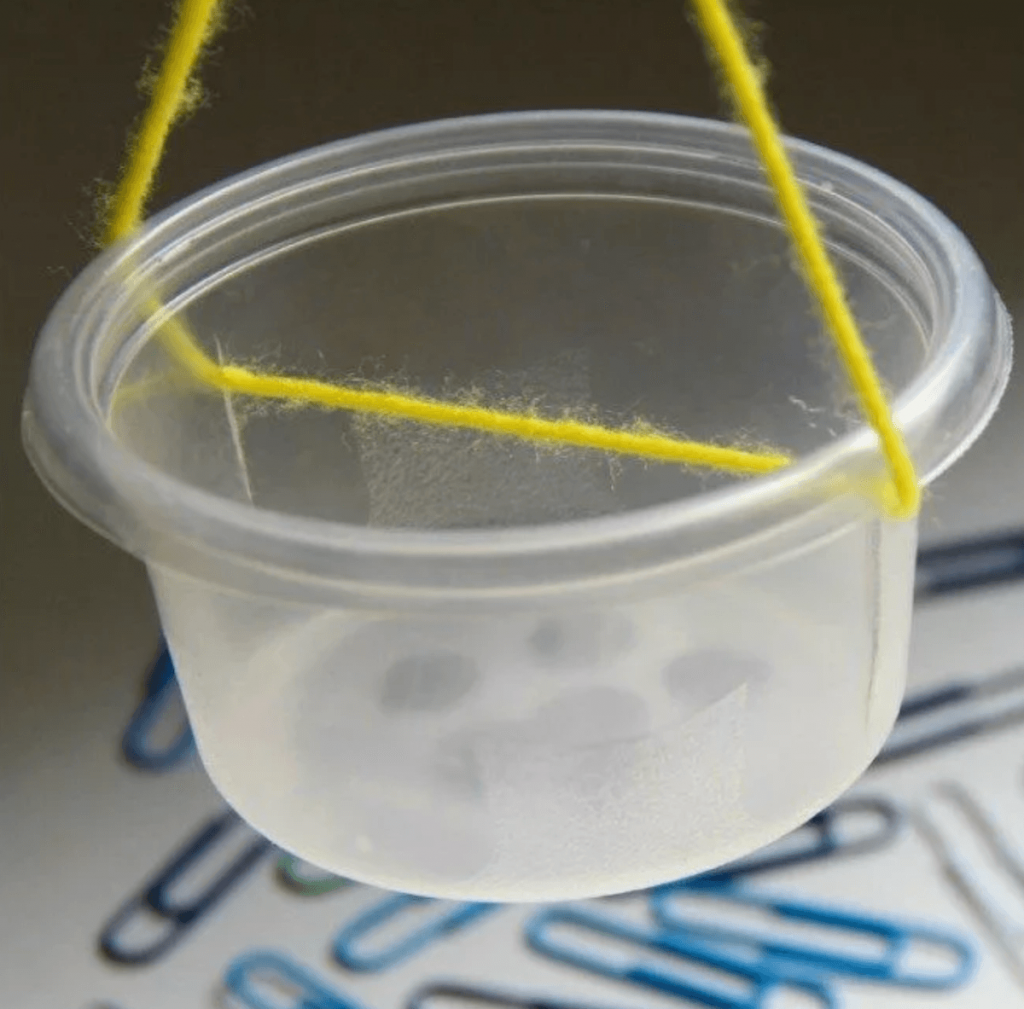
- The Project: Using a spool, string, a sturdy cardboard support structure, and a small bucket or basket, students can construct a functional miniature crane.
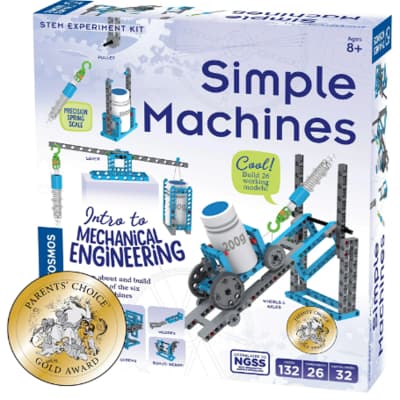
- The Experiment: Turn construction into a game by challenging students to load the bucket with varying weights (such as marbles or metal washers) to test the maximum load capacity and observe how fixed versus movable pulleys alter the required lifting force. For those seeking pre-packaged solutions, kits like the Simple Machines Science Experiment Model Building Kit offer advanced modular exploration.
2. Marble Run Inclined Plane: Redefining Elevation
An inclined plane—or ramp—allows objects to be raised to higher elevations with less force than lifting them straight up, at the cost of traveling a longer distance.
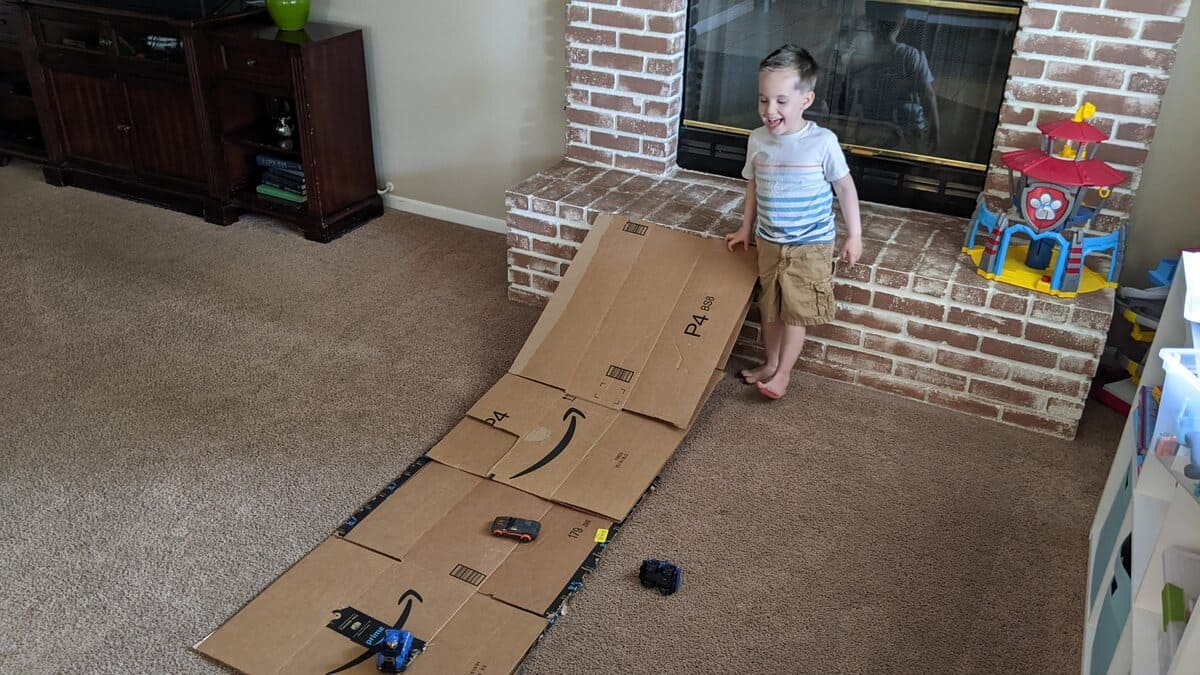
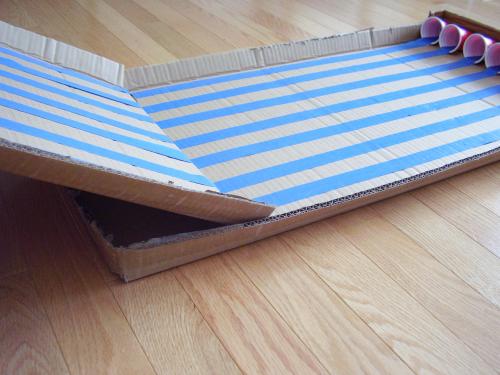
- The Project: Construct a cardboard marble run or toy car racecourse featuring ramps of varying steepness.
- The Experiment: Students measure the time it takes for a marble or car to descend ramps set at 15, 30, and 45-degree angles. This visual and kinetic activity clearly demonstrates the inverse relationship between the steepness of the plane and the effort required to move an object.
3. The Binder Clip Lever: Exploring Fulcrums and Load Classes
Levers consist of a rigid beam that pivots around a fixed point known as a fulcrum.
- The Project: Utilize a simple metal binder clip as a fulcrum and a small plastic ruler or popsicle stick as the beam to create a miniature seesaw or catapult.
- The Experiment: By shifting the placement of the binder clip (fulcrum) closer to or further from the load, students immediately experience how mechanical advantage shifts, requiring less effort to launch light objects into the air.
4. Splitting Play-Doh with a Wedge: Force Redirection
A wedge is essentially a moving inclined plane used to split objects, cut materials, or hold things in place.
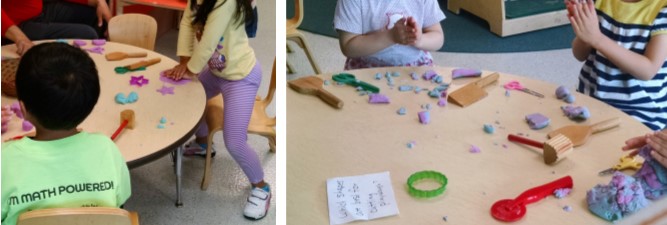
- The Project: Roll modeling clay ("Play-Doh") into cylindrical shapes resembling miniature logs.
- The Experiment: Have students attempt to cut the clay using only the flat side of their hand (impossible). Then, introduce a triangular plastic wedge. When pushed downward, the wedge redirects a vertical downward force into horizontal outward forces, cleanly slicing the clay and vividly illustrating how an ax or doorstop operates.
5. Demonstrating Screws: The Wrapped Inclined Plane
A screw is simply an inclined plane wrapped around a central cylinder.
- The Project: Take a solid block of wood and attempt to drive a smooth metal nail into it purely by hand pressure.
- The Experiment: Unsuccessful due to human physical limits, students then observe or participate in driving a threaded screw into the wood using a screwdriver. The helical ridges of the screw allow rotational force (torque) to be converted into linear force, easily penetrating dense materials.
6. Wheel and Axle Recycled Cars: Reducing Friction
The wheel and axle reduce the friction encountered when dragging an object across a surface, transforming sliding friction into rolling friction.
- The Project: Collect discarded cardboard tubes, plastic bottles, straws, and bottle caps to engineer custom recycled vehicles.
- The Experiment: First, drag an empty cardboard tube across the floor. Next, attach a straw axle and plastic bottle caps as wheels. Load the vehicle with weights to demonstrate how the wheel and axle mechanism drastically reduces resistance and facilitates smooth transportation.
Common Misconceptions About Simple Machines
Even though simple machines are foundational, several persistent misconceptions can hinder a deep comprehension of physics.
Misconception 1: All Levers Operate Identically
Many students assume all levers function the same way. In reality, levers are categorized into three distinct classes based on the relative positions of the fulcrum, the load, and the effort:
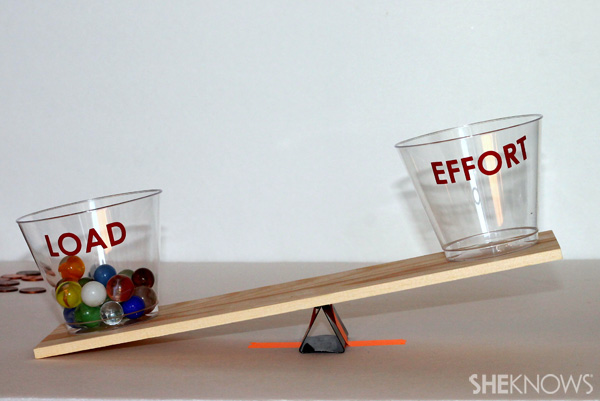
- First-Class Levers: The fulcrum is in the middle (e.g., a seesaw, crowbar).
- Second-Class Levers: The load is in the middle (e.g., a wheelbarrow, nutcracker).
- Third-Class Levers: The effort is in the middle (e.g., tweezers, a baseball bat, human arms).
Misconception 2: Friction Is Always an Obstacle
Friction is frequently taught strictly as a negative force that wastes energy. However, simple machines rely heavily on friction to function. Without friction, a wedge (like a doorstop) would slide right out from under a door, and a wheel and axle would experience continuous slip against the ground, rendering transportation impossible.
Misconception 3: Simple Machines Reduce Total Work
As established by the law of conservation of energy, simple machines do not reduce the total amount of work ($W = F times d$). They simply trade a smaller force over a longer distance, making daunting physical tasks manageable for human strength limitations.
Future Outlook: From Simple Tools to Complex Mechatronics
As educational paradigms continue to evolve, the study of simple machines remains more relevant than ever. In contemporary classrooms and maker spaces, these six classical devices serve as the conceptual stepping stones toward advanced robotics, automation, and complex mechanical engineering.
When children master the physics of a pulley or a lever through hands-on construction, they are not merely completing a craft project—they are internalizing the foundational logic of mechanical engineering. Whether they progress to designing automated assembly lines, programming robotic arms, or constructing elaborate Rube Goldberg machines, the journey of the modern engineer invariably begins with the simple machine.
By encouraging curiosity, fostering tactile experimentation, and investing in comprehensive STEM learning resources—such as educational subscription boxes and specialized building kits—parents and educators can ensure that the next generation is fully equipped to design, build, and innovate the world of tomorrow.

