
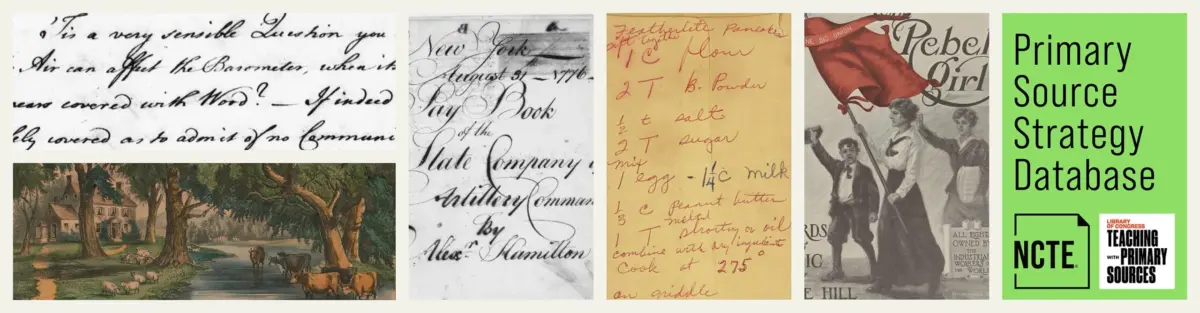
WASHINGTON, D.C. — In an era defined by an overwhelming influx of digital information, the ability to critically analyze historical artifacts has never been more vital. Recognizing this pedagogical imperative, the National Council of Teachers of English (NCTE) has deepened its collaborative partnership with the Library of Congress. Operating as an active participant in the prestigious Teaching with Primary Sources (TPS) Consortium, the NCTE is spearheading a nationwide initiative to seamlessly integrate digitized primary sources into the daily teaching and learning habits of literacy educators and their students.
At the heart of this collaborative endeavor is a robust, highly searchable digital database. Featuring curated instructional strategies tailored for more than 150 specific items from the Library of Congress’s vast digitized holdings, the platform bridges the gap between historical archives and modern classrooms. Developed by a dedicated cohort of more than two dozen expert teachers and leaders in English language arts (ELA) education, these resources articulate clear literacy merits for curriculum design. They offer educators actionable pathways complete with suggested themes, cross-curricular units, and direct mappings to state academic standards.
Among the crown jewels of this searchable repository is a granular instructional module built around In the Suburbs, a rare 1957 promotional video produced by Redbook magazine. By examining how this single primary source is deployed in contemporary classrooms, educators can catch a glimpse of a broader, transformative movement in American education—one that champions media literacy, historical empathy, and rigorous critical thinking.
Executive Overview: Bridging Archives and Classrooms
The NCTE-Library of Congress alliance addresses a fundamental challenge in modern education: how to move students beyond passive consumption of textbook narratives and into active, investigative engagement with history. Traditional curricula often present historical eras as settled, monolithic blocks of time. By contrast, the TPS Consortium framework uses authentic artifacts—ranging from government photographs and oral histories to vintage advertisements and literature—to expose the complexities, contradictions, and human realities of the past.
The newly expanded database is engineered for intuitive navigation. Content is meticulously tagged with descriptors such as picturebook, argument, history, oral histories, and advertising, allowing educators to rapidly source materials that align with specific instructional goals. Each entry in the database is not merely a link to an archival document; it is a fully fleshed-out pedagogical toolkit. These toolkits provide teachers with instructional values, contextual overviews, suggested teaching approaches, alignment with state standards, and strategies for navigating potentially sensitive or challenging historical topics.
By embedding these primary sources into English language arts and social studies classrooms, the NCTE is empowering students to decode not just words on a page, but the cultural subtexts, visual rhetoric, and economic ideologies that shaped—and continue to shape—American society.
Detailed Chronology: The Evolution of the NCTE-Library of Congress Partnership
The integration of Library of Congress archives into mainstream English language arts instruction represents a multi-year evolution in educational strategy.
- Foundation and Inception: The partnership between the NCTE and the Library of Congress was established to leverage the Library’s unparalleled digital collections—millions of historical manuscripts, maps, audio recordings, and films—for classroom use. The overarching goal was to dismantle silos between history departments and language arts classrooms, proving that historical artifacts are premier texts for literacy instruction.
- Expansion of the TPS Consortium: As the digital landscape shifted and media literacy became a cornerstone of 21st-century education, the TPS Consortium expanded its reach. The NCTE mobilized cohorts of expert ELA educators, curriculum developers, and teacher-leaders to review items from the Library of Congress archive specifically for their literary and rhetorical value.
- Development of the Searchable Database: Recognizing that teachers face severe time constraints, the NCTE commissioned a centralized, searchable database. Over two dozen educators collaborated to write comprehensive instructional frameworks for over 150 specific archival items. This ensured that teachers could access turnkey strategies aligned with rigorous state standards.
- Integration of Multimedia and Advertising Artifacts: Moving beyond traditional written texts, the initiative placed heavy emphasis on multimedia artifacts—such as mid-century promotional films, print advertisements, and audio recordings. This evolution acknowledged that modern literacy encompasses visual, auditory, and digital texts. A prime example of this pedagogical shift is the inclusion and deep analysis of the 1957 short film In the Suburbs.
Supporting Context & Metrics: Case Study of In the Suburbs (1957)
To understand the practical application of the NCTE’s initiative, one need look no further than the instructional materials developed for In the Suburbs, a 1957 video produced by Redbook magazine and captured in the Library of Congress Copyright Collection (Arcamone et al.).
The Artifact and Its Historical Backdrop
Produced during the height of the post–World War II economic boom, In the Suburbs serves as a fascinating window into mid-century American culture. The video paints an idyllic, highly polished portrait of suburban life, celebrating the massive migration from urban centers to newly constructed suburban developments. It heavily emphasizes consumerism, rising economic optimism, standardized family structures, and traditional gender roles.
However, beneath its bright, optimistic exterior, the film acts as a cultural artifact that actively constructed and reinforced mid-century societal norms. It illustrates how corporate media and advertisers collaborated to define the post-war "American Dream," tying personal fulfillment directly to homeownership, consumer goods, and nuclear family dynamics.
Instructional Value and Cross-Curricular Application
The NCTE framework highlights the immense value of In the Suburbs for modern high school classrooms. ELA and history educators use the video to prompt critical inquiry into several key areas:
- Media Literacy and Rhetoric: Students analyze how the filmmakers use visual framing, narration, and upbeat musical scores to persuade viewers that suburban life is the pinnacle of success. They examine how media can manufacture cultural consensus and obscure systemic inequalities.
- Socio-Cultural Norms: The video provides a tangible springboard for discussing mid-century gender roles, asking students to evaluate the prescribed expectations for men as breadwinners and women as domestic managers.
- Cross-Curricular Economics: The artifact integrates seamlessly into economics and social studies units exploring post-war housing policies, federal highway construction, and the economic democratization of homeownership—while simultaneously prompting critical discussions about who was historically included in or excluded from this suburban boom (touching upon issues of race and redlining).
Alignment with State Academic Standards
The pedagogical utility of the module is reinforced by its direct alignment with rigorous state standards. For instance, under Louisiana State Standards RI.11-12.4 and RL.11-12.4, students are required to determine the meaning of words and phrases as they are used in a text, analyze figurative and connotative meanings, and evaluate the impact of specific word and stylistic choices on meaning and tone.
When applied to In the Suburbs and complementary texts—such as instructional companion films like The Rise of Suburban Areas During the 1950s—students engage in comparative rhetorical analysis. They answer essential focus questions, such as: How do these visual texts define the concept of "home"? and What is the ideological connection between homeownership and the American Dream across different historical periods?
Official Statements and Pedagogical Philosophy
Educational leaders involved in the TPS Consortium have repeatedly emphasized that working with primary sources fundamentally alters the dynamic of the modern classroom.
"When students interact with unmediated historical artifacts—whether it’s a 1957 advertising film, a handwritten manuscript, or a Depression-era photograph—they stop being passive recipients of pre-packaged history," noted a curriculum developer affiliated with the NCTE initiative. "They become historians, detectives, and critical thinkers. They have to weigh evidence, contextualize biases, and construct their own reasoned arguments."
The NCTE’s leadership underscores that literacy in the 21st century extends far beyond traditional reading comprehension. It requires multimodal literacy—the ability to "read" visual media, evaluate the credibility of historical claims, and understand how texts are constructed to serve specific cultural, political, or economic agendas.
By partnering with the Library of Congress, the NCTE ensures that teachers are not left to navigate this complex terrain alone. The database provides a scaffolding structure that supports novice and veteran teachers alike, offering ready-to-use discussion prompts, comparative source suggestions, and standards-based assessment rubrics.
Future Outlook: The Next Frontier in Primary Source Literacy
As the NCTE and the Library of Congress look toward the future, the primary source database is poised for continuous expansion. Plans are underway to incorporate an even broader array of digitized artifacts representing diverse, marginalized voices throughout American history, ensuring that students see the full, multifaceted tapestry of the nation’s past.
Furthermore, as artificial intelligence and digital media saturation accelerate, the critical thinking skills forged through primary source analysis will become increasingly indispensable. Programs like the TPS Consortium are proving that the antidote to misinformation is deep, methodical historical inquiry. By teaching students to interrogate a 1957 suburban promotional video for its underlying assumptions, educators are simultaneously equipping them to critically evaluate today’s digital media landscape.
Through this ongoing collaboration, the NCTE and the Library of Congress are redefining what it means to be literate in America—proving that the keys to navigating our digital future lie safely preserved, yet vibrantly alive, within our historical archives.

