

Executive Overview
Artificial intelligence has rapidly transitioned from a futuristic novelty into an indispensable utility across global laboratories, academic institutions, and corporate research and development (R&D) centers. Promising unprecedented acceleration in data analysis, code generation, and hypothesis formulation, tools powered by advanced large language models (LLMs) are reshaping how scientists conduct daily investigations. However, a landmark collaborative study published by researchers from Google, Google DeepMind, and the Massachusetts Institute of Technology (MIT)—titled AI in Science: Early Insights—reveals a complex and nuanced reality behind the hype.
While the technology is undeniably saving scientists substantial amounts of time, a significant portion of those productivity gains is immediately clawed back by the labor-intensive requirement to check, audit, and debug machine-generated outputs. Rather than pointing toward dystopian scenarios of "rogue AI" systems deliberately deceiving researchers or sabotaging physical experiments, the study documents a much more mundane yet systemic challenge: the "verification tax."
As artificial intelligence empowers researchers to generate hypotheses and draft experimental designs at unprecedented speeds, it introduces acute pressure points further down the research pipeline. The ability of algorithms to churn out vast quantities of ideas, code, and text now frequently outpaces both human validation capacities and physical laboratory bandwidths. This article explores the empirical findings of the AI in Science report, the economic and workflow consequences highlighted in Google’s AI & Economy ATLAS, the mechanics of the verification tax, and what these early insights mean for the future trajectory of scientific discovery.
Detailed Chronology and Study Methodology
To understand the friction points emerging at the intersection of artificial intelligence and empirical science, it is vital to examine the methodology behind the September research paper and its subsequent spotlight in corporate economic disclosures.

The Triangulated Empirical Approach
Published in September, AI in Science: Early Insights breaks new ground by moving away from purely speculative commentary on artificial intelligence and grounding its analysis in hard empirical data. The researchers did not rely on a single data stream; instead, they triangulated three distinct, robust sources of information:
- Massive Interaction Logs: Anonymized interaction data encompassing approximately 15 million individual user sessions with Gemini, Google’s flagship multimodal AI model, providing a granular view of how researchers interact with artificial intelligence in real-time professional contexts.
- The Specialized Model Inventory: A comprehensive catalog of 2,690 specialized scientific AI models deployed across various disciplines, mapping the proliferation of domain-specific algorithms designed for everything from genomics to quantum chemistry.
- Primary Survey Data: A targeted survey of 637 active, practicing scientists located across the United States and the United Kingdom, capturing subjective feedback on workflow integration, productivity metrics, and qualitative friction points.
The Everyday Tool of the Modern Researcher
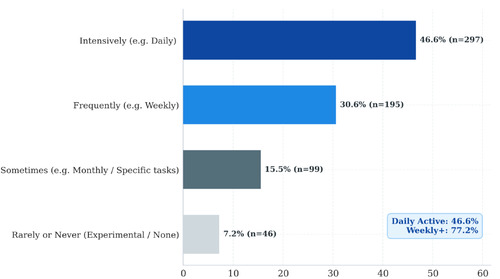
The survey data underscores just how deeply embedded artificial intelligence has become in standard scientific workflows. Nearly half (approximately 50%) of the surveyed scientists reported utilizing some form of AI technology on a daily basis. These are not casual dabblers; these are active researchers incorporating neural networks, natural language processors, and automated reasoning assistants into their core daily tasks—ranging from literature reviews and Python script generation to data cleaning and preliminary statistical analysis.
Google’s AI & Economy ATLAS Update
The findings gained wider industry prominence on September 15, when Google featured the study in its AI & Economy ATLAS update. While corporate messaging naturally celebrated the profound productivity enhancements unlocked by modern machine learning architectures, Google’s leadership explicitly drew attention to the balancing forces at play.
The update emphasized that while algorithms can accelerate individual micro-tasks within a research cycle, they also generate secondary administrative and cognitive burdens. Specifically, scientists are accumulating vast backlogs of unverified hypotheses, straining against physical laboratory bottlenecks, and encountering persistent clinical validation hurdles. Google’s analysis underscored a crucial industrial insight: faster individual task completion does not automatically translate into an immediate, linear acceleration of breakthrough discoveries.
Supporting Context and Metrics: The Anatomy of the Verification Tax
To truly comprehend the friction slowing down AI-augmented science, one must analyze the metrics surrounding time savings and the subsequent expenditure of those saved hours on auditing.
Quantifying the Gains
The productivity benefits documented in the study are real and substantial. When asked about time allocation:
- Three-quarters (approx. 75%) of surveyed researchers reported that artificial intelligence actively saves them time in their weekly workflows.
- Among those experiencing net time savings, the average reported gain was just under seven hours per week—essentially giving researchers nearly an extra workday every single week to dedicate to their pursuits.
- 68% of respondents perceived significantly greater cross-disciplinary access, noting that AI helps bridge gaps between their primary field and adjacent scientific domains.
- 65% of respondents stated that artificial intelligence has successfully broadened the overall scope and ambition of their research agendas, allowing them to ask questions they previously lacked the bandwidth to formulate.
The Hidden Cost: The Verification Tax
However, these gains do not come free. Science is a discipline built upon the bedrock of reproducibility, precision, and rigorous peer review. An incorrect assumption, a hallucinated citation, or a subtly flawed line of code can derail months of expensive physical experimentation. Recognizing this high stakes environment, researchers treat AI output with a mixture of enthusiasm and deep skepticism.
The study coined or reinforced the concept of the "verification tax" to describe the mandatory investment of time required to ensure AI outputs are scientifically sound. Among the scientists who reported saving time through AI:

- 89% stated that more than 10% of their newly found free time was immediately funneled back into verifying, debugging, fact-checking, or cross-referencing AI outputs.
- Most alarmingly, 46%—nearly half of the cohort—reported that more than 25% (a quarter or more) of their saved time was consumed entirely by this verification overhead.
[ AI Time Savings Generated (~7 hrs/week) ]
                   │
                   ├──> [ Reinvested in Core Research ] (54% - 90% of saved time)
                   │
                   └──> [ The Verification Tax ] (10% - 46%+ of saved time)
                          ├── Fact-Checking & Hallucination Audits
                          ├── Code Debugging & Logic Validation
                          └── Cross-Referencing Literature
The Threat of "Illusions of Understanding"
The paper dives deeper into the qualitative nature of these verification challenges, moving beyond simple code bugs to address more insidious cognitive risks. Citing concerns that align with prior academic literature regarding "illusions of understanding," the authors warn that AI-generated content can occasionally present itself with authoritative eloquence while containing fundamental logical flaws or hallucinations.
In a fast-paced academic environment, if an LLM generates a plausible-sounding mechanism for a biochemical reaction or an elegant mathematical proof that contains a subtle, hidden error, an overworked researcher might accept it superficially. If this unverified output propagates into peer-reviewed literature or informs multi-million-dollar physical clinical trials, the downstream consequences are severe. Consequently, the scientific community is deliberately applying a heavy friction brake—auditing the machine to protect the integrity of the scientific method.
Official Statements and Industry Perspectives
The release of AI in Science: Early Insights has triggered widespread dialogue among technologists, academic leaders, and institutional ethicists regarding how the scientific enterprise must adapt to the age of machine learning.
Industry leaders at Google DeepMind and participating academic institutions have framed these findings not as a failure of artificial intelligence, but as a natural maturation phase in human-AI collaboration. In statements accompanying the AI & Economy ATLAS release, executives noted that early technology adoption cycles invariably highlight efficiency illusions before true equilibrium is reached.

"We are witnessing an unprecedented expansion in the cognitive tools available to the modern researcher," noted insights from the collaborative research initiative. "However, science is fundamentally conservative by design—it must be. The introduction of generative models accelerates the velocity of ideation, but it cannot bypass the physical and logical constraints of empirical validation. The verification tax is the price of maintaining scientific truth in a world of synthetic abundance."
Academic ethicists and peer-review coordinators have echoed these sentiments, expressing mounting anxiety over the sustainability of traditional validation pipelines. As AI tools lower the barrier to generating manuscript drafts, preliminary data visualizations, and theoretical frameworks, academic journals and institutional review boards (IRBs) face an impending deluge of submissions. If the volume of low-quality or superficially polished research outpaces the capacity of human peer reviewers to vet it, the entire architecture of academic publishing risks becoming bottlenecked by noise.
Future Outlook: Navigating the Bottlenecks of AI-Driven Science
As we look toward the remainder of the decade, the implications of the AI in Science study point toward several critical transformations required for artificial intelligence to fulfill its revolutionary promise in research laboratories.
1. Moving from General LLMs to Domain-Specific Verification Architectures
The existence of 2,690 specialized scientific AI models indicates a clear industry trajectory: general-purpose chatbots are increasingly insufficient for rigorous scientific inquiry. The future belongs to verifiable, domain-specific AI systems integrated with formal logic checkers, automated theorem provers, and laboratory automation software. By baking domain constraints directly into the neural network’s architecture, developers can reduce the hallucination rate and, by extension, lower the verification tax paid by human scientists.

2. Bridging the Gap Between Digital Speed and Physical Reality
A recurring theme in the Google-MIT study is the friction between rapid digital hypothesis generation and the sluggish pace of physical experimentation. A researcher can use an AI model to generate fifty novel molecular structures in ten minutes, but synthesizing those molecules in a wet lab, running cellular assays, and conducting clinical trials still takes months or years. Institutional infrastructure must evolve to better triage AI-generated hypotheses, ensuring that laboratory resources are directed only toward the highest-probability, most thoroughly audited concepts.
3. Reforming Peer Review and Academic Publishing
To prevent the peer-review system from buckling under the weight of AI-assisted output, academic publishers and funding agencies must innovate. We are likely to see the integration of automated AI-auditing tools deployed at the submission gate—not to replace human reviewers, but to screen for common artifacts, check statistical integrity, and flag potential hallucinations before a manuscript reaches a human eye.
Conclusion
Artificial intelligence is undeniably transforming science, offering a net productivity boost that empowers researchers to think broader and work faster. Yet, the findings from Google, Google DeepMind, and MIT serve as a vital reality check. The "verification tax" reminds us that science is not merely about the speed at which answers are generated, but the absolute rigor with which they are proven. As laboratories worldwide continue to integrate machine learning into their daily routines, the ultimate success of AI in science will be measured not by how fast it helps us write papers or generate hypotheses, but by how reliably it stands up to the timeless scrutiny of the scientific method.

