
By the Global Medical Education Desk
Published in partnership with Higher Education Research Insights
Executive Overview
Medical residency has long been characterized by grueling hours, intense academic pressure, and high-stakes clinical environments. In the wake of the COVID-19 pandemic, these traditional stressors were exacerbated, leaving graduate medical education (GME) programs searching for innovative ways to foster institutional identity, alleviate burnout, and reinforce complex clinical knowledge without compounding resident fatigue.
Enter the ICUlympics—a pioneering, gamified educational intervention developed by physician-educators at HCA Florida Aventura Hospital.
Designed to strengthen camaraderie, teamwork, and institutional pride, this multi-tiered medical trivia competition transformed traditional, passive-learning didactics into an interactive, high-energy spectator sport. More than just a morale booster, however, a landmark pilot study published in 2025 asked a critical question: Can friendly competition lead to measurable, long-term clinical knowledge retention?
The results, tracking residents across internal medicine, emergency medicine, transitional-year, and preliminary-year programs, revealed a striking correlation. Residents who fully participated in all three days of the ICUlympics scored substantially higher on critical care knowledge assessments 30 days later compared to their non-participating peers. Furthermore, participants reported significant reductions in perceived burnout and marked improvements in their overall sense of belonging.
Following its initial success at Aventura Hospital, the ICUlympics has evolved into an expansive multicenter initiative across the South Florida and Miami regions, proving that rigor and play are not mutually exclusive in graduate medical education.
Detailed Chronology: From Concept to Clinical Competition
The genesis of the ICUlympics was rooted in necessity. Coming out of the crucible of the COVID-19 pandemic, faculty leaders at HCA Florida Aventura Hospital—led by Dr. Mauricio Danckers, a Pulmonary and Critical Care Medicine fellowship director—recognized that traditional residency milestones were failing to capture the social and emotional needs of trainees. Isolation, siloed departmental rotations, and digital fatigue were eroding the community fabric essential to high-functioning medical teams.
The team conceptualized a four-day, high-stakes academic competition tailored specifically to residents rotating through the hospital’s intensive care unit (ICU). The curriculum was meticulously structured to balance accessibility with rigorous board-level preparation.
Phase 1: Designing the Curriculum and Question Bank
Before launching the games, the research team constructed a comprehensive, peer-reviewed question bank. Content was drawn directly from the certification blueprints of the American Board of Internal Medicine (ABIM) and the American Board of Emergency Medicine (ABEM). To ensure validity and appropriate difficulty, the questions were pilot-tested among pulmonary and critical care fellows as well as non-participating residents.
Phase 2: The Qualifying Rounds (Days 1 and 2)
The competition opened with three qualifying days open to residents from internal medicine, emergency medicine, transitional-year, and preliminary-year tracks.
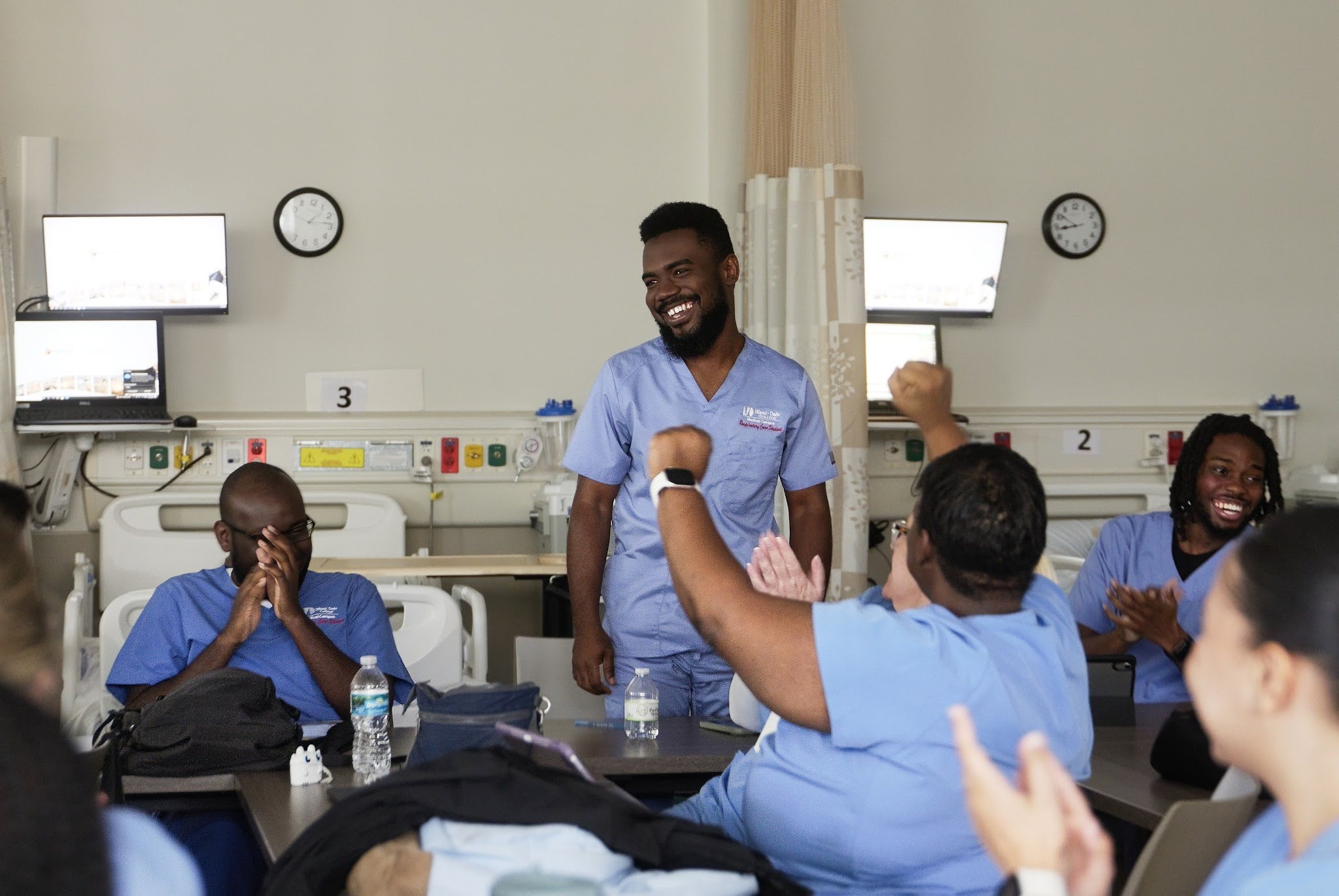
- Days 1 and 2 utilized the digital learning platform Kahoot!, through which participants tackled a cumulative total of 100 multiple-choice questions.
- Points accrued during these digital sessions carried forward on a live, shared leaderboard, instantly injecting a healthy, competitive spirit into the cohort.
Phase 3: The Floor-Based Elimination (Day 3)
On the third day, the competition transitioned from digital screens to physical space with a floor-based elimination game titled "Under Pressure."
- Residents physically positioned themselves within one of four labeled quadrants mapped out on the floor to answer 46 advanced critical care questions.
- Trainees who selected the incorrect quadrant were immediately eliminated, ratcheting up the tension and transforming cognitive retrieval into an athletic, dynamic spectacle.
Phase 4: The Live Championship (Day 4)
The culmination of the grueling qualifying rounds took place on day four, where the top three individual point-earners faced off in a live, Jeopardy!-style championship final. While full participation for the study was defined strictly as completing all three qualifying days (rather than reaching the grand finale), the live event served as a focal point for hospital-wide celebration, drawing peers and faculty mentors to cheer on the finalists.
Supporting Context & Metrics: The Science Behind the Score
While the celebratory atmosphere and entertainment value of the ICUlympics were immediately apparent, the research team’s primary academic burden was proving efficacy. To measure this objectively, the study utilized a structured methodological framework involving baseline assessments, control groups, and delayed follow-up testing.
The Numbers Tell the Story
Out of 92 eligible residents rotating through the ICU:
- 68 residents completed a baseline knowledge test and preliminary survey prior to the launch of the competition.
- 48 residents completed the identical follow-up knowledge assessment exactly 30 days post-competition.
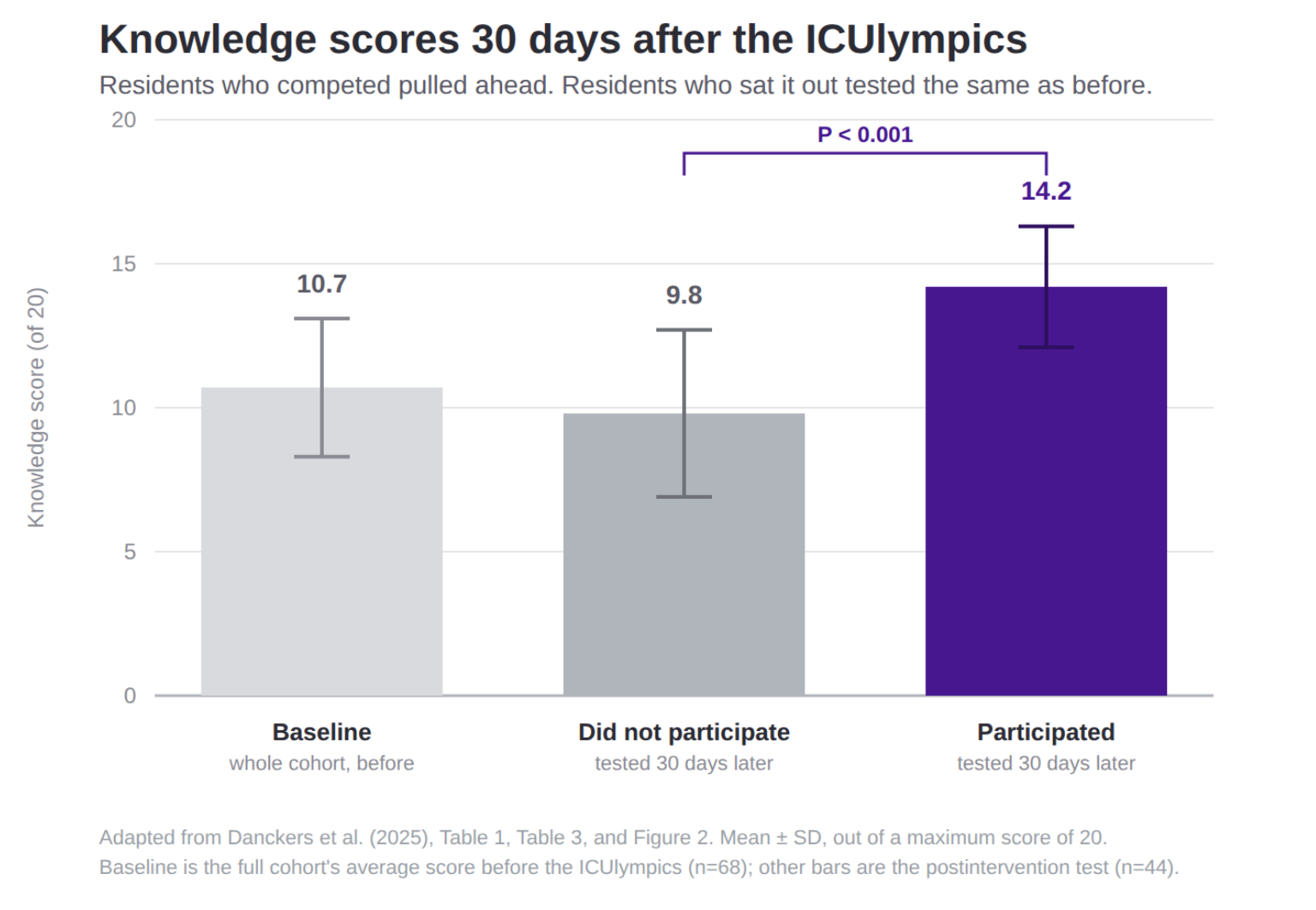
- Across the entire cohort, the baseline pre-test average sat at 10.7 out of 20 points.
When the 30-day follow-up data was analyzed, the performance gap between participants and non-participants was pronounced:
- Fully Participating Residents (N=19): Achieved an average score of 14.2 out of 20 on the 30-day follow-up knowledge test.
- Non-Participating Residents (N=25): Scored an average of 9.8 out of 20 on the same follow-up test—virtually identical to the cohort’s pre-competition baseline average.
Because participation was entirely voluntary and surveys remained anonymous, these metrics demonstrate a powerful, positive association between full engagement in gamified learning and sustained knowledge retention a month after the event concluded.
Leveraging the "Testing Effect"
The mechanism driving these dramatic scores goes beyond simple entertainment; it taps into a well-documented cognitive phenomenon known in educational psychology as the testing effect.
Rather than relying on passive re-studying—such as re-reading textbook chapters or scrolling through static slide decks—learners engaged in the ICUlympics were forced to actively retrieve information from memory under time constraints. This active recall reinforces neural pathways, making the retained knowledge significantly more durable over time. By embedding these high-retrieval challenges into a celebratory, social context, the educators bypassed the cognitive exhaustion typically associated with standard test preparation.
Official Statements and Qualitative Insights
Beyond raw examination scores, the qualitative feedback gathered via post-competition surveys illuminated profound shifts in resident sentiment regarding well-being, burnout, and program culture.
When surveyed on a 1-to-5 scale regarding their perceptions of medical training games:
- Effectiveness as a Learning Tool: Both participants (4.8/5) and non-participants (4.1/5) agreed that educational games are an effective method for acquiring new knowledge.
- Sense of Belonging: Participants reported a much stronger alignment regarding program connectedness (4.8 vs. 3.9 for non-participants).
- Overall Well-being: Participants strongly felt the games enhanced their daily wellness (4.8 vs. 3.8).
- Burnout Counteraction: Participants strongly credited the initiative with helping counteract residency burnout (4.8 vs. 3.8).
Expert Perspectives on Gamification in GME
Reflecting on the overarching philosophy of the project, Dr. Mauricio Danckers emphasized that gamification should never be viewed as a superficial gimmick meant to dumb down difficult material. Instead, when executed correctly, it elevates the entire standard of instruction.
"Gamification does not have to trade rigor for engagement," Dr. Danckers noted in discussions surrounding the pilot study.
Reflecting on his continued integration of interactive tools like Kahoot! within fellowship training, Dr. Danckers added that the platform has the unique power to "transform what might otherwise be a passive educational interaction into something participatory, competitive, social, and memorable, while still maintaining the rigor that we expect in graduate medical education."
This sentiment bridges a long-standing divide in medical education: the false dichotomy that learning must either be serious and punishing or fun and superficial. The success of the ICUlympics demonstrates that high academic standards can coexist with joy, community, and psychological safety.
Future Outlook: Scaling the ICUlympics Model Nationwide
What began as a localized pilot study at HCA Florida Aventura Hospital has rapidly snowballed into a national conversation. Following the publication of their findings in 2025, Dr. Danckers and his research team have actively expanded the ICUlympics framework across multiple healthcare systems throughout the South Florida and Miami regions.
The Multicenter Phase and Future Research Questions
The next phase of research—currently being compiled into an upcoming manuscript—seeks to answer more sophisticated pedagogical questions. Specifically, the team is analyzing whether game-based learning platforms translate equally well across diverse cohorts of learners with varying baseline characteristics, learning styles, and clinical specialties.
Furthermore, the organic spread of the project has outpaced formal academic channels. Sparked by conference presentations and widespread social media engagement, medical educators from across the United States have reached out to request workshops, toolkits, and live implementations of the ICUlympics for regional and national educational symposia. This groundswell indicates a profound, unmet demand within modern graduate medical education for scalable, community-focused pedagogical models.
Conclusion: A New Paradigm for Resident Education
As healthcare systems grapple with systemic burnout, high staff turnover rates, and the perpetual challenge of keeping clinical knowledge up to date, initiatives like the ICUlympics offer a compelling blueprint for the future. By intentionally designing educational interventions that honor the social and emotional needs of trainees alongside their intellectual growth, institutions can foster clinicians who are not only exceptionally well-prepared in critical care medicine, but also deeply connected to their peers, their programs, and their calling.
To explore further insights into how educators are leveraging interactive digital platforms to build lasting knowledge across higher education, visit kahoot.com/research.

