

Executive Overview
The enterprise artificial intelligence landscape has reached a defining inflection point. For the past several years, corporate boardrooms, IT departments, and venture capital firms have been transfixed by the novelty and raw generative power of Large Language Models (LLMs). Early proofs-of-concept and pilot projects were largely designed to test waters, validate internal use cases, and measure basic productivity gains. However, as organizations attempt to transition these isolated experiments into production-grade, business-critical systems, a harsh reality has come to light: the underlying digital infrastructure of the modern enterprise is profoundly unprepared.
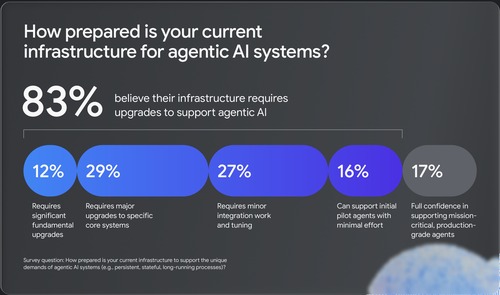
According to the newly released 2026 State of Infrastructure in the Agentic AI Era report from Google Cloud, a staggering 83% of organizations require infrastructure upgrades of varying magnitudes simply to support production-grade agentic AI systems. This is not merely a minor technical hurdle or a software configuration glitch. It represents a fundamental architectural gap between how legacy corporate systems were designed to operate and the voracious, continuous, stateful demands of autonomous software agents.
Unlike traditional software applications—or even early-generation chatbots that respond to a single, isolated prompt—agentic AI systems are designed to reason, plan, execute, and adapt independently. A single user prompt can trigger hundreds of downstream API calls, database queries, and automated transactions across disparate corporate ecosystems, including Customer Relationship Management (CRM) platforms, Enterprise Resource Planning (ERP) systems, and legacy data warehouses.
As enterprises race to deploy these autonomous workforces to drive efficiency, they are discovering that their current cloud, hybrid, and on-premises architectures buckle under the weight of continuous inference, multi-step orchestration, and rigorous data governance requirements. This in-depth report examines the core findings of Google Cloud’s latest research, explores the unique operational challenges posed by agentic workloads, breaks down the enterprise readiness gap, and charts the roadmap organizations must follow to survive and thrive in the agentic era.

Detailed Chronology: From Static GenAI Experiments to Autonomous Agents
To fully understand the urgency driving the 2026 infrastructure crisis, it is necessary to trace how enterprise artificial intelligence has evolved over a remarkably short, yet intensely volatile, period.
The 2025 GenAI Experimentation Boom
The journey began in earnest during the generative AI boom of 2024 and 2025. As highlighted in Google Cloud’s foundational 2025 infrastructure research—which famously diagnosed infrastructure as the "missing piece" in early GenAI strategies—organizations across virtually every sector engaged in near-universal experimentation. Companies stood up isolated sandboxes, experimented with prompt engineering, and tested out-of-the-box foundation models.
During this initial phase, the primary architectural conversations centered around cost efficiency, data privacy, and basic hybrid cloud or edge deployment strategies. Most companies treated generative AI as an auxiliary feature or an advanced search tool bolted onto existing software applications. The compute loads were sporadic, batch-oriented, and largely stateless. If a query failed or timed out, a human user simply hit refresh.
The Shift Toward Autonomy (2025–2026)
By late 2025 and into 2026, market pressures forced a strategic pivot. Business leaders were no longer satisfied with static chatbots that required constant human hand-holding. They demanded autonomous agents capable of performing complex, multi-step business processes from end to end—such as dynamically managing supply chain logistics, executing cross-border financial reconciliations, or autonomously resolving tier-three customer support tickets by interacting with live back-end databases.
This shift from passive generation to active, autonomous execution fundamentally changed the technological requirements. Agents do not just answer questions; they act. They browse, query, evaluate, execute, and verify. Consequently, the bottlenecks that organizations successfully bypassed during the pilot phase—such as fragmented data silos, high-latency interconnects, rigid API rate limits, and inadequate observability tooling—suddenly transformed into critical points of failure. The 2026 research marks the definitive end of the "experimentation honeymoon," forcing IT leaders to confront the hard infrastructure changes required to sustain autonomous systems at scale.
Supporting Context & Metrics: Breaking Down the Infrastructure Readiness Gap
The numbers compiled in Google Cloud’s 2026 study paint a vivid picture of widespread enterprise vulnerability. While the headline statistic—that 83% of organizations need infrastructure upgrades—catches the eye, a granular breakdown of the readiness spectrum reveals deeper operational nuances.
The Readiness Spectrum
- Full Confidence (17%): A small minority of organizations report absolute readiness. These are typically digital-native enterprises, hyperscalers, or financial institutions that have proactively modernized their core systems, adopted advanced MLOps pipelines, and engineered resilient, low-latency microservice architectures.
- Minimal Effort / Initial Pilots Only (16%): These respondents have sufficient infrastructure to run low-stakes, isolated agentic pilots with limited data access, but recognize that scaling these systems enterprise-wide would cause immediate failure.
- Minor Integration and Tuning Required (27%): Over a quarter of organizations sit in a moderately comfortable position. Their foundational infrastructure is sound, but they require targeted API integrations, minor latency reductions, and software tuning to support continuous agent execution.
- Major Upgrades to Specific Core Systems (29%): Nearly three-tenths of enterprises face substantial technical debt. Their core legacy systems—often decades-old ERPs or monolithic databases—are fundamentally incompatible with the high-frequency, asynchronous query loads generated by modern AI agents.
- Significant Fundamental Upgrades Required (12%): Alarmingly, more than one in ten enterprises admit that their entire IT infrastructure is obsolete for the demands of the agentic era, requiring a complete foundational overhaul from the silicon layer up to the orchestration plane.
[Agentic AI Infrastructure Readiness Breakdown]
+------------------------------------------+---------+
| Readiness Status                         | Share   |
+------------------------------------------+---------+
| Full Mission-Critical Confidence         |   17%   |
| Initial Pilots / Minimal Effort Needed   |   16%   |
| Minor Integration & Tuning Required      |   27%   |
| Major Upgrades to Core Systems Needed    |   29%   |
| Significant Fundamental Overhaul Needed  |   12%   |
+------------------------------------------+---------+
Why Agentic Workloads Break Traditional Infrastructure
To understand why four out of five organizations fall short, one must examine the operational DNA of agentic AI systems. Traditional enterprise workloads are deterministic and transient. They execute predefined code paths when triggered by a human user or a scheduled cron job.
In stark contrast, production-grade agentic workloads are:

- Persistent and Stateful: Agents must maintain a continuous thread of context across extended workflows, remembering previous decisions, intermediate calculations, and contextual constraints over hours or even days.
- Long-Running and Asynchronous: Unlike a standard web request that resolves in milliseconds, an agentic workflow may initiate a complex chain of reasoning that pauses to wait for external API responses, human approvals, or database locking mechanisms.
- Multi-Source and Highly Interconnected: Agents must seamlessly bridge structured databases, unstructured document repositories, real-time streaming data, and legacy mainframe systems without breaking data governance or security protocols.
- Power and Compute Intensive: Continuous inference—where models constantly evaluate their environment, plan next steps, and self-correct—demands immense computational throughput, placing unprecedented pressure on power consumption and hardware cooling strategies.
Official Statements and Industry Insights
The transition from conceptual AI strategies to hard infrastructure engineering has prompted leading technology executives to speak out on the structural demands of the new era.
Nirav Mehta, Vice President of Product Management at Google Cloud, captured the gravity of the shift when discussing the release of the 2026 findings:
"This report isn’t just a survey of the landscape; it’s a roadmap for establishing the new standard for production-grade autonomous systems."
Mehta’s perspective underscores a vital industry realization: optimism and executive mandate are no longer sufficient to drive AI adoption. Without rigorous architectural planning, investments in agentic AI risk stalling out in costly, unscalable pilot purgatories.

Industry analysts echo this sentiment, noting that the bottleneck in enterprise AI has officially migrated from algorithmic capability to systems engineering. While foundation models continue to grow smarter, faster, and more multimodal, their real-world utility is ultimately gated by the plumbing of the enterprise—network bandwidth, data governance frameworks, security perimeters, and orchestration telemetry.
Future Outlook: The Roadmap to Agentic Maturity
As organizations look toward the remainder of the decade, navigating the infrastructure gap identified by Google Cloud will require a deliberate, phased strategy. Developer platforms, enterprise architects, and IT leadership must align on several key operational pillars to build sustainable agentic environments:
1. Advanced Orchestration and Observability
Deploying a single agent is manageable; coordinating a fleet of autonomous agents that interact, negotiate, and execute tasks concurrently is an engineering labyrinth. Enterprises must invest in robust orchestration platforms capable of managing multi-step workflows, handling deadlocks, gracefully managing failures, and maintaining an audit trail of every autonomous decision. Observability tools must evolve from monitoring CPU utilization to tracking "agent intent"—providing real-time visibility into why an agent made a specific decision and what downstream systems it touched.
2. Bridging Legacy Systems with Modern APIs
The vast majority of enterprise data remains locked inside rigid, legacy architectures (such as on-premises mainframes and legacy relational databases). To prevent agents from causing catastrophic system outages or security breaches due to unchecked query volumes, organizations must build secure, high-performance API layers and data abstraction fabrics that safely expose legacy data to autonomous systems.

3. Holistic Governance, Security, and Data Residency
Agentic systems operate across boundaries—spanning on-premises datacenters, multi-cloud environments, and edge deployments. Ensuring strict compliance with global data privacy regulations (such as GDPR and HIPAA) requires automated governance frameworks that enforce role-based access control, data encryption, and verifiable data residency rules dynamically, in real time, as agents traverse corporate networks.
4. Sustainable Hardware and Power Management
As continuous inference scales, hardware selection can no longer be based solely on raw computational speed. Power consumption, thermal management, and energy efficiency are rapidly becoming primary drivers in enterprise hardware procurement decisions. Organizations must factor sustainability into their AI infrastructure roadmap, optimizing workloads to run on energy-efficient accelerators and localized edge hardware where appropriate.
Conclusion
The 2026 State of Infrastructure in the Agentic AI Era report serves as both a warning call and a strategic blueprint. The era of casual AI experimentation has officially closed. For enterprises striving to unlock the true autonomous productivity promised by agentic AI, closing the 83% infrastructure readiness gap is no longer optional—it is the foundational price of admission for the next generation of enterprise computing.

