
Executive Overview
For decades, the holy grail of educational reform has been singular, personalized instruction. Decisive research consistently demonstrates that high-dosage tutoring—intensive, frequent, and individualized academic support delivered by a trained educator—is among the most potent interventions available to reverse learning loss and accelerate student achievement. Yet, the model faces an intractable economic and operational wall: it is notoriously expensive, labor-intensive, and agonizingly difficult to scale across diverse school districts serving millions of students.
Enter generative artificial intelligence. Promoted by Silicon Valley visionaries and venture capitalists as the ultimate equalizer, modern AI promises to democratize elite-level academic support. By synthesizing vast repositories of pedagogical data, mimicking conversational empathy, and adapting in real-time to a student’s cognitive pace, AI-driven chatbots and virtual tutors claim they can deliver the benefits of high-dosage tutoring at a fraction of the cost.
However, the transition from algorithmic theory to classroom reality is fraught with philosophical tension, pedagogical risks, and institutional skepticism.
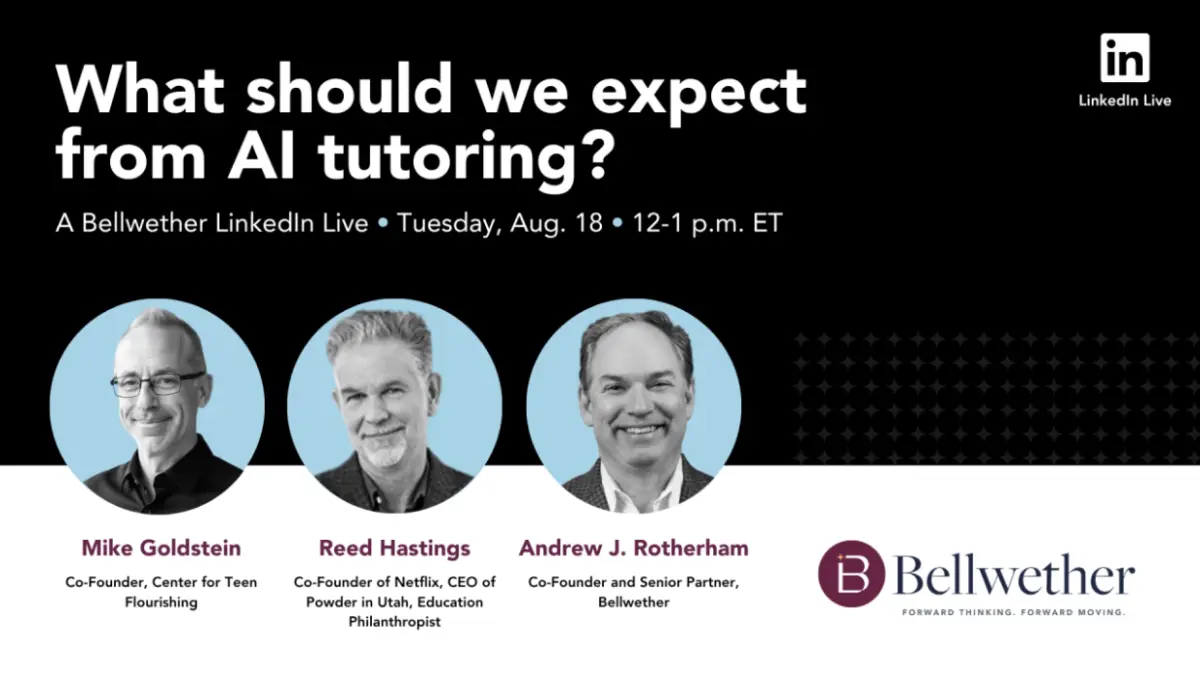
To explore this friction, a high-stakes debate convened industry titans and educational reformers at the intersection of technology and pedagogy. Moderated by Andrew Rotherham, co-founder and partner at Bellwether, the discussion pitted Netflix co-founder and education philanthropist Reed Hastings against tutoring pioneer Michael Goldstein. Their dialogue cuts to the core of contemporary education policy: Can artificial intelligence genuinely enhance tutoring for K-12 students, or is it merely another over-hyped ed-tech promise destined to founder upon the realities of the traditional classroom?
This investigative report examines the core arguments, explores the underlying metrics of the high-dosage tutoring crisis, analyzes the philosophical divides separating human-centric education from algorithmic intervention, and provides a strategic roadmap for school and district leaders navigating this technological inflection point.
Detailed Chronology: The Evolution of Tutoring, the Scaling Crisis, and the Rise of Generative AI
To understand the current debate over AI-powered tutoring, one must trace the trajectory of educational interventions over the past quarter-century. The timeline below charts how the education sector moved from traditional after-school help to the empirical gold standard of high-dosage tutoring, and how the sudden explosion of generative AI has disrupted the landscape.
[Early 2000s] ──> [2020-2022] ──────────> [Late 2022] ────> [2023-Present]
Fragmented        Pandemic Learning Loss    Launch of       The AI Tutoring
After-School      & The High-Dosage        Generative      Gold Rush &
Tutoring          Tutoring Boom            AI (LLMs)       Implementation Debates
Phase 1: The Pre-Pandemic Status Quo and the Rise of High-Dosage Tutoring
For generations, tutoring was largely an aftermarket luxury commodity for affluent families or an underfunded, sporadic remedial service for struggling students. Traditional after-school programs suffered from high absenteeism, weak curricula alignment, and poorly trained volunteers.
However, a robust body of empirical research—led by economists and education scholars at institutions like the University of Chicago’s Education Lab—began to shift the paradigm. Studies demonstrated that "high-dosage tutoring"—defined generally as tutoring sessions occurring three or more times per week, during the school day, in small groups (typically 1-to-3 or 1-to-4 ratios), with consistent, well-trained tutors aligned with core classroom curricula—could produce massive academic gains. Students receiving high-dosage tutoring frequently advanced one to two extra years of learning in math and reading within a single academic year.
Phase 2: The Pandemic Shock and the Scalability Wall
When COVID-19 shuttered schools in the spring of 2020, historic learning disruptions devastated student achievement, widening long-standing opportunity gaps. In response, federal policymakers infused state and local education agencies with historic amounts of relief funding through the Elementary and Secondary School Emergency Relief (ESSER) funds. School districts rushed to implement high-dosage tutoring programs to combat unprecedented learning loss.
Yet, reality quickly intervened. Districts discovered that while high-dosage tutoring worked brilliantly in controlled research environments, scaling it nationwide was an operational nightmare. Finding, vetting, training, and retaining thousands of human tutors proved nearly impossible amidst severe labor shortages. Furthermore, the recurring cost per student—often ranging from $2,000 to $4,000 annually—meant that once federal relief funds expired, the programs faced an immediate fiscal cliff.
Phase 3: The Generative AI Disruption
In late 2022, the public release of advanced Large Language Models (LLMs) fundamentally altered the conversation. Unlike rigid, rule-based educational software of the past—which relied on repetitive multiple-choice drills—generative AI exhibited the capacity for open-ended dialogue, contextual nuance, step-by-step Socratic questioning, and immediate translation across dozens of languages.
Ed-tech entrepreneurs and venture capitalists seized upon the technology. If an LLM could act as an infinite, tireless, patient tutor capable of interacting with a student via voice or text, the per-student cost of intensive academic support could plummet from thousands of dollars to mere pennies per hour. The promise was alluring: algorithmic equity.
Phase 4: The Current Reckoning
Today, schools and districts stand at a crossroads. As ESSER funds dry up and the initial novelty of generative AI gives way to sober analysis, education leaders are forced to separate genuine pedagogical innovation from marketing hype. The debate moderated by Andrew Rotherham between Reed Hastings and Michael Goldstein captures this exact moment of institutional hesitation: an industry desperate for a scalable solution, yet deeply protective of the human relationships that define effective teaching and learning.
Supporting Context & Metrics: The Mathematics of the Tutoring Crisis
To evaluate whether artificial intelligence can successfully bridge the tutoring gap, one must examine the stark economic and operational metrics that define modern K-12 education.
The Scale of the Need
According to recent data from the National Assessment of Educational Progress (NAEP) and state-level testing authorities, recovery from pandemic-era learning declines has been painfully slow. Millions of students remain multiple grade levels behind in foundational competencies, particularly in middle-school mathematics and early literacy.
- The Dosage Requirement: Education economists calculate that meaningful academic recovery requires sustained intervention—minimally 90 to 150 minutes of weekly tutoring embedded directly into the school day.
- The Population Deficit: In a public school system serving roughly 50 million students, if even 20% of the student body requires high-dosage intervention, the system must provision intensive support for 10 million children.
The Economics of Human-Centric Tutoring
Providing high-dosage human tutoring at scale requires a massive labor force.
- Cost Structure: Paying a living wage to certified educators, paraprofessionals, or specialized tutors to work with small groups translates to substantial per-pupil expenditures. In high-cost-of-living urban districts, the cost often exceeds $3,500 per student per year.
- The Funding Cliff: With the final deadline for obligating federal ESSER relief funds having passed, districts are absorbing massive budget deficits. Without alternative delivery mechanisms, human high-dosage tutoring programs face severe contraction or outright elimination.
The Promise and Peril of Ed-Tech Economics
Proponents of AI tutoring argue that the marginal cost of compute is dropping exponentially, making software-based intervention uniquely positioned to bypass the labor constraints of the traditional market.
- Infinite Scalability: A single, well-architected AI tutoring model can simultaneously engage with hundreds of thousands of students globally, adapting its instructional scaffolding to each learner’s unique error patterns.
- The Equity Trap: Critics, however, point to the digital divide and the quality gap. While affluent districts and private schools can afford customized, high-end AI integrations with robust safety guardrails and human oversight, under-resourced districts risk receiving cheap, poorly vetted chatbot applications that reinforce bias, hallucinate incorrect facts, and isolate students behind screens.
The Core Debate: Hastings vs. Goldstein (Moderated by Andrew Rotherham)
The discussion between Reed Hastings and Michael Goldstein—moderated with characteristic sharpness by Andrew Rotherham—crystallized the two opposing philosophies currently colliding in the ed-tech ecosystem.
Reed Hastings: The Optimistic Technologist and Philanthropist
Reed Hastings, renowned for scaling disruptive technologies globally through Netflix and investing heavily in educational equity, approaches AI tutoring through the lens of radical scalability and empowerment.
- The Cost-Accessibility Imperative: Hastings argues that human high-dosage tutoring, while pedagogically sound, is fundamentally a victim of the Baumol cost disease—an economic reality where services that rely heavily on human labor become increasingly expensive over time. Because society cannot afford to hire millions of human tutors for every struggling child, Hastings contends that rejecting AI out of hand is an elitist position that condemns disadvantaged students to academic stagnation.
- Personalization at Scale: Hastings emphasizes that generative AI models are rapidly evolving beyond simple question-and-answer engines into sophisticated Socratic partners. These systems do not merely give students the answers; they can be programmed to guide learners through complex problem sets by asking probing questions, offering customized analogies based on individual student interests, and operating with infinite patience in a judgment-free environment.
- Augmentation, Not Replacement: In Hastings’ view, AI is not positioned to fire classroom teachers or eliminate human educators. Rather, it acts as an indispensable force multiplier, lifting the administrative and instructional burden off overburdened teachers and providing targeted, individualized practice that would otherwise be impossible in a 1-to-30 classroom environment.
Michael Goldstein: The Pragmatic Tutoring Pioneer
Michael Goldstein, a veteran education leader and pioneer in high-dosage tutoring implementation, brings a granular, on-the-ground skepticism to the conversation.
- The Irreplaceable Value of Human Connection: Goldstein argues that learning is, at its foundational core, an emotional and relational enterprise. Disadvantaged students who have fallen behind academically are frequently disengaged, frustrated, and deeply skeptical of institutional authority. A chatbot—regardless of how advanced its natural language processing may be—cannot build genuine trust, notice subtle signs of emotional distress or trauma, or provide the powerful motivational encouragement that a caring human mentor offers.
- The Danger of Over-Promise: Goldstein cautions against the cyclical tendency of the technology sector to peddle silver-bullet ed-tech solutions to complex social problems. He points to a long graveyard of educational software—from early computer-assisted instruction to adaptive learning platforms—that promised revolutionary gains but frequently yielded marginal or disappointing results when deployed in real, messy classrooms.
- Implementation Realities: Goldstein reminds district leaders that introducing AI into classrooms introduces a cascade of new challenges: data privacy vulnerabilities, algorithmic bias, student distraction, and the erosion of critical social-emotional skill development. For Goldstein, technology should be viewed strictly as a subordinate tool rather than a transformative substitute for human instruction.
Andrew Rotherham’s Moderation
Guiding the conversation with analytical precision, Andrew Rotherham challenged both panelists to move past ideological abstractions. Rotherham pressed Hastings on how schools can guard against algorithmic hallucinations and pedagogical drift in AI models, while pushing Goldstein to offer concrete strategies for scaling academic support in the face of insurmountable fiscal realities. Rotherham underscored that the debate is not merely binary—it is not a choice between pure human instruction and unmitigated automation, but rather a complex negotiation over how to responsibly integrate emerging capabilities into existing pedagogical structures.
Future Outlook & Strategic Guidance for School Leaders
As artificial intelligence continues its rapid infiltration into educational institutions, school board members, superintendents, and principals must navigate a treacherous landscape of aggressive vendor marketing, anxious parents, and legitimate pedagogical opportunity.
What should educational leaders actually do with the technology sitting on their desks right now? Synthesizing the insights from the Hastings-Goldstein debate and current educational research suggests a pragmatic, multi-layered strategic framework:
1. Shift from Replacement to Augmentation
District leaders must explicitly reject the false dichotomy that AI can entirely replace human tutoring. Instead, AI should be deployed as a high-frequency, low-stakes practice environment. Just as athletes use automated pitching machines to complement live coaching, students can use AI tutoring modules for nightly homework support, foundational drill-and-practice, and concept review, freeing human tutors and teachers to focus on complex critical thinking, emotional engagement, and holistic mentorship.
2. Establish Rigorous Vetting and Guardrails
Educational institutions cannot afford to adopt consumer-grade AI tools without stringent oversight. School systems must demand transparency from ed-tech vendors regarding:
- Algorithmic Accuracy: How frequently does the model hallucinate incorrect academic content?
- Data Privacy & Compliance: Are student interaction logs compliant with strict privacy regulations such as FERPA and COPPA? Is student data being used to train commercial models?
- Bias and Fairness: Has the underlying LLM been audited for cultural, racial, and socioeconomic biases that could disproportionately misinterpret student inputs?
3. Prioritize Teacher Training and Professional Development
Technology is only as effective as the professional capacity of the educator wielding it. Districts must invest heavily in training teachers to understand the capabilities and limitations of generative AI. Educators need to know how to design prompts that align with state standards, how to monitor student usage for excessive reliance or cheating, and how to interpret the diagnostic data generated by AI tutoring platforms to inform their whole-group instruction.
4. Maintain Focus on Equity and the Human Element
As AI-driven tutoring tools proliferate, districts must ensure that low-income students are not relegated to an entirely automated educational experience while affluent students continue to enjoy elite, human-to-human mentorship. Technology should be leveraged to extend the reach of human educators—allowing master teachers to oversee wider networks of supported learners—rather than serving as a cheap substitute designed primarily for cost-cutting.
Conclusion
The debate between Reed Hastings and Michael Goldstein encapsulates the profound tension defining modern education. Artificial intelligence undoubtedly holds the technical capacity to transform how academic support is delivered, offering unprecedented scalability and personalized pacing that could theoretically dismantle traditional barriers to student success.
Yet, as Michael Goldstein rightly insists, education is fundamentally a human endeavor rooted in empathy, trust, and relationship-building—qualities that silicon and algorithms cannot replicate.
Ultimately, the future of AI in tutoring will not be determined by the Silicon Valley visionaries who code the software, nor by the skeptics who reject it outright. It will be forged in the practical, daily decisions of classroom teachers, school principals, and district leaders who must courageously separate the genuine pedagogical value of artificial intelligence from the fleeting promises of the ed-tech marketplace. By anchoring technological adoption in rigorous evidence, unwavering equity, and an unshakeable commitment to human connection, schools can harness the power of AI without losing the soul of education.

