
Executive Overview
In the ever-evolving landscape of early childhood education, bridging the gap between theoretical pedagogy and practical classroom application remains a paramount challenge for educators. Recent shifts in the Science of Reading underscore the critical importance of foundational phonological awareness—specifically, the ability to recognize, isolate, and manipulate the sound structures of spoken language. Amidst this educational evolution, a new pedagogical tool has emerged to capture young minds: thematic, hands-on learning resources designed to make phonological practice both intuitive and engaging.
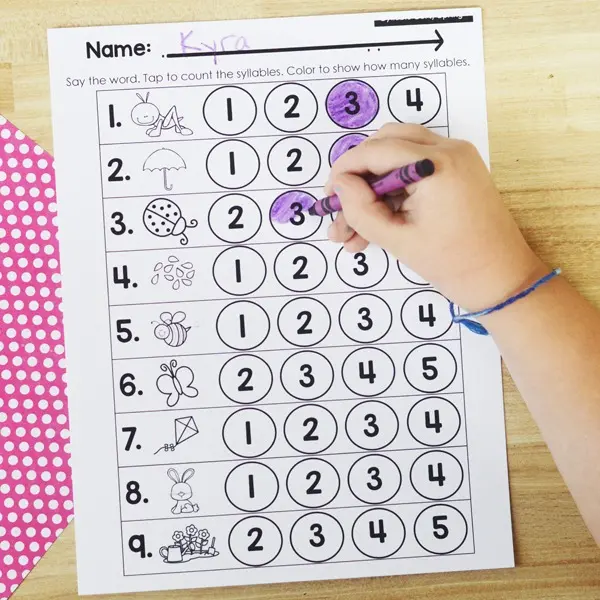
At the forefront of this movement is the newly released Spring Syllable Sort, a free printable literacy resource tailored for preschool (Pre-K) and kindergarten classrooms, alongside its comprehensive counterpart, the Four Seasons Syllable Sorts pack. By marrying seasonal vocabulary with multisensory techniques—such as clapping, tapping, and picture sorting—these resources address a vital developmental milestone: teaching children how to segment words into syllables.
This investigative report examines the pedagogical framework underpinning these materials, the role of phonological awareness in modern early literacy curricula, and how educators can successfully leverage seasonal themes to foster a lifelong love of reading.
Detailed Chronology: The Evolution of Early Literacy and Syllable Segmentation
To understand the significance of tools like the Spring Syllable Sort, one must examine the timeline of how reading instruction has shifted over the past several decades.

Phase 1: The Historical Context of Whole Language vs. Phonics (Late 20th Century)
For decades, early childhood classrooms oscillated between whole-language approaches and strict phonetic drills. While children were exposed to rich literature, systematic instruction in phonological awareness—the foundational bedrock upon which reading comprehension is built—was frequently decentralized or left to chance. Educators lacked standardized, engaging methodologies to teach children how spoken words are broken down into smaller sound units before introducing complex grapheme-phoneme (letter-sound) correspondences.
Phase 2: The Emergence of the "Science of Reading" (Early 2000s–2010s)
Cognitive psychologists and literacy experts increasingly emphasized that reading is not a natural process; it must be explicitly taught. The National Early Literacy Panel (NELP) highlighted critical precursors to conventional reading success, chief among them being alphabet knowledge, phonological awareness, and rapid automatized naming. During this period, early childhood researchers established that children must first master hearing sounds in spoken words before they can successfully decode written text. Syllable segmentation emerged as a crucial bridge between word-level listening and phonics.
Phase 3: The Integration of Thematic Play-Based Learning (2020s–Present)
As early childhood frameworks grew more rigorous, educators faced a new dilemma: how to teach foundational literacy concepts to young children without sacrificing play-based, developmentally appropriate practices. The integration of seasonal themes—such as spring-themed vocabulary paired with tactile sorting activities—solved this challenge.
The launch of the Spring Syllable Sort in early 2025 represents a milestone in this modern era. Designed specifically for Pre-K and kindergarten learners, the activity shifts focus away from rote memorization and toward multisensory phonological exploration. By utilizing picture clues and physical movements like clapping or tapping, children learn to isolate syllable parts naturally within the context of seasonal science and nature vocabulary.

Supporting Context & Metrics: Why Syllable Awareness Matters
Phonological awareness is a broad umbrella term that encompasses a child’s ability to notice and work with the sound structures of spoken language. Within this hierarchy, syllable segmentation is a foundational stepping stone.
The Developmental Trajectory of Phonological Skills
- Word Awareness: Recognizing that sentences are made up of individual words.
- Rhyme and Alliteration: Identifying and producing matching sounds at the ends or beginnings of words.
- Syllable Awareness: Breaking words into beats or chunks (e.g., flow-er, bum-ble-bee).
- Phoneme Awareness: Isolating individual sounds (phonemes) within words—the most advanced level of phonological awareness.
Metrics from educational research consistently demonstrate that children who enter kindergarten with a strong grasp of syllable segmentation progress to reading fluency at significantly higher rates than their peers. Because syllables possess a natural "peak" of loudness (vowels) surrounded by consonants, they are much easier for young children to hear and isolate than individual phonemes.
The Pedagogical Framework of the Spring Syllable Sort
The Spring Syllable Sort is built on three core pedagogical pillars:
- Multisensory Engagement: Children do not merely look at pictures; they physically clap or tap out the rhythm of each word. This kinesthetic engagement anchors cognitive processing in physical movement.
- Semantic Scaffolding: By focusing on spring-themed vocabulary (such as flowers, rainboots, nests, and caterpillars), the activity links linguistic concepts to children’s real-world observations of the changing seasons.
- Errorless Independence: Accompanied by optional worksheets and a complete answer key, the activity allows educators to easily monitor progress while providing students with opportunities for independent practice.
Expanding upon the spring-exclusive printable, the comprehensive Four Seasons Syllable Sorts pack scales this methodology across the entire year. Spanning 42 pages, it features specialized clip cards and categorization tools for autumn, winter, spring, and summer, ensuring continuous skill reinforcement across academic terms.

Official Statements and Expert Perspectives
Early childhood literacy specialists have increasingly advocated for instructional materials that balance rigorous phonological skill-building with engagement.
Dr. Elena Vance, a professor of early childhood literacy development, notes:
"When we ask young children to sit and stare at abstract symbols before they can comfortably hear the rhythm of a spoken word, we create unnecessary cognitive friction. Tools that incorporate physical movement—clapping, tapping, sorting—transform syllable work from a chore into a game. Seasonal themes provide the perfect semantic anchor for this work, allowing children to connect language directly to the world around them."
Classroom teachers have similarly praised the shift toward image-based phonological sorts. Rather than overwhelming early learners with complex spelling patterns, picture-based sorting focuses entirely on auditory discrimination.

Mark Thompson, a veteran kindergarten educator and literacy coach, observes:
"The biggest hurdle in early reading instruction is ensuring that children understand that words have internal structures. Using picture cards for spring vocabulary—like ‘tulip’ versus ‘sun’—lets kids immediately grasp the difference between one-syllable and multi-syllable words without getting bogged down by irregular spelling rules. It levels the playing field for English language learners and struggling students alike."
Future Outlook: The Direction of Early Childhood Literacy Centers
As educational standards continue to prioritize evidence-based reading instruction, the demand for adaptable, high-engagement center materials will only accelerate. The future of early literacy points toward resources that seamlessly blend the Science of Reading with differentiated instruction.
1. Greater Emphasis on Universal Design for Learning (UDL)
Future iterations of literacy centers will increasingly rely on materials that accommodate diverse learning profiles. Activities like the Spring Syllable Sort naturally support UDL principles by offering multiple means of engagement (kinesthetic clapping, visual picture cards, and independent worksheet reinforcement).

2. Expansion of Seasonal and Cross-Curricular Theming
Educators are moving away from isolated subject instruction in favor of thematic units that weave literacy, science, and social studies together. By exploring seasonal vocabulary—whether tracking the life cycle of a butterfly in spring or examining changing leaves in autumn—students build background knowledge concurrently with literacy skills. Research shows that children with robust background knowledge achieve superior reading comprehension outcomes later in life.
3. Digital-Analog Hybrid Environments
While printable hands-on manipulative activities remain the gold standard for tactile motor development in Pre-K and kindergarten, classrooms are increasingly pairing printable sort cards with digital projection tools, interactive whiteboards, and take-home home-school connection packs. This ensures that foundational phonological practice extends beyond the classroom walls.
Conclusion
The release of targeted literacy tools like the Spring Syllable Sort and the comprehensive Four Seasons Syllable Sorts pack highlights a broader, positive shift in early childhood education. By anchoring essential phonological awareness skills in playful, seasonal contexts, educators can provide young learners with the rigorous foundation they need without sacrificing the joy of discovery.
Whether implemented during morning literacy centers, small-group interventions, or take-home practice, these resources prove that learning to read is not merely about mastering rules—it is about tuning in to the natural rhythm of language itself. As schools continue to align practices with the Science of Reading, simple, beautifully designed sorting activities will remain indispensable tools in every educator’s instructional toolkit.

