Nutanix Expands Cloud Platform Capabilities to Power Production-Grade Agentic AI and Hybrid Infrastructures
Iffa Jayyana September 1, 2026 11 views 0 Comments
By: Global Technology Desk Published: August 2026
Executive Overview
In an aggressive push to capture the rapidly growing enterprise artificial intelligence market, Nutanix has announced a sweeping set of platform updates designed to streamline the deployment, management, and governance of production-grade agentic AI. Centered around the newly generally available Nutanix Enterprise AI (NAI) 2.8 and the upcoming rollout of the Nutanix Kubernetes Platform (NKP) 2.19, this latest release wave directly targets the complexities of running advanced autonomous AI workloads alongside traditional enterprise applications.
For years, organizations adopting generative AI and autonomous agents have faced a stark architectural dilemma: either isolate their AI workloads within specialized, siloed environments or struggle to force-fit high-performance AI frameworks into legacy infrastructure. Nutanix is looking to dismantle this trade-off through its signature "dual-native" architectural model. By treating virtual machines (VMs) and containers as first-class citizens on a unified fabric, the Nutanix Cloud Platform (NCP) aims to allow businesses to deploy AI agents, large language models (LLMs), and data pipelines right where their core applications and datasets already live.
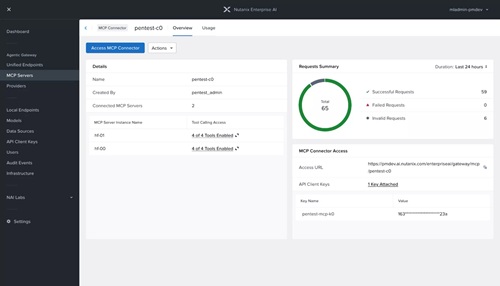
The centerpiece of the NAI 2.8 release is its robust Model Context Protocol (MCP) server management within the Nutanix Agent Gateway, establishing granular, centralized governance over how autonomous agents access critical enterprise tools and data. Simultaneously, the imminent arrival of NKP 2.19 brings expanded bare-metal container management, a specialized AI Applications Catalog, and CNCF Kubernetes AI Conformant certification. Together, these updates signify a maturation of Nutanix’s enterprise strategy, shifting the conversation from simple AI experimentation to secure, governed, and highly scalable production deployment.
Detailed Chronology of Platform Enhancements
The late-August rollout represents the culmination of months of targeted engineering developments aimed at bridging the gap between infrastructure operations and developer-driven AI workflows.
Early August: Laying the MCP Foundation
The groundwork for this announcement was laid on August 10, when Nutanix released an open-source Model Context Protocol (MCP) server specifically built for the Nutanix Cloud Platform. Designed to foster interoperability, this open-source tool leverages the Nutanix Prism v4 API, allowing popular AI developer tools and assistants—such as GitHub Copilot, Claude Code, and Cursor—to interact seamlessly with enterprise infrastructure.
Behind this interaction sits the Prism v4 API Gateway, which provides essential enterprise-grade guardrails, including strict role-based access control (RBAC), request throttling, comprehensive metering, and detailed auditing. This ensures that developer-facing AI assistants cannot execute unauthorized or unmonitored infrastructure changes.
August 26: The NAI 2.8 and NKP 2.19 Announcement Wave
Building directly upon the August 10 open-source release, Nutanix officially announced the broader platform enhancements on August 26.
Nutanix Enterprise AI 2.8 (Generally Available): Deployed and ready for production environments, NAI 2.8 introduces advanced MCP governance features directly inside the Nutanix Agent Gateway. It also enhances Nutanix Private Inference capabilities, offering refined model fine-tuning for smaller parameter models and support for air-gapped NVIDIA NIM microservice deployments.
Nutanix Kubernetes Platform 2.19 (Coming Soon): Slated for general availability in the near term, NKP 2.19 expands container orchestration capabilities across both virtualized and bare-metal environments, featuring dedicated support for the AHV hypervisor, physical server deployments via NKP Metal, and a curated AI Applications Catalog.
Service Provider Central (Generally Available): Alongside its AI-focused updates, Nutanix announced the general availability of SP Central, a unified, multitenant control plane designed to simplify the management of infrastructure, applications, cloud-native services, and AI workloads across distributed environments.
Deep Dive: Core Technological Innovations
To fully appreciate the scope of the Nutanix announcements, it is necessary to examine the specific engineering components introduced in NAI 2.8 and NKP 2.19.
1. NAI 2.8: Masterminding Agentic AI Governance via the Agent Gateway
As enterprises move past simple chatbot interfaces and toward "agentic AI"—where autonomous agents plan, reason, and execute multi-step workflows across systems—the surface area for security vulnerabilities and unexpected data access grows exponentially.
To combat this, NAI 2.8 introduces comprehensive, generally available MCP server management within the Nutanix Agent Gateway. Acting as a centralized proxy and connection point, the Agent Gateway sits between autonomous AI agents and various MCP servers (whether deployed locally within the NAI cluster or remotely).
Key features of this governance layer include:
Granular Tool Permissions: Administrators can restrict or grant tool access on a per-user or per-API-key basis, preventing agents from invoking unauthorized capabilities.
Local MCP Server Lifecycle Management: Locally deployed MCP servers benefit from streamlined rolling updates, ensuring that security patches and feature upgrades do not disrupt agentic workflows.
Dual-Component Architecture: Nutanix has effectively established a two-part MCP strategy. While the NCP MCP server (released on August 10) exposes infrastructure operations to AI tools, the Agent Gateway governs agent access to downstream MCP servers, tools, and enterprise data repositories.
2. Expanding Private Inference and Tech Previews
Running large language models securely within corporate boundaries remains a priority for highly regulated industries. NAI 2.8 extends Nutanix Private Inference with two major production-ready capabilities:
Fine-Tuning: Native support for fine-tuning models featuring fewer than 8 billion parameters, enabling organizations to tailor open-weights models to proprietary datasets without data leaving the private cloud.
Air-Gapped NVIDIA NIM Support: Full support for deploying NVIDIA NIM microservices in completely air-gapped environments, addressing the stringent security requirements of government, healthcare, and financial services sectors.
Additionally, Nutanix introduced two major features in technical preview (with strict warnings against production use):
Multi-Node and Multi-GPU Inference: Designed to support massive frontier models exceeding 100 billion parameters, distributing memory and compute overhead across multiple physical nodes and GPUs.
KV Cache Offloading: Allowing Key-Value (KV) cache to be offloaded from high-cost GPU memory to host CPU memory, significantly optimizing resource utilization during high-concurrency inference tasks.
3. NKP 2.19: Unifying Bare-Metal and Virtualized Kubernetes for AI
The upcoming Nutanix Kubernetes Platform 2.19 targets the infrastructure layer, ensuring that containerized AI applications scale efficiently regardless of whether they sit on virtual machines or bare-metal servers.
NKP Metal: This capability extends the familiar Nutanix operating model directly to physical servers. Utilizing built-in Nutanix Foundation and Lifecycle Manager technologies, NKP Metal automates node deployment, operating system configuration, and firmware lifecycle management for bare-metal clusters—a critical requirement for high-throughput AI training workloads that demand direct, unvirtualized hardware access.
NKP on AHV and Flow Integration: For organizations utilizing Nutanix’s native AHV hypervisor, NKP integrates directly with Nutanix Flow, enabling strict network-level micro-segmentation and isolation of AI agents to prevent lateral movement in the event of a security compromise.
AI Applications Catalog: NKP 2.19 introduces a dedicated catalog of pre-validated AI and machine learning software packages. Enterprise engineering teams can deploy complex frameworks—such as Kubeflow for machine learning pipelines, Milvus for vector database management, and Slurm for high-performance computing (HPC) workload management—with minimal manual configuration.
CNCF Certification: Highlighting its adherence to open cloud-native standards, NKP has officially achieved CNCF Kubernetes AI Conformant Platform certification.
Supporting Context & Strategic Metrics
The timing of Nutanix’s product updates reflects broader macroeconomic and technological shifts in the enterprise software market. According to recent enterprise IT spending surveys, over 70% of organizations are actively testing or deploying generative AI solutions, yet more than half cite infrastructure complexity, data gravity, and security governance as primary roadblocks to moving those projects out of sandboxes and into full production.
By avoiding the "lift-and-shift" trap, Nutanix is capitalizing on its established footprint in enterprise data centers. For a typical Global 2000 enterprise running thousands of virtual machines on AHV or VMware ESXi, the prospect of carving out an entirely separate, greenfield infrastructure silo exclusively for AI is both cost-prohibitive and operationally daunting.
Nutanix’s dual-native approach addresses this friction directly. By running VMs and containers on the same operational plane, enterprises can collocate their AI inference engines immediately adjacent to existing transactional databases, ERP systems, and data lakes. This proximity drastically reduces network latency—a critical metric when autonomous agents are executing hundreds of synchronous API calls per second—while leveraging existing enterprise backup, monitoring, and security baselines.
Official Statements and Industry Perspective
In the official announcement released on August 26, executive leadership emphasized the core philosophy driving these platform developments: customer choice and friction-free operational scaling.
"Enterprise AI should not require customers to rebuild the systems that already run their business," stated Thomas Cornely, Executive Vice President of Product Management at Nutanix.
Cornely’s remarks underscore the company’s strategic differentiation from hyper-scalers and specialized AI cloud providers. While public cloud providers often incentivize organizations to centralize data within proprietary cloud silos, Nutanix is positioning its hybrid multicloud platform as a sovereign, flexible alternative where companies can run production agentic AI securely on-premises, at the edge, or across hybrid environments.
Industry analysts have noted that the integration of Model Context Protocol (MCP) governance is a particularly timely move. As developer ecosystems rapidly adopt standardized agent protocols spearheaded by companies like Anthropic and OpenAI, enterprise IT departments have grown increasingly anxious about rogue agents executing unauthorized API mutations. By embedding MCP governance directly into the Nutanix Agent Gateway and Prism v4 API, Nutanix provides the administrative visibility and auditing capabilities required by corporate compliance officers.
Future Outlook
As Nutanix prepares for the general availability of the Nutanix Kubernetes Platform 2.19 and continues to mature technical preview features like multi-node/multi-GPU inference and KV cache offloading, the company’s trajectory is firmly anchored in the operationalization of autonomous enterprise systems.
Looking ahead over the next 12 to 18 months, several key milestones will define the success of this strategy:
Enterprise Adoption of Agentic Workflows: Observing how effectively organizations utilize the Nutanix Agent Gateway to govern complex, multi-agent enterprise applications without sacrificing performance.
Transition of Tech Previews: The eventual promotion of multi-node/multi-GPU inference and KV cache offloading from technical preview to general availability, which will unlock support for truly massive foundation models within private clouds.
Ecosystem Expansion: Continued growth of the AI Applications Catalog within NKP, as third-party AI and data management vendors certify their software stacks on Nutanix’s dual-native fabric.
Ultimately, Nutanix is betting that the future of enterprise AI belongs not to isolated monoliths, but to deeply integrated, securely governed, and flexibly deployed hybrid infrastructures. With the arrival of NAI 2.8 and NKP 2.19, the company has provided its customer base with a pragmatic, enterprise-ready roadmap to turn that vision into production reality.