

Executive Overview
In contemporary educational discourse, literacy remains one of the most fiercely debated topics, yet the conversation is overwhelmingly dominated by reading. Endless panels, policy changes, and classroom interventions focus heavily on phonics, fluency, and reading comprehension. Meanwhile, writing instruction—the expressive twin of reading—is frequently relegated to the background.
This glaring omission has long troubled educators Melanie Meehan and Maggie Roberts. Meehan, a former curriculum coordinator who runs an in-person writing center, and Roberts, a literacy consultant and veteran middle school teacher, have dedicated their careers to bridging the gap between how children learn and how they are taught to write.
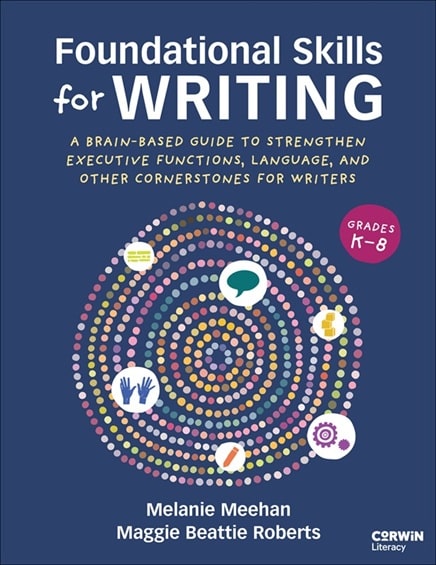
Earlier this month, Meehan and Roberts released their new book, Foundational Skills for Writing: A Brain-Based Guide to Strengthen Executive Functions, Language, and Other Cornerstones for Writers. The text confronts a foundational truth: writing is one of the most cognitively demanding tasks we ask students to perform. When children struggle with writing, it is rarely due to a lack of imagination or effort; rather, it is because foundational mechanics—ranging from transcription to executive functioning—have not been sufficiently automatized.
To help educators transform theoretical neuroscience into practical classroom habits, the authors have introduced "Minute Moves." These are short, highly flexible, 60-to-90-second activities designed to be seamlessly integrated into classroom transitions, warm-ups, or downtime. By strengthening students’ neurological pathways one brief exercise at a time, these routines free up the cognitive bandwidth necessary for complex composition.

Detailed Chronology: The Evolution of Writing Instruction and the Birth of "Minute Moves"
The Reading-Writing Imbalance
For decades, literacy reform has moved in waves, usually prioritizing receptive skills (reading) over expressive ones (writing). While reading and writing rely on overlapping cognitive networks, writing requires an additional layer of output generation.
Meehan and Roberts recognized that teachers were frequently expected to assign writing without being given the diagnostic tools to break down why students fail to produce text. When children stare at a blank page, educators often diagnose the issue as laziness or writer’s block. In reality, the child’s working memory may simply be overloaded by the mechanical demands of transcription, spelling, and sentence construction.
Diagnosing the Cognitive Bottleneck
In developing Foundational Skills for Writing, Meehan and Roberts mapped out the core domains that must function smoothly for writing to occur:
- Transcription Skills: Physical acts like handwriting, keyboarding, spelling, and fine/gross motor development.
- Oral Language: Speaking and listening precursors, including sentence construction and vocabulary storage.
- Executive Functioning: Higher-order cognitive processes like working memory, cognitive flexibility, and inhibitory control.
When these components are underdeveloped, they consume all available mental energy, leaving no room for creativity, argument development, or voice.
Deploying the "Minute Moves"
To combat this, the authors conceptualized "Minute Moves"—micro-interventions that take mere moments but yield compounding cognitive benefits. During a recent interview, Meehan and Roberts outlined eight signature strategies divided into three core categories: spelling, sentence construction, and executive functioning.
Supporting Context & Metrics: The Mechanics of the "Minute Moves"
Spelling Minute Moves: Building Neural Pathways
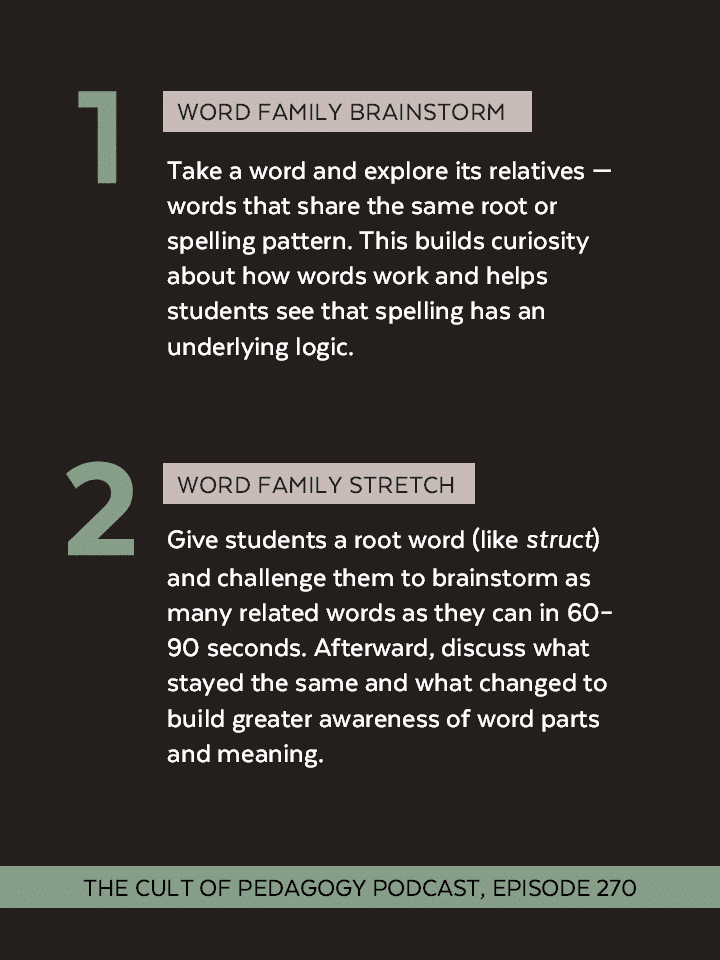
1. Word Family Brainstorm
Rooted in the philosophies of spelling researcher Rebecca Treiman—who posits that children find words inherently fascinating—this strategy moves away from rote memorization. Instead of teaching homophones like two, to, and too in isolation, educators link two to concepts of "twoness" through words like twin, twine, and twenty. By exploring etymological connections (such as linking decision to decide, incision, concise, and scissors via a Latin root meaning "to cut"), students begin to see spelling as a logical, interconnected web rather than an arbitrary list.
2. Word Family Stretch
Teachers set a 60-to-90-second timer and challenge students to generate as many words as possible from a single root (e.g., struct, meaning "to build"). The magic happens during the subsequent debrief: analyzing what stayed the same, what changed, and how prefixes and suffixes shifted the meaning. This teaches students to distinguish between "bound" roots (which cannot stand alone) and "free" roots (which can).
3. Prefix Swap
Building on word families, this exercise focuses strictly on altering prefixes to transform base words—such as turning form into reform, transform, inform, and deform. Meehan notes that this exercise is exceptionally powerful for multilingual learners, who frequently recognize familiar roots and affixes (bene, mal) from their native languages, accelerating their English vocabulary acquisition.

Sentence Construction Minute Moves: Moving Beyond Choppy Prose
4. Sentence Scramble
Educators write individual words or phrases of a sentence onto physical index cards and scramble them. Students work collaboratively to physically manipulate the cards, solving the puzzle and answering analytical questions: How did you figure out the order? Which words had to stay together? Instructors can increase the difficulty by removing punctuation or inserting distractor words.
5. Sentence Expander
Beginning with a bare-bones kernel sentence like The cat purrs, students answer guiding questions (Which cat? What color? Where? When? Why?) to progressively build complexity. Meehan champions the use of terms like "doer" and "doing" instead of "subject" and "predicate" to make grammar more accessible to young learners.
6. Sentence Combining
Described by Roberts as a high-impact, rapid intervention, sentence combining teaches students to merge short, choppy sentences into syntactically complex structures. For instance, combining My cat is orange and My cat is big yields My big orange cat…. Beginners can have target words underlined for "harvesting," while advanced students experiment with conjunctions (because, and, but) to alter logical relationships.
Executive Functioning Minute Moves: Fostering Cognitive Flexibility
7. "What’s Another Way?"
Targeting cognitive flexibility—the ability to shift perspectives and revise thinking—this move asks students to rewrite a single sentence in multiple ways. They might start with a dependent clause, substitute pronouns, or drastically shorten the sentence. Meehan emphasizes that powerful writing relies on intentional variety: knowing when to deploy a long, complex sentence and when to deploy a punchy, short one.

8. New Angle
This macro-level strategy asks students to retell a familiar scene from a book, class text, or short film through an entirely different character’s perspective. Roberts recalls a ninth-grade cafeteria food fight retold through the eyes of a teacher covered in applesauce. Meehan utilizes Pixar shorts like Snack Attack during tutoring sessions, having students write from opposing points of view. Beyond writing proficiency, this exercise fosters empathy, democratic discourse, and perspective-taking.
Official Statements & Insights from the Authors
The core philosophy underpinning Meehan and Roberts’ work is rooted in empowerment rather than remediation.
"The more that you can get kids curious and thinking words are cool, the better," Melanie Meehan explains, emphasizing that linguistic curiosity is the primary driver of spelling retention and vocabulary expansion.
When discussing the transition from simple to complex syntax, Maggie Roberts highlights the compounding nature of targeted practice:
"Sentence combining is a really high-impact, quick way for kids to graduate from writing a series of simple sentences to ones that are more syntactically complex, interesting, and precise."
Furthermore, the authors stress that teaching executive functioning explicitly transforms student identity.
"When you start naming that as cognitive flexibility for kids," Meehan notes, "that’s exciting to them. There’s something genuinely empowering about being told you’re practicing a sophisticated cognitive skill—especially for students who have struggled to see themselves as capable writers."
Roberts reinforces that exercises like "New Angle" extend far beyond the boundaries of the language arts classroom, serving as vital exercises in emotional intelligence and civic engagement:
"It’s not just about writing and it’s not just about watching this show, but it’s also about democracy and thinking about how other people think and what their perspectives are."
Future Outlook: Integrating Foundational Writing into Modern Curricula
As schools continue to grapple with literacy achievement gaps, the introduction of brain-based, micro-intervention frameworks like Foundational Skills for Writing signals a much-needed evolution in pedagogical strategy.
By shifting the narrative away from high-stakes, intimidating writing prompts and toward bite-sized, gamified routines, educators can lower affective filters and reduce cognitive overload. The success of "Minute Moves" proves that teachers do not need to overhaul their entire schedules to make room for writing instruction; rather, literacy can be systematically reinforced in the margins of the school day—during transitions, line-ups, and warm-ups.
Ultimately, Meehan and Roberts have provided a roadmap for a neglected educational frontier. By treating writing not as an innate talent, but as a complex set of foundational, neurological skills that can be explicitly trained, educators can finally bridge the gap between reading and writing, empowering a new generation of confident, articulate, and cognitively flexible writers.

