

Executive Overview
In the rapidly evolving landscape of generative artificial intelligence, the industry’s focus is undergoing a profound paradigm shift. For years, the prevailing dogma of the AI boom dictated that bigger was inherently better. Enterprise developers, researchers, and tech giants alike poured massive computational resources into scaling frontier models, aiming for monolithic systems capable of functioning as all-purpose answer engines. However, as artificial intelligence transitions from conversational novelties to complex, autonomous, long-running agentic workflows, the cracks in the monolithic model approach have become glaringly apparent. Enter Nvidia and its latest release: Nemotron 3.5 Lightning.
Unveiled on August 11, Nemotron 3.5 Lightning is not designed to be the omniscient conversational partner that steals headlines for passing complex legal exams or writing poetry. Instead, Nvidia has engineered it to be a high-velocity, specialized workhorse tailored specifically to operate within multi-step, long-running AI agent systems. Operating as a 30 billion-parameter mixture-of-experts (MoE) model that activates a lean 3 billion parameters per token, Nemotron 3.5 Lightning shatters conventional speed barriers. It supports massive context windows of up to 1 million tokens and delivers up to four times the output speed of comparably sized models.
Crucially, Nvidia is releasing the model with open weights, comprehensive training data, and recipes under its OpenMDW-1.1 license. Yet, the true significance of the Nemotron 3.5 Lightning launch extends far beyond the technical specifications of a single model. It represents a watershed moment that champions a radical new architectural blueprint: the transition from isolated, general-purpose models to a collaborative "system of models."
By introducing NeMo Switchyard alongside Lightning—an open-source routing library designed to dynamically direct workloads across an enterprise’s hybrid mix of open, proprietary, and hardware-accelerated models—Nvidia is rewriting the rules of AI deployment. Model selection is no longer a static, one-time platform choice made at the inception of a project. Instead, it has become a fluid, runtime decision optimized for latency, inference cost, hardware efficiency, and task specialization. This in-depth report explores the engineering triumphs of Nemotron 3.5 Lightning, the architectural philosophy of agentic model ensembles, and the transformative economic impact this shift will have on enterprise artificial intelligence.

Detailed Chronology & Technical Architecture
The Genesis of Specialized Efficiency
To understand why Nvidia developed Nemotron 3.5 Lightning, one must examine the computational bottlenecks plaguing modern AI agents. Traditional AI applications typically followed a request-response pattern: a user submits a prompt, and a single frontier model processes the input, generates a response, and terminates the session.
However, the cutting edge of AI development has moved rapidly toward autonomous agents. These systems are tasked with complex, multi-stage objectives—such as auditing codebases, conducting multi-source market research, or managing end-to-end supply chain logistics. To accomplish these goals, an agent may need to generate dozens, hundreds, or even thousands of intermediate model calls, executing repetitive tool invocations, data validations, formatting routines, and logical checks.
Routing every single one of these micro-tasks through a massive, general-purpose reasoning model is computationally prohibitive and economically unsustainable. It introduces unacceptable latency, drives inference costs sky-high, and strains hardware infrastructure. Recognizing this chokepoint, Nvidia’s engineering teams set out to build a model that prioritized velocity and operational efficiency over raw, generalized intelligence.
Under the Hood: Specifications of Nemotron 3.5 Lightning
Released on August 11, Nemotron 3.5 Lightning is engineered from the ground up to eliminate the friction points of agentic execution. The core specifications of the model highlight Nvidia’s focus on high-throughput, low-latency performance:
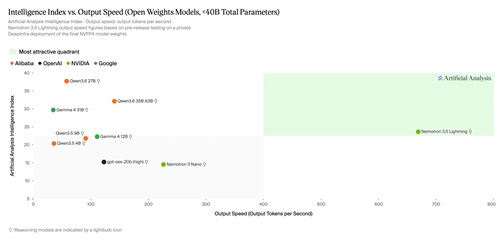
- Parameter Architecture: Built as a 30 billion-parameter mixture-of-experts (MoE) model.
- Active Parameters: Dynamically activates only 3 billion parameters per token, drastically reducing computational overhead during inference.
- Context Window: Fully supports context windows scaling up to 1 million tokens, allowing the model to digest massive historical logs, code repositories, or enterprise documents within agentic pipelines.
- Inference Speed: Delivers up to four times the output speed of similarly sized conventional models.
- Licensing: Offered fully open, including open weights, training data, and recipes under Nvidia’s OpenMDW-1.1 license.
Advanced Optimization Techniques
Achieving a fourfold increase in generation speed while maintaining the high accuracy required for enterprise tool use required more than just a clever parameter count. Nvidia integrated several advanced architectural innovations into Lightning’s framework:
- Mixture-of-Experts (MoE) Efficiency: By routing tokens through a sparse subset of neural network pathways (activating 3 out of 30 billion parameters), the model achieves the capacity and breadth of a massive model while retaining the compute-light inference footprint of a much smaller system.
- Multi-Token Prediction: Unlike traditional autoregressive models that predict a single token at a time, Lightning leverages multi-token prediction to forecast several sequential tokens simultaneously, smoothing out generation spikes and accelerating throughput.
- Speculative Decoding: This technique pairs a smaller, ultra-fast draft model with the target model to verify multiple token predictions in parallel, dramatically cutting down the time-to-first-token and subsequent generation latency.
- NVFP4 Quantized Checkpoints: By incorporating native 4-bit floating-point (NVFP4) quantization, Nvidia optimized the model to run with peak efficiency on its latest hardware architectures, reducing memory bandwidth pressures without sacrificing numerical precision.
Supporting Context & Metrics: The Shift to a "System of Models"
The Economics of Enterprise AI Workflows
The release of Nemotron 3.5 Lightning underscores a fundamental economic reality confronting corporate AI adopters: throwing raw intelligence at every problem is financially unsustainable. In an enterprise setting, operational margins depend on balancing three competing variables: inference cost, latency, and task accuracy.
When deploying an AI agent to execute a multi-step workflow, developers face a stark trade-off. Frontier reasoning models—such as the largest iterations of proprietary foundational models—excel at high-level planning, strategic decision-making, and navigating ambiguous, unstructured problems. Yet, using these expensive behemoths to format JSON outputs, verify API responses, or parse routine log files is the computational equivalent of hiring a senior aerospace engineer to tighten screws on an assembly line. It is a wasteful misallocation of resources.
Nvidia’s research indicates that modern enterprise agents increasingly operate not as isolated systems, but as model ensembles. In this paradigm, different models are designated for specialized roles based on their strengths:

- The Reasoning Tier: A heavy, highly capable frontier model acts as the "orchestrator" or "planner." It analyzes the user’s initial objective, breaks it down into a structured DAG (Directed Acyclic Graph) of sub-tasks, and handles complex logical forks.
- The Execution Tier: Fast, specialized models like Nemotron 3.5 Lightning take over the heavy lifting. They execute the repetitive tool calls, validate intermediate data streams, reformat outputs, and perform routine CRUD (Create, Read, Update, Delete) operations at blistering speeds.
Enter NeMo Switchyard: Dynamic Runtime Routing
To operationalize this multi-tier architecture, building an agentic system can quickly become an engineering nightmare if hardcoded logic is used to route tasks between models. Applications would become brittle, tightly coupled to specific API endpoints, and difficult to update as new models are released.
To solve this, Nvidia introduced NeMo Switchyard alongside Nemotron 3.5 Lightning. NeMo Switchyard is an open-source routing library engineered to act as the traffic controller for enterprise AI applications. Its primary function is to intercept individual requests generated during an agentic workflow and dynamically direct them to the most appropriate model based on real-time constraints:
- Quality Thresholds: Does this specific sub-task require rigorous zero-shot reasoning, or is pattern-matching sufficient?
- Latency Budgets: Is the user waiting on a synchronous UI render (requiring sub-second response times), or is the agent running asynchronously in the background?
- Inference Cost: How can the enterprise minimize token expenditure while maintaining SLA (Service Level Agreement) compliance?
Crucially, NeMo Switchyard allows organizations to orchestrate this traffic across a heterogeneous mix of models—spanning open-source weights, proprietary commercial APIs, and Nvidia-accelerated internal models—without requiring developers to rewrite the underlying application code.
This fundamentally alters the software development lifecycle for AI agents. Model selection transitions from a static platform decision made during initial project scoping into a dynamic, runtime evaluation optimized continuously by the Switchyard routing layer.

Official Statements and Industry Perspective
Nvidia’s leadership and technical publications have framed the Nemotron 3.5 Lightning and Switchyard release as a crucial evolutionary step for enterprise artificial intelligence. In official developer documentation and enterprise blog posts, the company emphasized that the future belongs to specialized cooperation rather than monolithic brute force.
"Modern agents increasingly operate as model ensembles, with different models specializing in different work," Nvidia noted in its enterprise launch documentation. "Raw capability remains one factor, but latency, inference cost, deployment location, and task specialization become part of the same decision. A model that is not the strongest choice for difficult reasoning may still make sense for a large volume of narrower tasks if it can complete them more quickly and with sufficient accuracy."
Industry analysts have widely praised the strategic timing of Nvidia’s release. As enterprises move past the proof-of-concept phase and into production-grade deployments, cost overruns and latency complaints have emerged as the primary friction points inhibiting widespread AI adoption. By providing an open-weight model optimized explicitly for high-frequency agentic tasks, alongside an open-source routing library to manage multi-model environments, Nvidia is addressing the exact infrastructural pain points keeping Chief Information Officers (CIOs) awake at night.
Furthermore, by releasing the model under its OpenMDW-1.1 license—including training data and recipes—Nvidia is reinforcing its commitment to the open-weights community, giving enterprise developers the transparency and fine-tuning autonomy required for highly regulated industries such as finance, healthcare, and defense.

Future Outlook: The Horizon of Agentic AI Architecture
Runtime Flexibility and Workflow Optimization
The release of Nemotron 3.5 Lightning and NeMo Switchyard points toward a definitive trajectory for the next era of software engineering: workflow-level optimization.
In the near future, development teams will no longer evaluate an AI system based solely on how a single model performs on a standardized benchmark (such as MMLU or GSM8K). Instead, evaluation suites will target the performance, cost-efficiency, and latency profile of the entire workflow. Developers will fine-tune routing policies within libraries like Switchyard, experimenting with different combinations of reasoning engines and specialized execution models to find the optimal Pareto frontier for their specific business logic.
Hardware and Software Co-Design
As Nvidia continues to tightly couple its hardware stack (such as Blackwell and upcoming architectures) with optimized software libraries and specialized models like Lightning, the barrier to entry for running complex, multi-agent enterprise systems will drop significantly. The ability to run quantized checkpoints (like NVFP4) natively on accelerated hardware ensures that organizations can scale their agentic operations locally or within secure hybrid-cloud environments without incurring runaway cloud computing bills.
Conclusion
Nvidia’s Nemotron 3.5 Lightning is much more than just another model release in a crowded AI market. It is a calculated architectural statement. By validating the concept of the "system of models" and providing the open-source tools required to route workloads dynamically, Nvidia is helping usher enterprise AI out of its awkward adolescence and into a mature, highly optimized operational phase. As agents take on more autonomous responsibility across global industries, the speed, efficiency, and collaborative grace pioneered by systems like Lightning and Switchyard will undoubtedly serve as the bedrock of the next generation of intelligent software.

