
Executive Overview
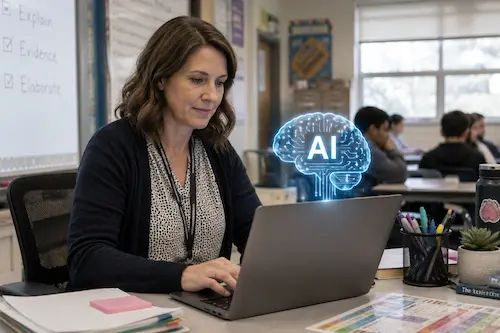
The integration of artificial intelligence within K-12 education has reached a critical inflection point. Just a few academic cycles ago, school administrators and classroom educators were embroiled in intense debates regarding the existential threats posed by generative technology. Discussions focused heavily on academic integrity, plagiarism detection, and the feasibility of outright bans within school district networks. Today, that defensive posture has dissolved, replaced by a strategic, systemic effort to harness artificial intelligence as a catalyst for instructional efficacy and human-centered learning.
As school systems across the United States finalize operational strategies for the 2026–2027 academic year, the central narrative has shifted dramatically. The operational question in education is no longer whether AI belongs in the classroom, but rather how it can be governed and deployed to amplify human expertise. Leading educational strategists emphasize that the ultimate value of AI in schooling does not lie in algorithmic lesson generation or automated content production. Instead, its primary promise is time restoration—reclaiming administrative hours to cultivate relational depth, foster student belonging, and strengthen the socio-emotional foundations essential for academic success.
Based on insights from educational leaders, including Timothy Montalvo—Assistant Principal at Fox Lane Middle School in Westchester, New York, and adjunct professor at Iona University and the College of Westchester—this analysis examines the structural shift driving modern AI adoption in schools. By moving from reactive tool usage to intentional instructional workflows, educators are utilizing technology to preserve and enhance the fundamentally human essence of teaching.
       EVOLUTION OF AI IN K-12 EDUCATION: 2022–2027

  [ 2022–2023 ] ──► Panic & Containment
                    • Institutional bans on generative tools
                    • Academic integrity concerns dominance

  [ 2023–2024 ] ──► Reactive Tinkering
                    • Isolated teacher experimentation
                    • Basic lesson plan generation

  [ 2024–2025 ] ──► Systemic Governance
                    • District policy & guidance rollouts
                    • Adoption of specialized EdTech platforms

  [ 2026–2027+ ] ──► Relational Amplification
                    • Purpose-driven AI workflows
                    • Focus on student belonging & critical inquiry
Detailed Chronology: The Four-Phase Evolution of Classroom AI
The trajectory of artificial intelligence in elementary and secondary education highlights a rapid transition from institutional panic to deliberate, policy-driven integration.
Phase 1: Institutional Panic and Containment (2022–2023)
Following the public rollout of consumer-facing large language models (LLMs) in late 2022, school districts faced immediate disruption. Initial reactions were defined by containment strategies. Major public school systems instituted network-wide bans on AI platforms to safeguard academic honesty. Professional development during this era focused largely on detection mechanisms, catching unauthorized usage, and establishing punitive policies around digital cheating.
Phase 2: Reactive Tinkering and Individual Experimentation (2023–2024)
As restrictive bans proved technically unfeasible and instructionally counterproductive, pioneering educators began experimenting independently with generative tools. Teachers quietly utilized AI to draft lesson outlines, generate multiple-choice quizzes, and write routine communications. However, these applications remained fragmented, relying on individual trial and error without institutional frameworks or cohesive pedagogical objectives.
Phase 3: Systemic Policy and Infrastructure Development (2024–2025)
By mid-2024, state departments of education and local school boards began instituting formal AI governance guidelines. Districts transitioned from generic consumer tools to specialized, education-focused platforms designed with strict privacy standards (compliant with FERPA and COPPA). Professional development shifted from basic tech onboarding to structured training around prompt design, data security, and ethical implementation.
Phase 4: Relational Amplification and Purposeful Workflows (2026–2027 Horizon)
Entering the 2026–2027 preparation period, the educational sector has entered an era of mature integration. AI is no longer viewed as a novel novelty or an existential threat, but as an infrastructure layer designed to streamline non-instructional workloads. The prevailing instructional philosophy asserts that AI should handle repetitive administrative processing, granting educators the cognitive bandwidth to engage in high-impact human interventions.
Supporting Context & Metrics: Operational Realities and Workload Economics
To understand why AI integration is shifting toward time restoration, one must analyze the administrative burden carried by modern educators. Standardized teaching workflows have historically been compromised by non-instructional administrative overhead, directly contributing to teacher burnout and high retention turnover.
| Task Category | Historical Time Allocation (Pre-AI) | AI-Augmented Workflow Target | Strategic Educational Benefit |
|---|---|---|---|
| Material Differentiation | 4–6 hours/week | 1–2 hours/week | Rapid multi-tiered text adaptation without sacrificing core academic rigor. |
| Administrative Routine | 5–8 hours/week | 1–2 hours/week | Automated formatting, routine email drafting, and curriculum scaffolding. |
| Formative Feedback | 6–10 hours/week | 2–4 hours/week | Rapid analysis of learning gaps, allowing more direct student conferencing. |
| Direct Student Mentorship | Restricted by time limits | Expanded capacity | Increased opportunities for 1-on-1 check-ins, socio-emotional support, and targeted interventions. |
Data from educational research institutions consistently indicates that teachers work an average of 50 to 54 hours per week, with less than half of that time dedicated to direct student interaction. By delegating formatting, text leveling, data aggregation, and administrative drafting to calibrated AI systems, school systems can reclaim up to 30% of operational capacity. This reclaimed time is systematically reallocated toward fostering student belonging, conducting small-group instruction, and executing targeted behavioral interventions.
Strategic Implementation: The Five Core Pillars of Purposeful Integration
Drawing from contemporary instructional leadership models, forward-thinking educational institutions are structuring their AI transition around five core operational pillars.
                  THE FIVE PILLARS OF INTENTIONAL CLASSROOM AI

    +-------------------------------------------------------------+
    | 1. Build Purposeful Workflows (Not Just Toolboxes)          |
    +-------------------------------------------------------------+
    | 2. Accelerate Differentiation Without Dropping Rigor        |
    +-------------------------------------------------------------+
    | 3. Drive Cognitive Partnership over Answer Generation       |
    +-------------------------------------------------------------+
    | 4. Embed Universal AI Literacy & Critical Inquiry           |
    +-------------------------------------------------------------+
    | 5. Prioritize Student Belonging Over Administrative Burden  |
    +-------------------------------------------------------------+
1. Transitioning from Toolboxes to Interoperable Workflows
The early era of edtech adoption encouraged teachers to accumulate a wide selection of disconnected apps and extensions. Contemporary leadership advocates for a streamlined, task-specific operational workflow. Rather than searching for a universal AI application, effective schools train teachers to match specific tasks with specialized engines:
- Synthesis and Research Engines: Deployed for rapid curriculum mapping, aligning content standards, and analyzing multi-source educational research.
- Generative Drafting Systems: Leveraged for formatting, structuring complex rubrics, and generating multi-level text variants.
- Interactive Pedagogy Assistants: Embedded within student interfaces to act as guided, Socratic tutors that prompt inquiry rather than outputting solutions.
2. Accelerated Differentiation Without Lowering Academic Rigor
Historically, differentiating instruction for diverse learning needs—such as English Language Learners (ELL), students with Individualized Education Programs (IEPs), or advanced scholars—required hours of manual material modification. AI engines enable educators to adjust instructional delivery instantly while preserving core content standards:
- Multi-Tiered Reading Level Adjustments: Text passages can be re-leveled across multiple Lexile bands in seconds, keeping core concepts identical across all student tiers.
- Scaffolding & Conceptual Visuals: Rapid generation of targeted graphic organizers, sentence frames, and conceptual metaphors catered to specific student interests.
- Linguistic Bridges: Real-time translation and contextual vocabulary breakdown for non-native English speakers, maintaining cognitive demand while eliminating arbitrary linguistic barriers.
3. Fostering Cognitive Partnership Over Answer Generation
A critical challenge in modern classrooms is preventing technological reliance from degrading student critical thinking skills. Leading districts are shifting student-facing AI interactions from outcome generators to cognitive scaffolds.
Instead of deploying tools to draft essays or calculate math solutions, students are taught to use AI as a Socratic dialogue partner. Under this paradigm, students utilize AI to:
- Challenge their own logical assumptions and test thesis statements.
- Generate counterarguments to refine persuasive writing.
- Deconstruct complex conceptual problems through iterative step-by-step questioning.
4. Embedding Universal AI Literacy and Algorithmic Inquiry
Passive consumption of digital tools is being replaced by active instruction in digital literacy and algorithmic awareness. School frameworks for the 2026–2027 school year increasingly mandate explicit instruction in:
- Verification and Hallucination Auditing: Teaching students to systematically cross-reference AI assertions with primary, peer-reviewed sources.
- Algorithmic Bias and Data Ethics: Training students to identify built-in cultural, geographical, and historical biases within machine-learning outputs.
- Prompt Engineering and Refinement: Developing student precision in language, logic, and context construction to extract meaningful, nuanced insights.
5. Reclaiming Operational Capacity for Human Belonging
The fundamental value proposition of AI implementation in K-12 spaces is relational. Academic research demonstrates that student engagement, attendance, and behavioral outcomes improve significantly when students experience a profound sense of institutional belonging.
By offloading mechanical administrative work—formatting documents, organizing gradebook entries, structuring parent notifications, and generating initial lesson drafts—educators gain vital face-to-face capacity. This reclaimed time enables teachers to greet students individually at the door, conduct individual writing conferences, observe non-verbal behavioral changes, and offer targeted encouragement when students face personal or academic challenges.
Official Statements and Expert Perspectives
Highlighting this pedagogical paradigm shift, Timothy Montalvo—Assistant Principal at Fox Lane Middle School in Westchester, NY, and adjunct education professor—emphasizes that educational technology must ultimately serve human connection rather than operational output alone.
"The best educators aren’t using AI to replace their expertise. They’re using it to amplify it. The real promise of AI isn’t that it helps teachers produce more. It’s that it helps educators protect more time for the human work of teaching."
— Timothy Montalvo, Assistant Principal, Fox Lane Middle School
Montalvo stresses that school district leadership must pivot away from evaluating AI tools based on shear volume of output, focusing instead on how these tools affect classroom relationships and student engagement.
"AI should never create greater distance between teachers and students. Used thoughtfully, it should do the opposite. It should give educators more capacity to create belonging—because before students respond to instruction, feedback, or expectations, they need to know they are seen, supported, and valued. The future of education isn’t defined by artificial intelligence. It’s defined by the educators who use it wisely."
Future Outlook: Strategic Imperatives for the 2026–2027 Academic Year
As school districts finalize long-term strategic plans, educational leaders must build operational environments where technology consistently serves pedagogical intent. The upcoming academic cycles will demand clear institutional frameworks focused on ethical adoption, systemic equity, and human-centered design.
                STRATEGIC ROADMAP FOR DISTRICT LEADERS (2026–2027)

  +-----------------------+-----------------------+-----------------------+
  |  EQUAL ACCESS &       |  HUMAN-IN-THE-LOOP    |  CONTINUOUS POLICY    |
  |  INFRASTRUCTURE       |  PEDAGOGICAL MODELS   |  EVALUATION           |
  |                       |                       |                       |
  |  Ensure all students  |  Mandate professional |  Shift metrics from   |
  |  have vetted, secure  |  judgment over        |  raw output to        |
  |  AI tools to prevent  |  automated output to  |  relational growth &  |
  |  equity divides.      |  maintain rigor.      |  student belonging.   |
+-----------------------+-----------------------+-----------------------+- Closing the Digital and Algorithmic Divide: District leaders must ensure equitable access to enterprise-grade, privacy-compliant AI systems. Without equal access, socio-economic disparities will widen between districts that can afford customized, safe educational AI environments and those that rely on ad-hoc tools.
- Maintaining the "Human-in-the-Loop" Standard: Institutional policy must mandate that automated tools remain strictly advisory. Evaluative feedback, grading, behavioral assessments, and individualized learning paths must retain human educators at the core of decision-making.
- Measuring Success via Relational Indicators: As educational systems evaluate the return on investment for AI integrations, metrics must move beyond time-saved spreadsheets. The true indicator of success will be whether reclaimed operational hours translate into enhanced student mentorship, higher teacher retention rates, and improved school culture.
Ultimately, artificial intelligence is reshaping the logistics of modern instruction. However, the core drivers of transformative learning—empathy, intellectual curiosity, mutual trust, and a deep sense of belonging—remain explicitly human. The success of AI in education will not be measured by the complexity of its algorithms, but by its capacity to allow teachers to be more present, responsive, and impactful in the lives of their students.

