
Executive Overview
The landscape of American K-12 public education finance is undergoing a historic structural transformation. According to the third annual update of Bellwether’s longitudinal analysis of the U.S. Census Bureau’s Annual Survey of School System Finances, fiscal year (FY) 2024 data highlights a stark departure from the federal pandemic-relief era. For the past several years, emergency federal dollars served as the primary engine driving nationwide school funding growth. Today, that temporary lifeline has largely receded, forcing state governments to step into the breach even as classrooms empty out due to long-term demographic shifts.
The release of the FY24 data provides a comprehensive, nationwide view of how school funding and student enrollment have evolved through and beyond the COVID-19 pandemic. The picture that emerges is one of a K-12 system in profound transition. As districts rushed to obligate their remaining Elementary and Secondary School Emergency Relief (ESSER) funds ahead of the September 30, 2024, federal deadline, state governments ramped up their own investments. Nationally, inflation-adjusted total per-pupil funding climbed to a historic high of $21,389, roughly $2,000 more per student than pre-pandemic levels in FY20.
Yet, this aggregate figure masks deep structural vulnerabilities. While total per-pupil funding increased in 39 states between FY23 and FY24—a significant rebound from just 23 states the previous year—11 states still saw total funding decline. Furthermore, these financial adjustments are taking place against the backdrop of accelerating student enrollment losses. In FY24, 42 states experienced drops in public school enrollment, reversing a brief post-pandemic moderation and pushing 45 out of 50 states below their pre-pandemic enrollment baselines.
The ramifications of this shifting funding matrix will not be felt equally. Jurisdictions that utilized one-time federal COVID-19 relief funds to finance recurring operational costs—such as permanent staff salary bumps or ongoing programmatic expansions—rather than building sustainable, recurring state revenues face an impending fiscal cliff. As policymakers look toward FY25, FY26, and the ultimate disappearance of all ESSER dollars by FY27, the burden of maintaining educational equity and fiscal stability rests heavily on state capitals.
Detailed Chronology: The Pandemic Era to the FY24 Rebound
To fully grasp the significance of the FY24 finance data, one must examine the macroeconomic trajectory of K-12 funding over the past half-decade. The educational fiscal timeline is best understood in three distinct phases: the peak pandemic relief era, the transitional squeeze, and the state-led rebound of FY24.
Phase 1: The Peak Federal Surge (FY20 – FY22)
When the COVID-19 pandemic upended the American educational system in the spring of 2020, Congress responded with unprecedented fiscal interventions. Through the CARES Act, the Coronavirus Response and Relief Supplemental Appropriations (CRRSA) Act, and the American Rescue Plan (ARP), the federal government injected roughly $190 billion into K-12 education via the ESSER fund.
This capital infusion triggered an explosion in school district budgets. Between FY20 and FY21, an astonishing 48 states saw total per-pupil funding increase. Federal per-pupil funding skyrocketed, rising in nearly every state in FY21 (49 states) and FY22 (47 states). During this window, federal dollars were the undisputed driver of financial growth, allowing school districts to purchase personal protective equipment, upgrade ventilation systems, deploy remote learning technology, and launch intensive academic recovery interventions.
However, this reliance on temporary federal dollars masked underlying economic realities. State funding growth during this initial phase was largely stagnant; only nine states increased per-pupil state funding between FY21 and FY22 as state legislatures initially waited to see how tax revenues would weather the public health crisis.
Phase 2: The Transitional Squeeze (FY22 – FY23)
The financial cliff began to manifest clearly between FY22 and FY23. As one-time federal relief funds began to run dry or were fully accounted for, the momentum in school funding ground to a near-halt.
Between FY22 and FY23, the number of states experiencing increases in total per-pupil funding plummeted from near-universal adoption down to just 23 states. Simultaneously, federal per-pupil funding reversed course, dropping in 38 states. School districts found themselves managing a tapering stream of federal resources while inflation began to erode their purchasing power. Yet, state governments had not yet scaled up their contributions aggressively enough to fully offset the declining federal footprint, creating a tense holding pattern across many state education agencies.
Phase 3: The State-Led Rebound and ESSER Wind-Down (FY23 – FY24)
The latest data from FY24 captures a definitive pivot. With the federal ESSER obligation deadline looming on September 30, 2024, districts frantically spent down their remaining federal allocations. By August 2024, states and districts nationwide had spent approximately $170 billion—roughly 90 percent—of the total ESSER pool, leaving a remaining balance to be liquidated through March 2026.
As federal support receded for the second consecutive year—with federal per-pupil funding dropping in 36 states and falling nationally from $2,667 to $2,479 (a 7% decline)—state governments stepped in. Breaking the stagnation of previous years, 39 states increased their per-pupil state funding between FY23 and FY24. This state-level intervention propelled national inflation-adjusted per-pupil state funding to an unprecedented high of $9,716. Consequently, total per-pupil funding rebounded, climbing in 39 states and pushing the national average to $21,389 per student.
Supporting Context & Metrics: Unpacking the Numbers
A granular examination of the U.S. Census Bureau’s Annual Survey of School System Finances—analyzed comprehensively through interactive tools like Bellwether’s Fortifying Funding platform—reveals distinct geographic and financial dichotomies.
Total Funding vs. State Funding Disconnects
While the national narrative highlights a coordinated handoff from federal to state funding, individual state trajectories varied wildly. Thirty-five states experienced concurrent increases in both total per-pupil funding and state-level per-pupil funding between FY23 and FY24.
However, notable outliers expose friction within local economies:
- Total Funding Up, State Funding Down: In states such as Colorado, Florida, Illinois, and Oregon, total per-pupil funding managed to grow despite reductions in state-level per-pupil funding. This growth was often sustained by local property tax revenues, residual federal liquidation, or localized economic expansions.
- State Funding Up, Total Funding Down: Conversely, in Connecticut, Iowa, Nebraska, and Washington, state per-pupil funding rose even as total per-pupil funding fell. In these jurisdictions, increases from state legislative appropriations were insufficient to offset the steep, sudden evaporation of federal ESSER dollars and, in some cases, declining local revenues.
At the top end of the ledger, states implementing the most aggressive per-pupil dollar increases in state funding included Nevada, New Mexico, Vermont, Minnesota, and Idaho. On the other side of the spectrum, 11 states experienced actual per-pupil decreases in state funding during FY24, leaving their public school systems vulnerable to severe budgetary contractions.
The Persistent Enrollment Crisis
Compounding these financial shifts is a profound demographic contraction. For two years following the onset of the pandemic, public school enrollment losses appeared to be moderating, with 20 states reporting declines between FY21 and FY22, and another 20 reporting declines between FY22 and FY23.
In FY24, that temporary stabilization vanished. Forty-two states saw student enrollment fall. Only eight states—Alaska, Delaware, Maryland, Montana, New Jersey, North Dakota, South Carolina, and Washington—managed to attract more students over that period.
Looking at the broader post-pandemic era, the data reveals that enrollment losses are not temporary anomalies but structural shifts. Forty-five of the 50 states maintain lower public school enrollment in FY24 than they did in FY20. The primary catalyst for this trend is a historic decline in national birth rates. According to demographic data, the U.S. birth rate fell by 15 percent between 2012 and 2024, with every single state recording a decline of at least 6 percent over that timeframe.
When fewer children are born, fewer children enter kindergarten. For school districts operating under formulas tied directly to Average Daily Attendance (ADA) or student enrollment counts, fewer students equate directly to reduced revenue streams, setting the stage for painful school consolidations and staff layoffs.
Official Statements & Expert Perspectives
Education finance experts and policy analysts have been vocal about the implications of the FY24 data release. The overarching consensus within the research community is that while state lawmakers deserve credit for stepping up in FY24, the hardest fiscal tests are yet to come.
"The FY24 data capture a public education system caught between two eras," noted policy analysts tracking the Census Bureau updates. "Federal relief was still being actively spent down, state funding stepped up to prevent a catastrophic fiscal drop, and enrollment continued its quiet, relentless downward slide. But the temporary nature of this choreography is coming to an end."
Economists have repeatedly warned about the dangers of the "funding cliff." When the American Rescue Plan was enacted in 2021, districts were explicitly cautioned against using temporary, one-time federal grants to fund permanent structural expansions—such as hiring permanent teachers, raising baseline salaries across the board, or committing to multi-year programmatic contracts without a recurring revenue backstop.
Fiscal analysts emphasize that the states and districts facing the most severe budgetary crises in the upcoming fiscal cycles are those that ignored these warnings. "The reckoning will not happen all at once," policy researchers explain. "Because districts were given a liquidation window extending through March 2026, lingering ESSER-funded expenditures will continue to bleed into FY25 and FY26 budgets. However, FY27 will stand as the watershed moment—the first fiscal year where federal ESSER dollars are entirely absent from the financial equation."
Furthermore, civil rights advocates and education equity experts have expressed deep concern over how these compounding pressures will impact marginalized student populations. As districts face tighter operating margins, programs designed to support English language learners, students with disabilities, and economically disadvantaged youth are frequently vulnerable to cuts unless protected by targeted state-level funding formulas.
Future Outlook: Preparing for the FY27 Fiscal Cliff and Beyond
As state legislatures and school boards draft their budgets for the coming fiscal years, the convergence of expiring federal aid, persistent enrollment declines, and tightening macroeconomic conditions demands strategic foresight.
1. Managing the Post-ESSER Realities
With the federal ESSER liquidation deadline arriving in early 2026, school districts must execute disciplined "off-ramps" for programs previously supported by emergency funds. Districts that failed to right-size their operational footprints during the peak relief years will be forced to make painful adjustments. State policymakers will need to evaluate whether to permanently absorb successful interventions—such as high-dosage tutoring or expanded mental health services—into state funding formulas or allow them to sunset.
2. Navigating Long-Term Demographic Decline
Enrollment pressures show zero indication of reversing. Projections from the National Center for Education Statistics (NCES) indicate that public K-12 enrollment will continue its downward trajectory nationwide. Specifically, models project that 40 out of 50 states will record lower student headcounts in the fall of 2031 than they did in the fall of 2022.
School districts can no longer treat empty classrooms as a short-term anomaly. Educational leaders must transition from crisis management to proactive long-term planning. This involves difficult conversations regarding facility utilization, school closures, strategic staff redeployment, and the transition from fixed-cost models to flexible, resource-efficient operational structures.
3. Federal Policy Headwinds and State Responsibility
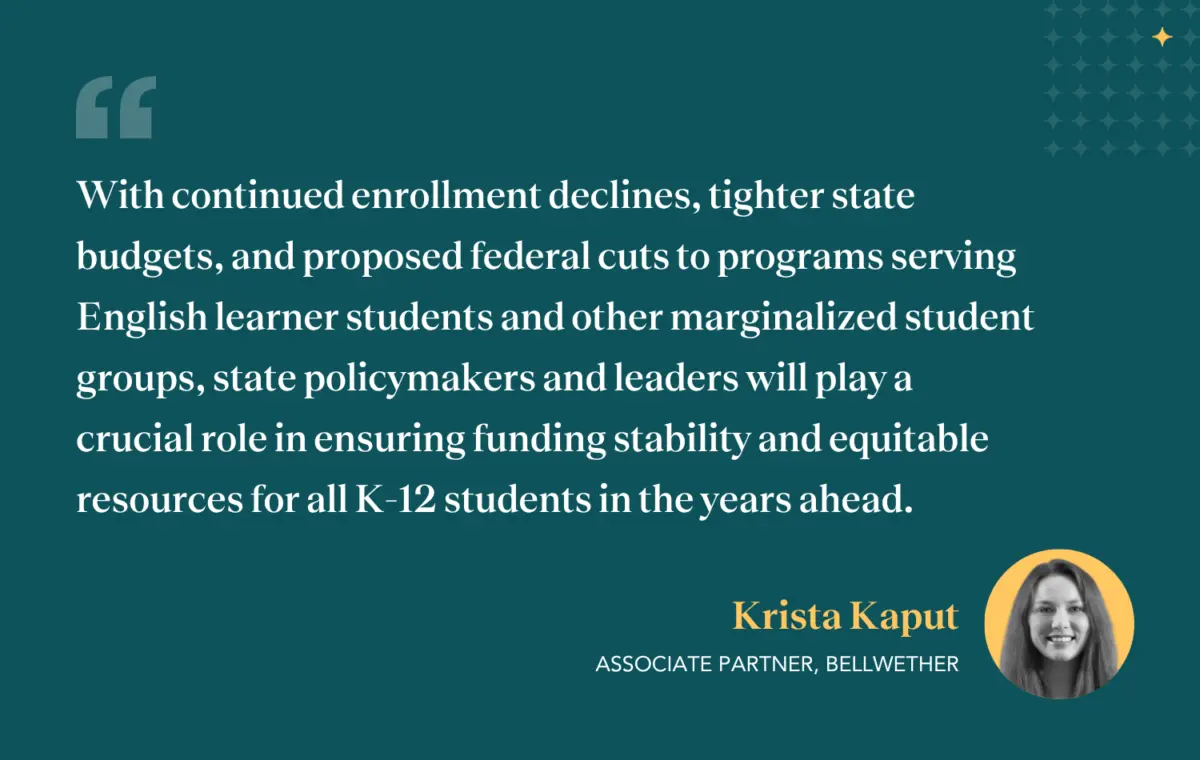
Compounding these internal state challenges are potential external pressures. Proposed federal budgetary adjustments and shifts in priorities—including potential contractions in federal funding streams dedicated to marginalized student groups—mean that state capitals will shoulder even greater responsibility for educational equity.
To safeguard academic recovery and ensure long-term stability, state lawmakers must prioritize structural tax and funding reforms. This includes modernizing state school funding formulas to adequately support districts experiencing steep enrollment declines (often through enrollment-smoothing mechanisms or minimum-funding guarantees) while directing targeted resources to high-need student populations.
Ultimately, the FY24 Census Bureau data serves as both a snapshot of resilience and a warning flare. The ability of the American K-12 public education system to weather the post-pandemic transition will depend entirely on the willingness of state leaders to make deliberate, sustainable investments in an era of declining student numbers and permanently altered fiscal horizons.

