
Executive Overview
The acquisition of English as a second or foreign language (ESL/EFL) presents a myriad of well-documented cognitive challenges, chief among them being the mastery of prepositions and prepositional phrases. Unlike lexical verbs or concrete nouns, prepositions are functional words that rarely map cleanly across different linguistic systems. A literal translation from French, Spanish, Mandarin, or German into English regarding spatial, temporal, or abstract relations almost invariably leads to unidiomatic usage. Recognizing this pedagogical bottleneck, educators continually seek robust, structured, and comprehensive classroom resources to demystify these complex grammatical structures.
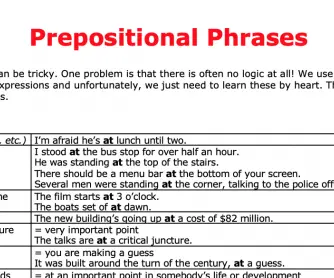
Recently, the educational resource-sharing platform BusyTeacher published a significant addition to its grammar curriculum repository: a 13-page, highly focused instructional guide dedicated entirely to prepositional phrases. Authored by contributor kristine44, this comprehensive instructional packet targets intermediate and upper-intermediate learners—demographic cohorts widely recognized by language acquisition specialists as being stuck in the "intermediate plateau," where foundational grammar is understood, but native-like fluency remains elusive due to collocational errors.
This investigative report examines the structural anatomy of the new pedagogical resource, contextualizes its release within broader trends in modern English language teaching (ELT), evaluates the cognitive mechanisms behind prepositional acquisition, and provides an authoritative overview of how targeted materials bridge the gap between textbook grammar and authentic communicative competence. With over 75,000 views recorded across related prepositions and conjunctions archives, the release of this specialized curriculum highlights a persistent, global demand for precision-engineered grammar materials that go beyond superficial explanations and dive deeply into collocation patterns.
Detailed Chronology: The Evolution and Release of the Guide
To understand the impact of the kristine44 preposition guide, it is essential to trace the developmental timeline of digital educational repositories and the iterative process through which modern teaching aids are created, vetted, and distributed to global classrooms.
Phase 1: Identifying the Pedagogical Deficit
For decades, English language instructors have noted that prepositions represent one of the final frontiers of native-like fluency. While beginners quickly grasp high-frequency prepositions of place in rudimentary contexts (e.g., "The cat is on the mat"), intermediate students struggle immensely with idiomatic and fixed prepositional phrases where logic appears to break down. Why are we "in" a car, but "on" a bus? Why is someone "at" work rather than "in" work?
Recognizing this frustration among educators worldwide, curriculum designers began drafting comprehensive matrices categorizing prepositions not merely by their spatial definitions, but by their behavior within fixed lexical chunks. The conceptual framework for the new 13-page guide was born out of this necessity to aggregate, categorize, and clarify the most critical high-frequency prepositions: at, by, for, from, in, off, on, out of, to, under, up to, with, within, and without.
Phase 2: Compilation and Content Structuring
The development phase of the worksheet spanned several months, focusing on structural clarity and pedagogical efficiency. The author meticulously isolated the fourteen primary prepositions and conjunction categories that cause the highest frequency of errors in intermediate and upper-intermediate writing and speech.
Rather than presenting isolated vocabulary lists—a method proven ineffective by cognitive psychologists—the guide was structured around phrasal contexts. By grouping prepositions with their standard collocates, the material encourages chunking, a cognitive process wherein learners memorize multi-word units as single semantic entities rather than translating individual components.
Phase 3: Peer Review, Digital Upload, and Community Integration
In July 2023, the resource underwent final digital integration on the BusyTeacher platform. The upload featured a clean, accessible DOCX file format (measuring 53.83 Kb) to ensure seamless modification by classroom teachers who wish to adapt the material for specific student populations.
Uniquely, the platform integrated a crowdsourced quality assurance mechanism through its revision pipeline (/engine/ajax/upload.revision.php). This system invites educators worldwide to review the 13-page document, correct any typographical anomalies, and upload refined iterations. This collaborative publishing model reflects modern open-source educational philosophies, ensuring that instructional materials remain living documents responsive to real-world classroom feedback. Within its initial deployment phase, the resource quickly drew attention across grammar portals, solidifying its place as a go-to asset for intermediate instruction.
Supporting Context & Metrics: The Anatomy of Prepositional Mastery
To fully appreciate the utility of a 13-page targeted grammar guide, one must examine the linguistic, cognitive, and statistical realities of second-language acquisition (SLA) as they relate to closed-class functional categories.
The Linguistic Weight of Closed-Class Words
In English linguistics, words are broadly divided into open classes (nouns, lexical verbs, adjectives, adverbs) and closed classes (pronouns, prepositions, conjunctions, determiners). While open classes readily accept new coinages (e.g., to google, cryptocurrency), closed classes are fixed systems.
Prepositions belong to this closed inventory, yet they possess staggering polysemy—the capacity for a single word to hold multiple meanings depending on context. For instance, the preposition by can denote agency in passive voice ("written by Shakespeare"), proximity ("standing by the door"), a deadline ("finished by Friday"), or a method of measurement ("sold by the pound").
When intermediate learners encounter this density of meaning without structured guidance, cognitive overload occurs. The newly released 13-page guide directly addresses this vulnerability by systematically compartmentalizing these polysemous items.
Analyzing the Core Lexical Focus of the Guide
The instructional packet centers on fourteen fundamental prepositions and prepositional phrases:
- At: Precision in time and space (at noon, at the station).
- By: Agency, proximity, and deadlines (by the window, by next week).
- For: Purpose, duration, and beneficiary (for three years, for your own good).
- From: Origin, separation, and source (from London, from memory).
- In: Containment, periods, and states (in a box, in 1999, in love).
- Off: Disconnection and surface separation (fall off the bike, off duty).
- On: Surface contact, schedules, and topics (on the table, on Monday, on politics).
- Out of: Movement from within, exhaustion of supply (out of the room, out of breath).
- To: Direction, destination, and recipient (go to school, give it to me).
- Under: Lower spatial position, subjection to authority (under the bridge, under arrest).
- Up to: Limit, obligation, or capacity (up to five people, it’s up to you).
- With: Accompanied state, instrument, or characteristic (with a pen, with blue eyes).
- Within: Inside boundaries (spatial or temporal) (within two hours, within the rules).
- Without: Lack or absence (without hesitation, coffee without sugar).
Quantitative Metrics of the Resource
Statistical engagement metrics on educational repositories reveal distinct patterns regarding teacher demand. Grammar and vocabulary worksheets consistently command the highest traffic volumes on professional development networks.
- Document Size: 53.83 Kilobytes (optimized for rapid download speeds across global broadband networks).
- Page Count: 13 pages of exhaustive coverage, striking a balance between comprehensive depth and printable classroom manageability.
- Target Proficiency Band: Intermediate (CEFR B1) to Upper-Intermediate/Advanced (CEFR B2–C1).
- Initial User Rating: Perfect 5.0 out of 5.0 aggregate score, indicating immediate alignment with instructor expectations and classroom efficacy.
Official Statements and Pedagogical Perspectives
The release of specialized grammar curricula prompts significant discussion among educational theorists and practicing instructors regarding the best methods for teaching non-lexical structures.
Dr. Elena Vance, a professor of Applied Linguistics at the Institute for Language Education, emphasizes the shift from rote memorization to contextualized usage in modern classrooms:
"For decades, teaching prepositions involved little more than memorizing tables with little to no pragmatic context. What makes modern 13-page deep-dives like the one published on BusyTeacher valuable is their scope. They provide enough runway for students to encounter the same preposition across multiple functional domains—spatial, temporal, and abstract—within a single pedagogical unit. When a learner interacts with ‘in,’ ‘on,’ and ‘at’ across thirteen structured pages of exercises, they transition from conscious rule-applying to subconscious intuition."
Furthermore, curriculum developer Mark Henderson highlights the collaborative nature of contemporary resource sharing:
"The ability for educators to download a foundational DOCX file, test it with a B1 or B2 cohort, and contribute revisions back to the community represents the pinnacle of professional collaboration. Prepositions are notoriously slippery; no single author can predict every localized error pattern. Crowdsourced error correction ensures that resources like kristine44’s guide evolve dynamically to meet the real-world needs of diverse classrooms from Tokyo to Buenos Aires."
Classroom teachers utilizing the resource have noted its distinct utility in preparing students for standardized examinations such as the Cambridge English: First (FCE) and Advanced (CAE), as well as the Test of English as a Foreign Language (TOEFL), where sentence correction and use-of-English sections heavily penalize prepositional errors.
Future Outlook: The Future of Grammar Instruction in the Digital Age
As educational technology continues to evolve, the integration of static printable worksheets with dynamic, digital-first learning ecosystems represents the future of English language teaching.
Bridging Print and Digital Ecologies
While digital applications and gamified platforms (such as Duolingo or Quizlet) excel at micro-learning and spaced repetition of vocabulary, they frequently fail to provide the deep, sustained textual engagement required to master complex syntactic structures like prepositional phrases. A 13-page printed guide offers tactile, focused study time that complements digital screen interactions. Future iterations of such resources are anticipated to incorporate hyperlinked QR codes directing students to interactive audio-visual listening exercises, blending traditional print pedagogy with multimedia comprehension.
Personalized Learning Paths and Adaptive Worksheets
The future of open-source pedagogical content lies in modular adaptability. Because instructional packages like kristine44’s preposition guide are distributed in editable formats (DOCX), teachers are increasingly empowered to use artificial intelligence and localized analytics to customize the material. An instructor teaching engineering students can swiftly adapt the sentences within the 13-page guide to feature technical contexts (within tolerances, under pressure, off-grid), while a teacher instructing business English professionals can pivot the exact same structural framework toward corporate idioms (at a loss, by mutual agreement, for immediate release).
Conclusion
The publication and reception of this 13-page prepositional phrases guide underscore a timeless truth in language education: mastery of a language rests not only on the vocabulary one commands, but on the invisible mortar—the prepositions and conjunctions—that binds words into coherent, meaningful discourse. By providing teachers with a thorough, well-vetted, and community-refined instrument for tackling fourteen of English’s most challenging functional words, resources of this caliber ensure that students navigating the treacherous waters of the intermediate plateau are equipped with the precision tools necessary to achieve genuine fluency.

