
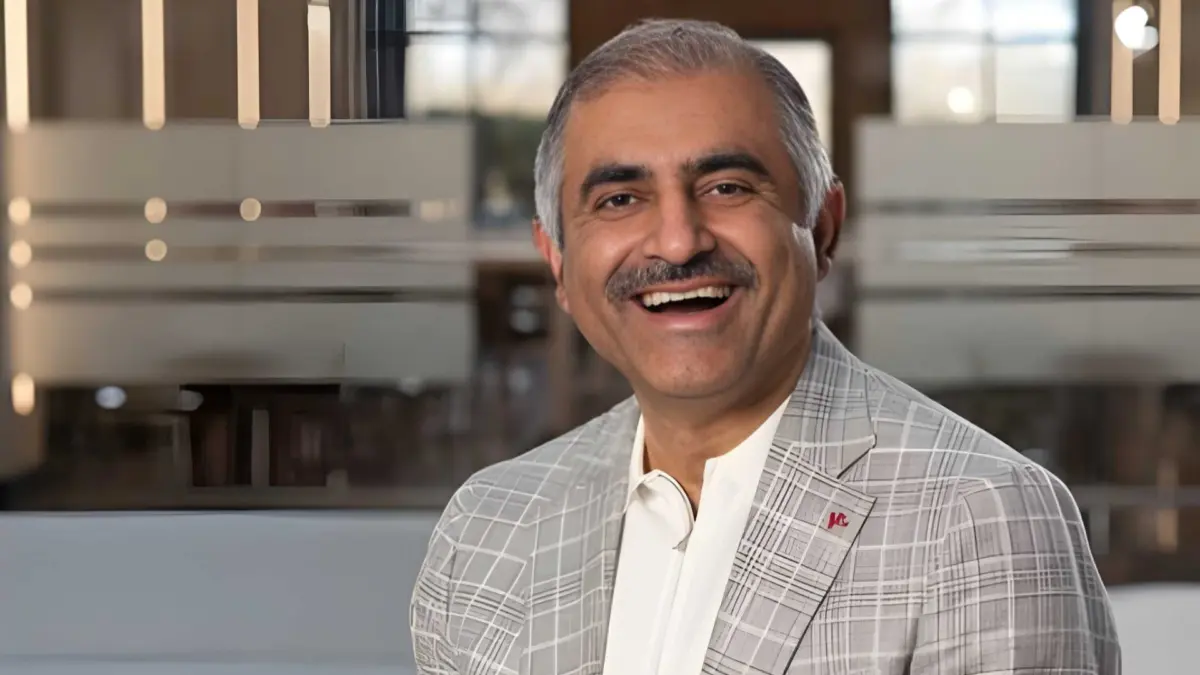
As artificial intelligence rapidly transitions from an experimental tool into an autonomous enterprise engine, a defining paradox of the twenty-first century has emerged: the more capable machines become, the more urgently organizations must cultivate uniquely human capabilities. This is the central thesis of Human Edge in the AI Age, the third installment of a definitive trilogy by Nitin Seth, a global business leader, entrepreneur, and Co-Founder and CEO of Incedo Inc.
Having previously examined digital transformation (Winning in the Digital Age) and data architecture (Mastering the Data Paradox), Seth shifts his analytical lens from silicon to spirit. Across a nearly three-decade career that includes senior leadership tenures as COO of Flipkart, Managing Director of Fidelity International in India, and Director at McKinsey & Company, Seth has witnessed firsthand how technology reshapes the corporate landscape.
However, his latest work argues that AI is fundamentally different from any prior technological wave. It is not merely a tool for speed and scale; it is an existential catalyst reshaping what it means to be human. To navigate this era successfully, Seth introduces the POSSIBLE framework—an eight-dimensional model designed to help individuals and institutions systematically build resilience, creativity, and judgment. This interview explores the foundational lessons of Seth’s career, the architecture of the POSSIBLE framework, and a strategic roadmap for leaders seeking to redesign work for an AI-native future.
Detailed Chronology: A Career Forged in Transformation
To understand Nitin Seth’s perspective on organizational evolution, one must examine the arc of his professional journey. Each corporate chapter provided critical lessons that ultimately culminated in the creation of Incedo Inc. and his philosophy on human-centric leadership.
1996: The McKinsey Crucible
Seth’s career began in 1996 at McKinsey & Company, an environment that instilled the fundamental disciplines of structured problem-solving, relentless client service, and long-term strategic orientation. Later, tasked with building the McKinsey Global Knowledge Centre in India from the ground up, Seth experienced his first profound entrepreneurial breakthrough. What began as a modest research support unit evolved into a world-class innovation hub. The lesson was indelible: breakthrough innovation can emerge from anywhere when exceptional talent is empowered with vision, culture, and operational freedom.
The Fidelity Paradigm: Integrating Business and Technology
Moving to Fidelity International as Managing Director, Seth led strategy and transformation during a pivotal era. The firm was shifting from an investment-management-led model to a technology-driven enterprise. This period demonstrated that business and technology are inextricably linked. More importantly, it exposed the hidden barriers of large-scale global transformations—revealing that legacy mindsets and organizational inertia are far more formidable obstacles than the technology itself.
The Flipkart Era: Hyper-Growth and Ambiguity
As Chief Operating Officer of Flipkart, Seth entered an environment defined by relentless velocity, deep ambiguity, and intense competition. Traditional management playbooks failed in the face of hyper-growth. This crucible taught Seth the vital importance of fast, decisive decision-making in unstructured environments, proving that modern organizations must learn and adapt faster than the broader market.
Founding Incedo: Bridging the Execution Gap
These collective experiences directly inspired the founding of Incedo Inc. Seth observed a recurring pathology in global enterprises: massive investments in technology frequently failed to translate into meaningful, measurable business outcomes. Incedo was built to bridge that exact gap, combining digital, data, and AI services to ensure that technology serves as a true accelerator of enterprise value.
Supporting Context & Metrics: The Philosophy of Human Edge in the AI Age
The Genesis of a Trilogy
When Seth completed his first two books on digital strategy and data, focusing on AI for the third book seemed like a natural progression. However, the writing process quickly evolved. Conversations with his wife, Arpna, reframed the project: the book was ultimately written for the younger generation to help them make sense of the world they will inherit.
Rather than succumbing to the polarized extremes of utopian optimism or dystopian fear—frequently summarized by the anxious question, "Will AI replace us?"—Seth urges society to reframe the debate: "How do we become the best version of ourselves in the AI age?"
The 3Cs: Durable Human Advantages
While AI can optimize workflows, generate synthetic media, and simulate complex reasoning, Seth argues that lasting competitive advantage belongs to those who master the 3Cs:
- Context: AI may solve 70% to 80% of a problem based on historical data, but the remaining 20% to 30%—the critical nuance required to apply knowledge to real-world situations—requires deep human judgment and contextual understanding.
- Creativity: As algorithms automate routine cognitive work, human creativity becomes the medium- to long-term advantage, enabling individuals to imagine what does not yet exist, challenge foundational assumptions, and formulate entirely new paradigms.
- Connection: Built on empathy, trust, shared experiences, and collaboration, human connection remains entirely unreplicable by machines. It is the social fabric that aligns teams, inspires communities, and achieves outcomes beyond the reach of any isolated system.
Official Statements: The POSSIBLE Framework and Work Redesign
In Human Edge in the AI Age, Seth synthesizes his decades of observation into the POSSIBLE framework—an eight-dimensional model designed to fortify individuals against professional and societal disruption.
+-------------------------------------------------------------+
|                     THE POSSIBLE FRAMEWORK                  |
+---------------------+---------------------------------------+
| P - Problem-Solving | Structured thinking & analytical rigor|
| O - Openness        | Continuous reinvention & adaptability |
| S - Spirituality    | Inner anchor, self-awareness, balance |
| S - Sports          | Grit, discipline, resilience, teamwork|
| I - Impact          | Measuring success by lives improved   |
| B - Balance         | Navigating opposing forces & well-being|
| L - Leadership      | Contributing to a larger purpose      |
| E - Entrepreneurship| Building value from the ground up     |
+---------------------+---------------------------------------+
Unconventional Dimensions: Sports and Spirituality
Two dimensions within the POSSIBLE framework frequently surprise management theorists: Sports and Spirituality.
- Sports: Seth credits athletic participation with transforming his confidence as a student. While AI can optimize performance metrics, it cannot cultivate grit, character, or the psychological determination to persevere through systemic adversity.
- Spirituality: Far from withdrawal from society, Seth defines spirituality as a practical journey inward—the foundational engine of self-awareness. Having practiced the Art of Living and daily meditation for over two decades, Seth views inner stillness as an essential corporate asset. In an era of compressed decision cycles and unrelenting ambiguity, meditation provides the mental clarity required to remain grounded, focused, and creative.
Graduated Trust and Agentic AI
As businesses deploy autonomous AI agents, leaders face complex governance challenges. Seth advocates for a model of graduated trust:
"Trust must be earned, graduated, and revocable. The more consequential, irreversible, or judgment-intensive a decision is, the higher the threshold of proof should be, and human accountability must remain in the loop."
Organizations should implement concentric circles of trust. Low-risk, reversible tasks can be delegated to autonomous agents with minimal oversight. However, high-impact decisions involving ethics, capital allocation, or enterprise safety must remain behind strict human approval gates. Furthermore, trust must be continuously verified through real-time observability, telemetry, and comprehensive audit trails.
Responsible Work Redesign
Seth issues a stern warning to corporate leaders: automating legacy jobs without redesigning work is a strategic failure. Citing the dramatic 800% rise in demand for forward-deployed engineers in 2025, Seth notes that software development is shifting upstream. Technical talent is no longer valued merely for writing code, but for framing ambiguous business problems, applying systems thinking, and orchestrating AI agents.
To support this shift, organizational structures must evolve from rigid hierarchies into lean, multidisciplinary pods possessing end-to-end autonomy. Performance metrics must transition from tracking superficial activities (such as hours saved) to measuring core business outcomes: faster time-to-market, superior decision quality, revenue expansion, and lowered costs to serve.
Future Outlook: Indicators of True Success by 2030
As enterprises race to adopt generative and agentic AI, Seth outlines three macro-indicators that will distinguish sustainable organizational success from hollow productivity gains by the end of the decade:
- Human Evolution ("Above the Loop"): Have humans used AI to expand their agency? True success means that freed from routine execution, employees spend their time interpreting complexity, exercising judgment, and imagining new possibilities.
- Enterprise Value Creation: Are organizations moving up the value curve? AI should drastically shorten the distance between an idea and its commercial impact, empowering small teams to unlock exponential growth while maintaining high employee satisfaction.
- Societal Sustainability: Does AI democratize opportunity on a macro scale? If productivity gains benefit only a narrow elite while societal inequality deepens and planetary health deteriorates, the technological revolution will have failed its broader humanitarian mandate.
Ultimately, Human Edge in the AI Age serves as an urgent, highly practical manifesto. It reminds leaders across industries that technology is merely an amplifier of human intent. By pairing continuous technological adoption with the rigorous cultivation of inner clarity, empathy, and resilience, professionals can ensure that the future of work remains profoundly human.

