
By Global Education & Workforce Desk
Executive Overview
As the Association for Career and Technical Education (ACTE) officially marks its landmark centennial of service, the educational landscape stands at a critical crossroads. For a century, the organization has championed the integration of practical skills and academic rigor, but the fundamental questions facing modern educators have rarely been more complex or urgent. From September 2025 through May 2026, Techniques, ACTE’s flagship publication, tracked the educators, program leaders, and advocates who spent the academic year tackling these enduring challenges head-on.
The core inquiry guiding this historical publishing cycle was multifaceted: What does it truly take to build inclusive career and technical education (CTE) pathways that reach every single learner, regardless of their background? Furthermore, how do physical learning spaces and dynamic student experiences actively shape what young people believe is possible for their futures?

Rather than focusing purely on programmatic logistics or bureaucratic policy updates, Techniques turned its lens toward the human element of education. The resulting year-in-review anthology comprises eight deeply reported features. These articles document the resilience of educators who refused to give up on marginalized populations, the innovations of fellowship alumni transforming postsecondary leadership, and the structural reforms necessary to sustain rural programs, retain industry-expert teachers, and embed wraparound support systems.
This comprehensive report synthesizes those eight definitive articles, offering an investigative overview of a pivotal year in CTE history—a year where the mandate was clear: elevate skills over stigma, design for equity from the ground up, and ensure that a century of educational leadership translates into a thriving future for the next generation of workers.
Detailed Chronology: A Year of Reflection and Innovation in CTE
The editorial journey of Techniques spanning the 2025–2026 academic year serves as a chronological narrative of modern vocational and career education. Each monthly installment addressed a distinct structural or cultural hurdle within the ecosystem, providing practitioners with actionable insights.

Fall 2025: Dismantling Stigma, Leading Change, and Redefining Exploration
The academic year opened in September 2025 with a powerful confrontation of systemic barriers. In "Skills Over Stigma," the publication examined the high stakes of high-quality CTE for justice-impacted learners. Written from the perspective of an author who is themselves justice-impacted and now dedicates their career to education and reentry, the feature underscored the reality that traditional educational pathways often shut out individuals with criminal records. By advocating for models that prioritize demonstrated competencies over historical stigmas, the article laid down a moral challenge for institutions nationwide: true workforce development must include society’s most vulnerable populations.
By October 2025, the focus shifted to systemic leadership transformation in "Leading the Change." Highlighting the contributions of alumni from the NextLevel Postsecondary CTE Fellowship, this annual feature showcased educators from diverse institutional sizes across the country who are actively dismantling outdated perceptions of vocational training. Notably, these leaders frequently pointed to their own students as their greatest teachers, illustrating a collaborative approach to modernizing postsecondary education.
As the semester drew toward its close in November–December 2025, Techniques addressed the mechanics of experiential learning in "Student-Centered Work." This installment investigated work-based learning (WBL) models, arguing that true career exploration cannot happen in a rigid, one-size-fits-all framework. Instead, meaningful WBL requires providing students with the psychological and structural freedom to question, refine, and redirect their career trajectories based on their evolving personal interests.

Winter 2026: Institutional Design and the Power of Human Storytelling
Entering the new calendar year in January 2026, the publication tackled the operational realities of student retention in "High-Quality CTE By Design." For decades, wraparound supports—such as mental health counseling, child care assistance, and food security programs—have been treated as secondary, supplemental add-ons. This feature made a compelling case for embedding such supports directly into the DNA of program design from day one, proving that holistic care is indispensable to program completion.
In February 2026, the magazine published "Meaningful Student Experiences," which shifted attention to the physical and curricular environments of learning. Offering a practical roadmap for facilities design, the author demonstrated that institutions do not always need massive capital campaigns or new construction to modernize. By thoughtfully reimagining existing spaces, schools can create immersive environments where students immediately see themselves reflected in professional careers the moment they step into a classroom or lab.
The historic milestone of the association took center stage in March 2026 with "A Century of Storytelling." Marking ACTE’s 100th anniversary, the article explored how the organization leverages modern documentary filmmaking alongside traditional data collection. While numerical metrics are essential for legislative advocacy, human-centric storytelling ensures that the impact of CTE remains relatable, personal, and enduringly memorable.

Spring 2026: Economic Sustainability and Teacher Retention
As the 2025–2026 academic cycle neared its conclusion, Techniques confronted the severe economic and human resource pressures threatening the sustainability of modern programs.
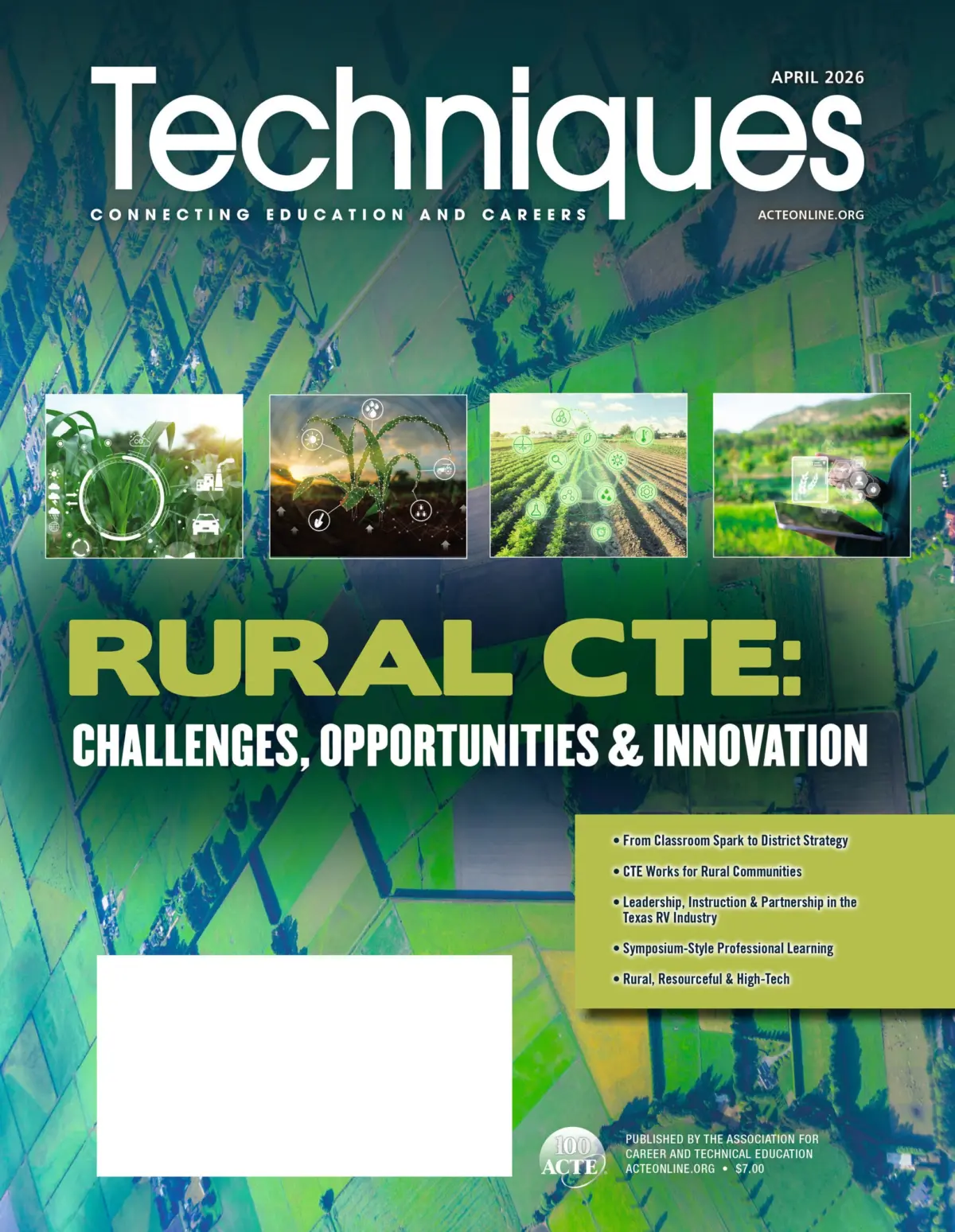
In April 2026, "Challenges & Opportunities" addressed the acute vulnerabilities facing rural CTE programs. Plagued by dwindling workforce numbers and shrinking local resources, rural administrators frequently face the looming threat of facility closures. This article provided a vital operational framework, teaching leaders how to translate qualitative program impacts into robust quantitative data that school boards and state legislatures can utilize to justify long-term investments in rural workforce development.
Finally, in May 2026, the publication addressed one of the most critical crises in modern education: teacher burnout and retention. In "No More Revolving Door," the magazine shared the sobering story of a former insurance professional who transitioned to a CTE teaching career, only to resign two days into the school year. Utilizing original research, the article analyzed why industry experts flee the classroom and outlined a comprehensive blueprint for institutional leaders. The core finding was clear: when teacher induction is treated as an immersive, supportive developmental experience rather than a bureaucratic checklist, industry professionals stay—and when they stay, students thrive.

Supporting Context & Metrics: The State of Career and Technical Education
To fully appreciate the urgency of the narratives published in Techniques, one must examine the broader socio-economic landscape surrounding Career and Technical Education during this centennial epoch.
Modern labor markets are undergoing a seismic shift driven by automation, artificial intelligence, and a rapidly aging traditional workforce. According to labor and education analytics:
- The Skills Gap: Industry reports consistently highlight millions of unfilled middle-skills jobs due to a mismatch between traditional academic degrees and employer demands. High-quality CTE serves as the direct bridge to closing this gap.
- The Justice-Involved Workforce: With over 600,000 individuals released from state and federal prisons annually, integrating justice-impacted learners into vocational programs represents an untapped economic engine. Research cited in ACTE advocacy materials indicates that postsecondary education in correctional facilities reduces recidivism rates by up to 43%, yielding significant taxpayer savings and safer communities.
- Rural Economic Vitality: Rural schools educate nearly 9 million students in the United States, yet they frequently operate under severe fiscal constraints. The survival of rural CTE is inextricably linked to regional economic stability, particularly in sectors like agriculture, advanced manufacturing, and healthcare.
- The Educator Exodus: National education surveys indicate that teacher attrition rates among career-switchers entering education from private industry are disproportionately high during the first three years. Without robust, industry-tailored induction pipelines, schools risk losing the very experts best equipped to teach cutting-edge technical skills.
Official Statements & Editorial Perspectives
Reflecting on the monumental body of work compiled over the academic year, ACTE leadership and editorial staff emphasized the enduring mission of the association as it transitions into its second century.

"The best CTE stories are never only about programs. They’re about the people inside them—what they built, what they believed, and what they refused to give up on," noted Lia Milgram, Managing Editor for ACTE, encapsulating the philosophical core of the year-long review.
Milgram and contributing writers stressed that while educational policy, funding allocations, and facility blueprints are crucial, the heartbeat of vocational education remains deeply human. Whether advocating for the reintegration of justice-impacted populations, reimagining rural economic metrics, or creating welcoming environments for industry professionals transitioning into teaching, the overarching theme of the centennial year was radical inclusivity and resilience.
Furthermore, educational fellows highlighted in the October 2025 feature noted that modern CTE is shedding its historical misperceptions as a secondary track for non-college-bound youth. Instead, it is increasingly recognized as a premier, high-tech, rigorous educational pathway that prepares learners for both immediate high-wage careers and advanced postsecondary study.

Future Outlook: The Next Century of CTE Advocacy and Practice
As Techniques concludes its retrospective review of the 2025–2026 cycle, the trajectory for Career and Technical Education points toward a future defined by data-backed advocacy, systemic equity, and human-centered design.
- Mainstreaming Wraparound Support: Educational institutions are expected to increasingly institutionalize holistic student support services as non-negotiable components of program funding rather than relying on volatile grant-based or supplemental funding streams.
- Transforming Teacher Onboarding: School districts facing severe technical educator shortages will likely adopt the induction blueprints highlighted in recent research, shifting from passive compliance checklists to active mentorship and professional community-building.
- Leveraging Multimedia Advocacy: Following the success of documentary-style storytelling in celebrating ACTE’s centennial, future advocacy campaigns will lean heavily into multimedia narratives to demonstrate the tangible return on investment (ROI) of vocational programs to lawmakers and community stakeholders.
- Expanding Access and Equity: The push to eliminate systemic barriers for justice-impacted individuals, rural communities, and non-traditional learners will remain at the forefront of policy reform, ensuring that the next 100 years of CTE are characterized by universal access to economic mobility.
Through the pages of Techniques, educators, leaders, and advocates have charted a clear, courageous course for the future. As the association looks beyond its first century, the blueprint for success is firmly established: honor the skills of every learner, invest in the educators who guide them, and build pathways that transform potential into lasting achievement.

